

Class A fire rated means a material scored a flame spread index of 0 to 25 and a smoke developed index of 450 or less in the ASTM E84 tunnel test. UL 723 is the Underwriters Laboratories standard for the same test.
The rating describes how far and how fast flame travels across the surface of the sample that was tested, and it applies only to that sample, mounted the way it was mounted.
On an acoustic panel, "Class A" or "fire rated" can describe just one part. A fabric can carry a Class A result while the core behind it has none, and the reverse.
What Is the ASTM E84 Tunnel Test?
ASTM E84 is a 10 minute test of how flame spreads across a surface. A sample with a nominal size of 24 ft long by 20" wide forms the ceiling of a long tunnel furnace, with the surface being rated facing down toward the fire.
A gas burner at one end supplies the flame, and a forced draft pulls it along the tunnel. The operator records the position of the flame front over time. A light beam and photocell across the exhaust duct measure how much the smoke dims the light.
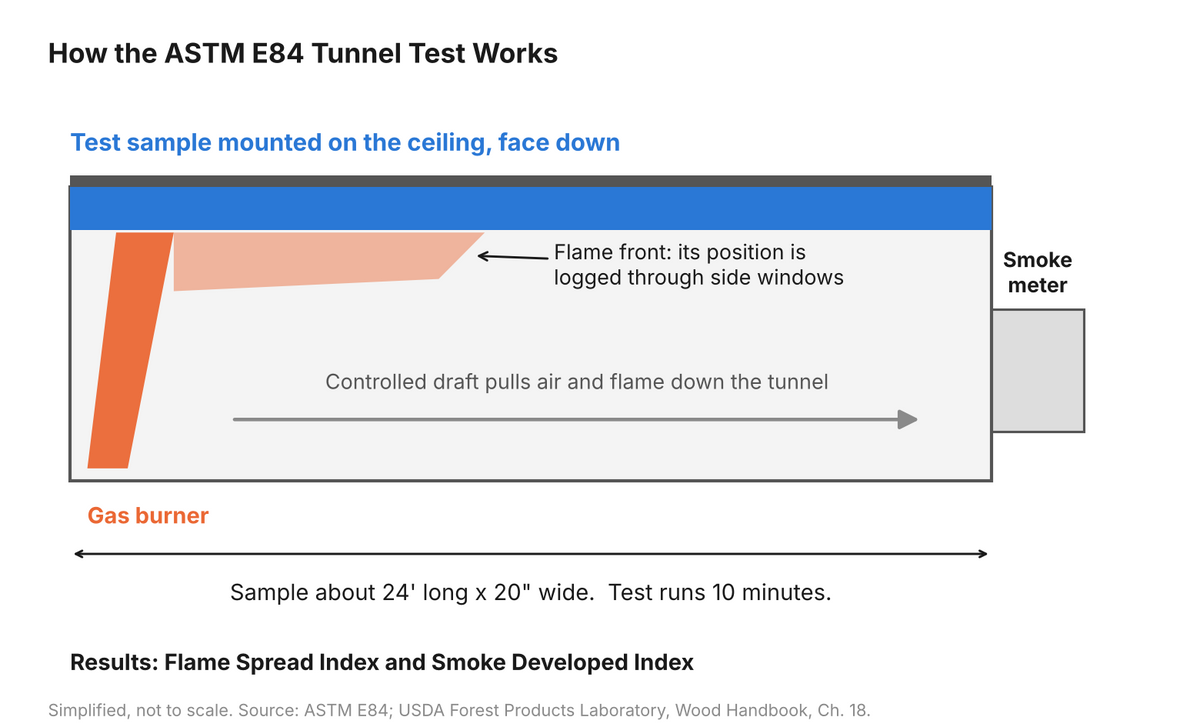
The test produces two numbers.
- The flame spread index compares the sample to two reference surfaces: fiber-cement board, set at 0, and select grade red oak flooring, set at 100.
- The smoke developed index compares how much the sample's smoke dims that light against the same two references.
Data sheets often list the result as "ASTM E84 (UL 723)" because the two standards describe the same tunnel test.
The standard states that the test "does not by itself incorporate all factors required for fire-hazard or fire-risk assessment." It rates surface burning only.
Class A, B and C Flame Spread Ratings
The flame spread index is sorted into three classes:
- Class A: Flame spread index of 0 to 25.
- Class B: Flame spread index of 26 to 75.
- Class C: Flame spread index of 76 to 200.
A smoke limit goes with each class. Published class tables pair Class A, B and C with a smoke developed index of 450 or less, so a Class A result needs a flame spread index of 25 or less and a smoke developed index of 450 or less.
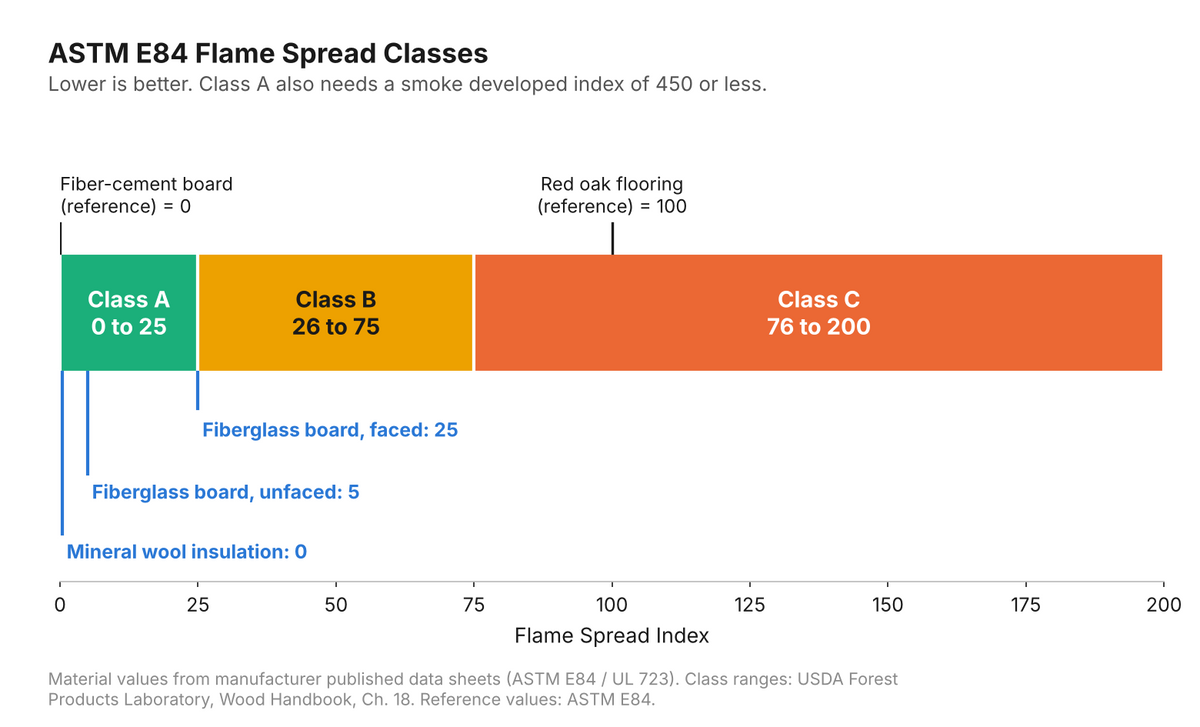
Red oak flooring, the 100 reference, sits in Class C. "Fire rated" on its own is not a class. Ask which class, and ask for both numbers.
A Class A Rating Applies to What Was Tested
The test rates the specimen that went into the tunnel, mounted the way it was mounted. ASTM E84 notes that supports under a specimen can lower its flame spread index compared to the same material tested without support. Published test reports carry this line or one like it: "The test results presented in this report apply only to the samples tested."
That matters for acoustic panels because a panel is a stack of parts: a face fabric, a core, a frame and sometimes adhesive. Each part can be tested on its own.
- Fabric: Fabric is often tested alone. One published E84 report for a textile describes two lengths, each 2 ft wide by 12 ft long, laid loose over 2" hexagonal wire mesh held up by steel rods across the tunnel. A Class A fabric result tells you about the fabric. It says nothing about the core behind it.
- Core: A Class A core wrapped in a fabric with no test report is the same gap in reverse.
- Facing: A facing changes the numbers. One manufacturer data sheet for rigid fiberglass board lists a flame spread index of 5 and a smoke developed index of 5 unfaced, and 25 and 50 with a facing. Both are Class A, but the faced board sits right at the top of the range.
ASTM publishes separate practices for mounting wall coverings (ASTM E2404) and site-fabricated fabric stretch systems (ASTM E2573) for this test. A report should say how the sample was prepared and mounted.

How Mineral Wool and Fiberglass Rate
The two most common acoustic panel cores have published E84 data from their manufacturers.
| Core Material | Flame Spread Index | Smoke Developed Index | Class |
|---|---|---|---|
| Mineral wool (stone wool) insulation | 0 | 0 | A |
| Rigid fiberglass board, unfaced | 5 | 5 | A |
| Rigid fiberglass board, faced | 25 | 50 | A |
The same mineral wool data sheet also lists the material as noncombustible under ASTM E136, which is a separate test from E84. These numbers belong to the core material as the manufacturer tested it. They do not carry over to a finished panel with a fabric, a frame and adhesive added.
Why Polyurethane Foam Is a Concern
On February 20, 2003, the fire at The Station nightclub killed 100 people. The National Institute of Standards and Technology (NIST) investigated and found that pyrotechnics used by the band ignited polyurethane foam lining portions of the walls and ceiling of the platform.
- In NIST's tests, a non-fire retarded foam sample that NIST purchased ignited in less than 15 seconds when exposed to a pyrotechnic device.
- In a fire test on a reconstruction of the platform, conditions at head height (5 ft above the floor) in the middle of the room, 18 ft from where the foam ignited, were lethal in less than 90 seconds after the foam ignited.
- The same report found that a fire retarded polyurethane foam, exposed the same way, did not ignite.
Foams differ that much from one product to the next, so a foam panel needs its own test report like any other material.
The tunnel test has a specific limit with foam and other materials that melt or drip. ASTM E84 states that when a sample melts, drips or delaminates enough to break up the flame front, the result is a low flame spread index that does not "relate directly to indices obtained by testing materials that remain in place."
A low number on a foam that melted in the tunnel is not the same as a low number on mineral wool. For what thin foam does for a room acoustically, read moving blankets, egg crates and foam in a home studio.
Class A Fire Rated Acoustic Panels in a Home Studio
A typical acoustic panel for a bedroom or garage studio is a mineral wool or fiberglass core wrapped in fabric. Those cores have published Class A results on their own, as the table above shows. The open questions are the fabric, the frame and the finished panel.
A moving blanket, an egg crate mattress topper or a sheet of packing foam usually comes with no ASTM E84 report at all. If you build your own panels, buy a core and a fabric that each come with a published E84 report, and keep those reports with your receipts.
What to Ask a Seller About a Fire Rating
- The Report: Ask for the ASTM E84 or UL 723 test report itself, not a line on a product page.
- The Component: Ask which part was tested: the fabric, the core or the assembled panel.
- The Mounting: Ask how the sample was mounted and on what. Fabric laid over wire mesh is a different specimen than fabric stretched over a core.
- Both Numbers: Get the flame spread index and the smoke developed index. Class A needs both in range.
- The Match: Check that the material in the report is what ships: the same core, the same facing and the same fabric.
- Foam: Ask whether the foam is fire retarded and whether it melted or dripped in the test.
For how a 4" core and a 2" core differ, see Broadband vs Mid / High Acoustic Panels, or browse our broadband acoustic panels and ceiling clouds.
Sources
- ASTM International, ASTM E84, Standard Test Method for Surface Burning Characteristics of Building Materials, ASTM International, 2023.
- ASTM International, ASTM E2404, Standard Practice for Specimen Preparation and Mounting of Textile, Paper or Polymeric (Including Vinyl) and Wood Wall or Ceiling Coverings, Facings and Veneers, to Assess Surface Burning Characteristics, ASTM International, 2022.
- ASTM International, ASTM E2573, Standard Practice for Specimen Preparation and Mounting of Site-Fabricated Stretch Systems to Assess Surface Burning Characteristics, ASTM International, 2019.
- USDA Forest Service, Forest Products Laboratory, Wood Handbook, Chapter 18: Fire Safety of Wood Construction (FPL-GTR-282), USDA, 2021.
- Grosshandler, W., Bryner, N., Madrzykowski, D., Kuntz, K., Report of the Technical Investigation of The Station Nightclub Fire (NIST NCSTAR 2), Volume I, National Institute of Standards and Technology, 2005.
- Manufacturer published technical data sheet for stone wool fire and sound insulation (ASTM E84 and ASTM E136), 2025.
- Manufacturer published product data sheet for rigid fiberglass insulation board (UL 723 / ASTM E84), 2026.
- Commercial Testing Company, published ASTM E84 test report for a textile, accessed 2026.
- UL Standards & Engagement, UL 723, Test for Surface Burning Characteristics of Building Materials, Edition 11.
- Louisiana Office of State Fire Marshal, Flame-Spread Ratings: Class A, B and C flame spread and smoke developed limits, accessed 2026.
Need a Second Opinion?
Send us your room dimensions, photos and what you're hearing through our free room review form. Our panels and bass traps are built to order in North Los Angeles in 50 fabric colors. Reach out to us for design assistance.