
Immersive Music and Post Rooms
Dolby Atmos Room Design
We design Dolby Atmos and immersive rooms for music, mixing and post production: the speaker layout, the treatment around it, the wiring for every channel and the isolation plan. We build the treatment in our shop, install the speakers and calibrate the room.
What Changes in an Atmos Room
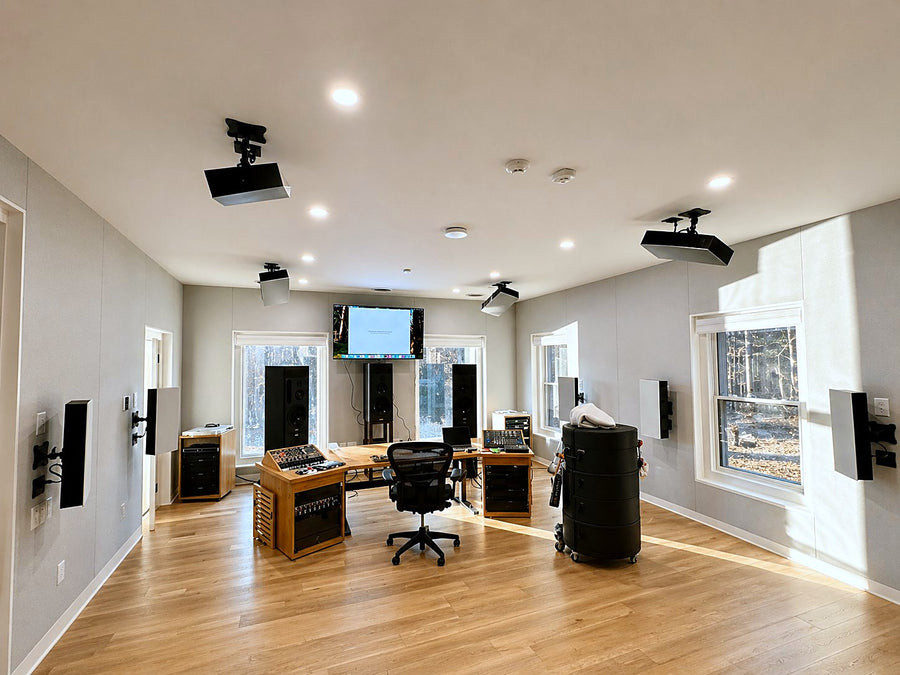
A stereo control room is set up around two speakers and one listening position. An Atmos room adds speakers on every side of the listener and above them. Each of those speakers has its own direct path to the mix position and its own reflection points on the walls and ceiling, so the whole room takes part in what you hear.
That changes how the room is planned:
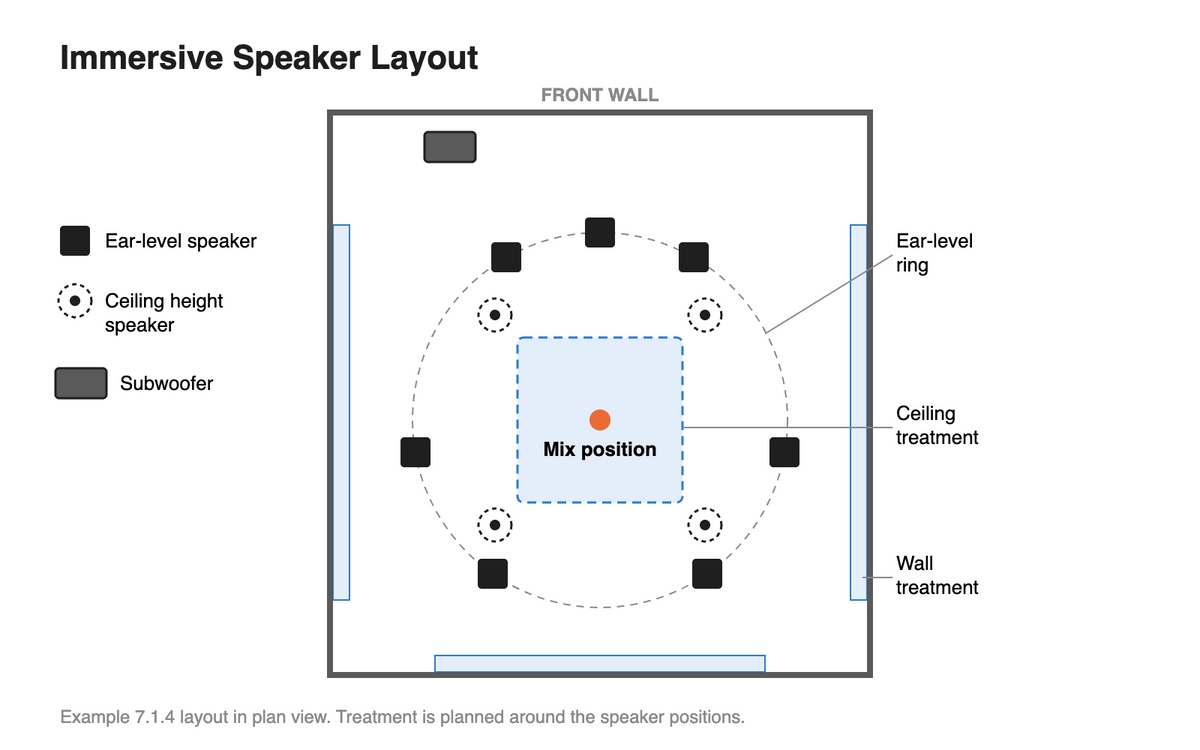
- More Speaker Positions: A ring of speakers at ear level around the mix position, height speakers in or below the ceiling, and one or more subwoofers.
- A Clear Path for Every Speaker: Each speaker needs an unobstructed line to the listening position. Desks, racks, screens and doors are placed so nothing sits in the way.
- Treatment Planned Around the Speakers: The speaker positions are fixed first, and the absorption, bass trapping and lighting are laid out around them.
- Bass Management: Low frequencies below a set crossover point are routed from every channel to the subwoofers, so where the subwoofers sit has a large effect on the bass at the mix position.
Speaker Layouts
Atmos layouts are named with three numbers: ear-level speakers, subwoofers, then height speakers. A 7.1.4 layout is seven ear-level speakers, one subwoofer and four height speakers. A 9.1.6 layout adds two more ear-level speakers and two more height speakers. Those are common examples. The right layout depends on the room's size, the ceiling height and what the room is used for, and we set it during design.
Treatment Around the Speakers
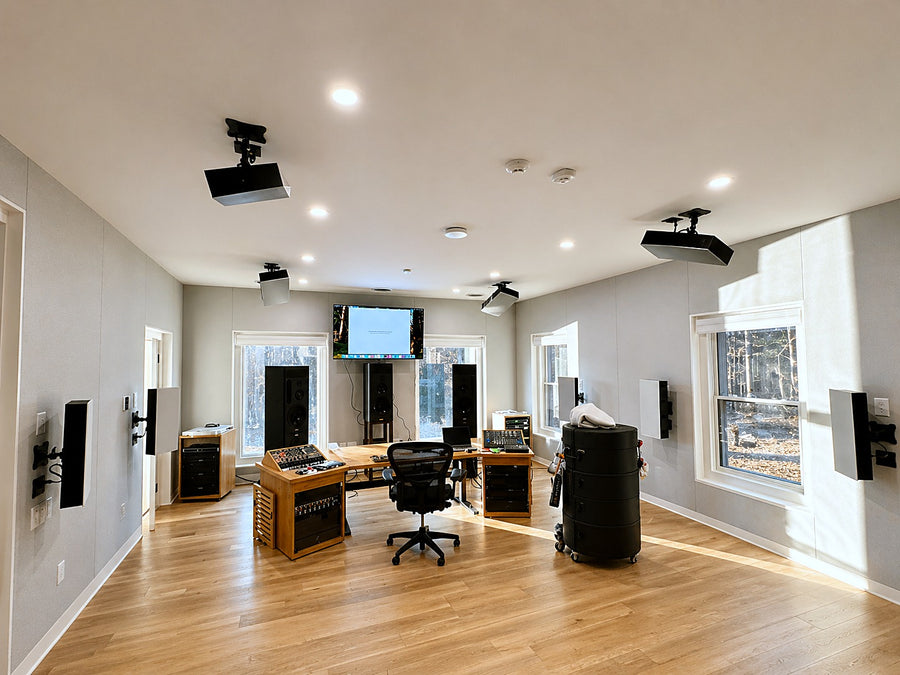
In a stereo room the first panels go at a few reflection points on the side walls and ceiling. With speakers on every side, reflection points cover most of the walls and much of the ceiling, so treatment is spread more evenly through the room. The ceiling has to carry absorption and the height speakers at the same time, and lighting has to fit between them.
Many immersive rooms use a fabric track system on the walls and ceiling. The absorption depth is set surface by surface behind the fabric, and the room reads as finished walls instead of separate panels. Bass traps go where the low end needs them, often across the back wall and in the corners.
Bass Management and Subwoofers
Bass behaves differently from the rest of the spectrum in a small room. Room modes, the resonances set by the room's dimensions, make the low end rise and fall from one spot to the next. Subwoofer count and placement, bass trapping and calibration all work on the same problem. Published research on multiple subwoofers, measured across a group of seats, found four at the midpoints of the four walls the best practical layout for consistent bass from seat to seat, with two at the midpoints of opposite walls nearly as good. In a mix room with one main seat, the room is set up for that seat. We place the subwoofers during design, then measure and adjust them once they are in. See why bass changes from seat to seat.
Isolation
Subwoofers put out the frequencies that are hardest to keep in a room. A single layer wall loses about 6 dB of transmission loss for each octave lower in pitch, so a wall that handles voices can still let the low end through to the rest of the house. Where the room needs it, we design the isolation for the walls, floor, ceiling, doors and HVAC, and your licensed contractor builds it from our plan. The soundproofing design page covers how that works.
What We Do
- Room and Speaker Layout: Speaker positions, mix position, desk and equipment placement, drawn before anything is built.
- Low Voltage Wiring: Speaker runs for every channel and the subwoofers, planned so the wiring is in the walls and ceiling before they close. See studio wiring.
- Isolation Design: A plan for your contractor, with consulting through the build so the design is carried out properly.
- Shop-Built Treatment: Fabric track, bass traps, panels and clouds built in our North Los Angeles shop, then installed by our crew.
- Speaker Installation and Calibration: We mount the speakers, measure the room and calibrate the system. See room measurement and speaker calibration.
For stereo control rooms, vocal booths and tracking rooms, see recording studio design.
A 9.2.4 Music Room in South Carolina
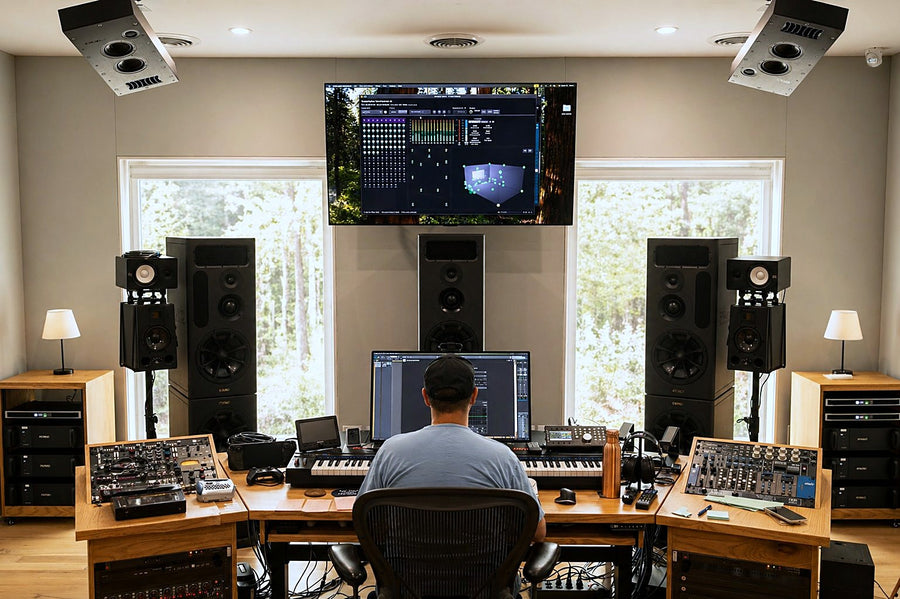
The client added this room to the house for composing, mixing and listening in Dolby Atmos, including music for TV, film and video games. The system is 9.2.4: nine ear-level speakers, two subwoofers and four height speakers.
Because the room was a new addition, the isolation, the acoustics and the speaker system were planned together from the start. The floor framing is separated from the house, the walls are double framed with two layers of drywall and a damping compound between them, and the ceiling sits on isolation rafts. Tuned membrane bass traps run across the back wall, and a full fabric track system with integrated lighting covers the walls and ceiling.
Related Guides
- Home Theater vs. Recording Studio Acoustics
- Can Room Correction EQ Replace Acoustic Treatment?
- What Is a Fabric Track Wall?
See every service on our services page, how a project runs in How We Work, and where we work.
Send us the room size and the speaker layout you have in mind. Reach out to us for design assistance.
Free Room Review Call (818) 217-1653