

No. Room correction EQ cannot replace acoustic treatment. It can cut bass peaks at one listening spot, but it cannot fill deep nulls, cannot change the room's reverberation time, and cannot remove reflections, flutter or comb filtering in the mids and highs.
Room correction works like this: a measurement microphone at the seat records a sine sweep from each speaker, and software or a digital signal processor (DSP) builds a filter from the result. The published research shows which problems that filter can fix and which it can't.
What Room Correction EQ Changes
EQ changes the signal going into the speaker. It does not change the room. Every reflection, every standing wave and every bare surface is still there after the filter is loaded.
Floyd Toole, in a 2015 paper in the Journal of the Audio Engineering Society, lists what conventional equalization cannot do for an audience of several listeners:
- Reflections: It cannot add or remove them.
- Reverberation: It cannot change reverberation time.
- Bass Between Seats: It cannot reduce seat-to-seat variations in bass.
- Room Materials: It cannot compensate for frequency dependent absorption in acoustical materials and furnishings.
Why EQ Can Cut a Bass Peak but Cannot Fill a Null
Toole writes that below the transition frequency, about 200 to 300 Hz in small rooms, the room's standing waves are the dominant factor in what is measured and heard. A standing wave, or room mode, is sound bouncing between parallel surfaces that reinforces itself at certain frequencies.
The transition frequency, also called the Schroeder frequency, can be estimated as 2,000 x the square root of (decay time in seconds ÷ room volume in cubic meters). For a 12 x 14 ft bedroom with an 8 ft ceiling, about 38 cubic meters, it comes out near 180 Hz with a 0.3 second decay:
- 0.3 ÷ 38 = 0.0079.
- Its square root is 0.089.
- 2,000 x 0.089 = 178.
The same room comes out near 290 Hz with 0.8 seconds. Below that frequency some notes stack up into peaks and others cancel into nulls, and EQ treats these two problems very differently.
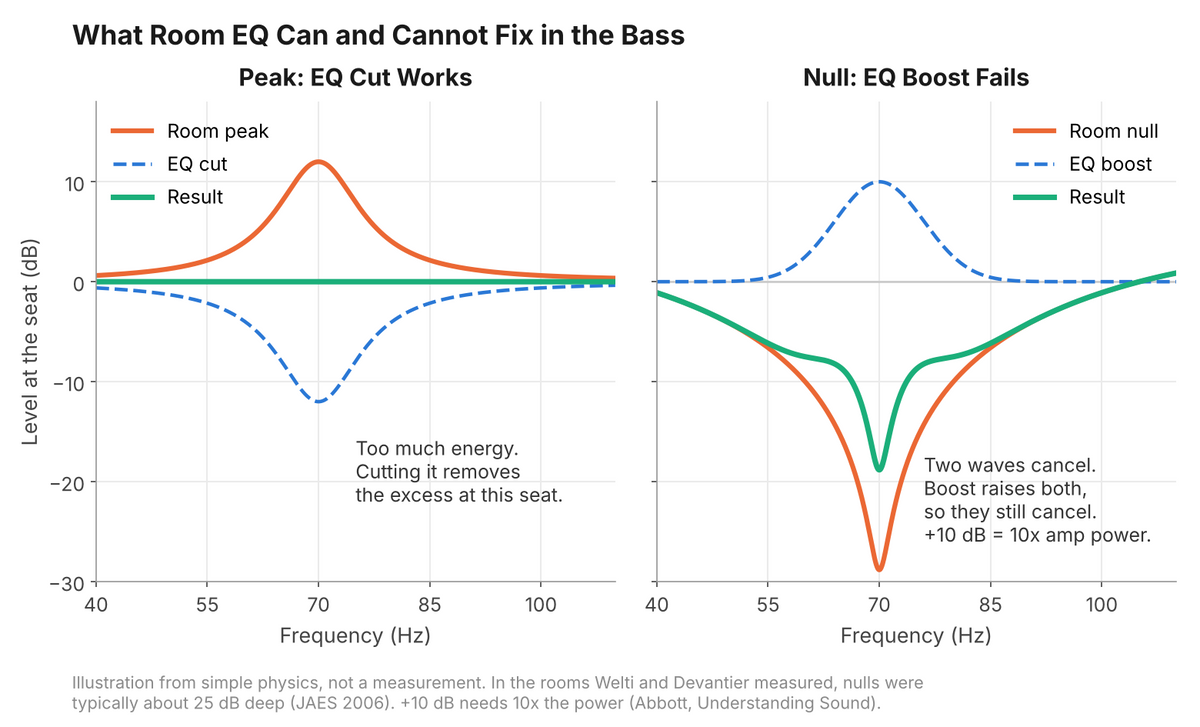
- Peaks: A peak is too much energy at one frequency. Cutting it works. Toole wrote in 2006 that "an equalizer can be used to reduce the audible excesses of objectionable room resonances" at a single listening position.
- Nulls: A null is two waves arriving out of step and canceling. A boost raises both waves by the same amount, so they still cancel. Welti and Devantier report that in the rooms they measured, the dip at a null was typically around 25 dB.
- Headroom: Every 3 dB of boost doubles the power asked of the amplifier. A 10 dB boost asks for ten times the power at that frequency. That power goes into a spot where it cancels, and it plays louder everywhere else in the room.
A published review of room equalization methods makes the same point from the engineering side: the depth of notches in the measured response "should be suitably limited to avoid excessive gains."
EQ Does Not Stop a Room From Ringing
Room correction does not shorten the time it takes a room to die away. Toole lists "change reverberation time" among the things EQ cannot do.
There is one narrow exception. Toole found that low-frequency room resonances behave as minimum phase, meaning the timing of the response follows directly from its level, so cutting a resonant peak at a seat also reduces its ringing at that seat. The room's own decay rate does not change. The correction is fitted to the response measured at the microphone.
Absorption works on the energy itself. Toole describes it as "damping the resonances by draining energy from the offending modes, which will result in reduced pressure maxima and elevated minima." The elevated minima are the nulls that EQ cannot touch. For more on decay, see how long a bare room rings and why thin panels don't fix bass.
Room Correction Works for One Seat
The review by Cecchi, Carini and Spors states it directly: "Exact equalization is possible only in one location, and the extent of the equalized zone is just a fraction of the acoustic wavelength." At high frequencies they note the corrected zone can be smaller than the space between your ears, about 18 cm (7").
The same limit applies in the bass. Welti and Devantier write that when the frequency response changes significantly from one listening location to another, the system cannot be equalized effectively. A filter that flattens a peak at the mix position can deepen a dip a few feet away.
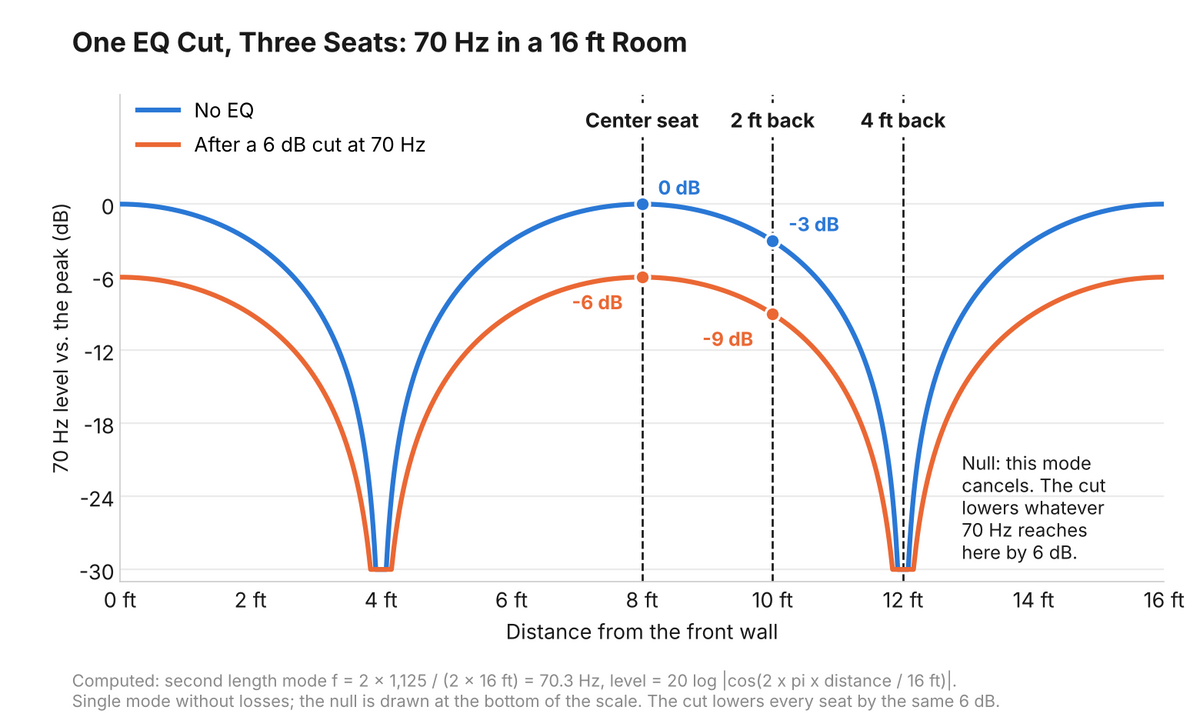
The chart below shows this with front-to-back standing waves in a 16 ft long room.
- The second length mode of that room is 2 x 1,125 ÷ (2 x 16) = 70 Hz.
- It is loud at the end walls and at the center of the room, and it cancels 4 ft from each end wall, which is 4 ft from the center.
- A 6 dB cut at 70 Hz brings the peak at the center seat down 6 dB, and it lowers 70 Hz by the same 6 dB everywhere else in the room.
- A seat 2 ft behind center starts 3 dB below the peak and ends up 9 dB below it.
- A seat 4 ft behind center sits where this mode cancels, so it was already the weakest spot for 70 Hz, and the cut takes another 6 dB off whatever 70 Hz still reaches it.
A 16 ft room is a normal size for a garage studio or a large bedroom. In a studio with one mix chair, the EQ only has to work at one seat, so measure there and keep the chair where you measured. A home theater couch is harder, because every seat on it is in a different spot in the pattern.
Multi-point EQ, which averages measurements from several seats, can widen the corrected area. Toole adds that multiple subwoofers can reduce seat-to-seat variation first, and "global equalization can then be beneficial to several listeners." For a home theater, a second subwoofer is often the more useful buy before more EQ. More on this in why bass changes seat to seat.
Reflections, Flutter and Comb Filtering Are Not EQ Problems
Above the transition frequency, what you hear is the direct sound from the speaker plus its reflections off nearby surfaces. When a reflection combines with the direct sound, it creates a comb of peaks and dips, called comb filtering.
Toole points out that a high resolution measurement makes these peaks and dips look alarming, and that the urge is to smooth them with EQ. He calls them "non-minimum-phase phenomena that are not correctable by minimum-phase equalization." A filter that cuts one of those peaks changes the direct sound at every seat, while the comb pattern it was fitted to shifts as soon as you move your head.
Flutter echo is a reflection repeating between parallel surfaces, so it is also outside what EQ can reach. Treatment at the reflecting surface removes it. Toole reports that a 1" layer of fiberglass board at the point of a strong first reflection is effective at removing sound energy above about 1 kHz.
In a home studio, that means a 2" or 4" panel hung flat on each side wall where you would see the speaker in a mirror from the mix chair. See our guide to the flutter echo and slap back fix.
Room EQ vs Acoustic Treatment: What Each One Fixes
| Problem | Room EQ | Acoustic Treatment |
|---|---|---|
| Bass peak at the main seat | Reduces it | Reduces it |
| Seat-to-seat bass variation | No | Helps some; placement and more than one subwoofer do more |
| Deep bass null | No | Raises it |
| Reverberation time | No | Shortens it |
| Early reflections and comb filtering | No | Absorbs them at the reflection point |
| Flutter echo | No | Absorbs it |
Where Room EQ Does Help
EQ belongs at the end of the process. In this order, it does useful work:
- Speaker Switches First: Many studio monitors have switches on the back for low end or for sitting near a wall. Set those to match how the speakers are placed before running any correction software.
- Placement Next: Speaker and listening positions decide which standing waves you sit in. Start with speaker and desk placement.
- Treatment After That: Bass traps in the corners lower the peaks and raise the nulls. Absorption at the reflection points handles the mids and highs. See our bass traps, 4" core broadband panels and ceiling clouds.
- EQ Last: Cut the bass peaks that remain at the main seat. Fit the filter to an average of several measurements taken a few inches apart around your head, not to one point. Do not boost nulls.
- Leave the Highs Alone: Peaks and dips above the transition frequency come from reflections. Fix them with treatment, not filters.
Sources
- Floyd E. Toole, The Measurement and Calibration of Sound Reproducing Systems, Journal of the Audio Engineering Society, Vol. 63, No. 7/8, 2015.
- Floyd E. Toole, Loudspeakers and Rooms for Sound Reproduction: A Scientific Review, Journal of the Audio Engineering Society, Vol. 54, No. 6, 2006.
- Floyd E. Toole, Music, Rooms and Listeners: Science in the Creation and Delivery of Audio Art, Acoustics Today, Vol. 9, No. 2, Acoustical Society of America, 2013.
- Todd Welti and Allan Devantier, Low-Frequency Optimization Using Multiple Subwoofers, Journal of the Audio Engineering Society, Vol. 54, No. 5, 2006.
- Stefania Cecchi, Alberto Carini and Sascha Spors, Room Response Equalization: A Review, Applied Sciences, Vol. 8, No. 1, MDPI, 2018.
- David Abbott, Decibels (the Math), Understanding Sound, Physics LibreTexts.
- Magne Skålevik, Schroeder Frequency Revisited, Forum Acusticum, Aalborg, 2011.
- Mode and transition frequencies are calculated from the formulas above, using a speed of sound of 1,125 ft/s (343 m/s). Levels along the 16 ft room are 20 log |cos(2 x pi x distance ÷ 16 ft)| for the second length mode.
Need a Second Opinion?
Send us your room dimensions, photos and what you're hearing through our free room review form. Our panels and bass traps are built to order in North Los Angeles in 50 fabric colors. Reach out to us for design assistance.