

Clap your hands in an empty room with bare walls. If you hear a fast, metallic buzz that hangs on after the clap, that's flutter echo. To fix flutter echo you usually need treatment on only one surface of each parallel pair, which makes it one of the cheaper acoustic problems to solve.
What Flutter Echo Is
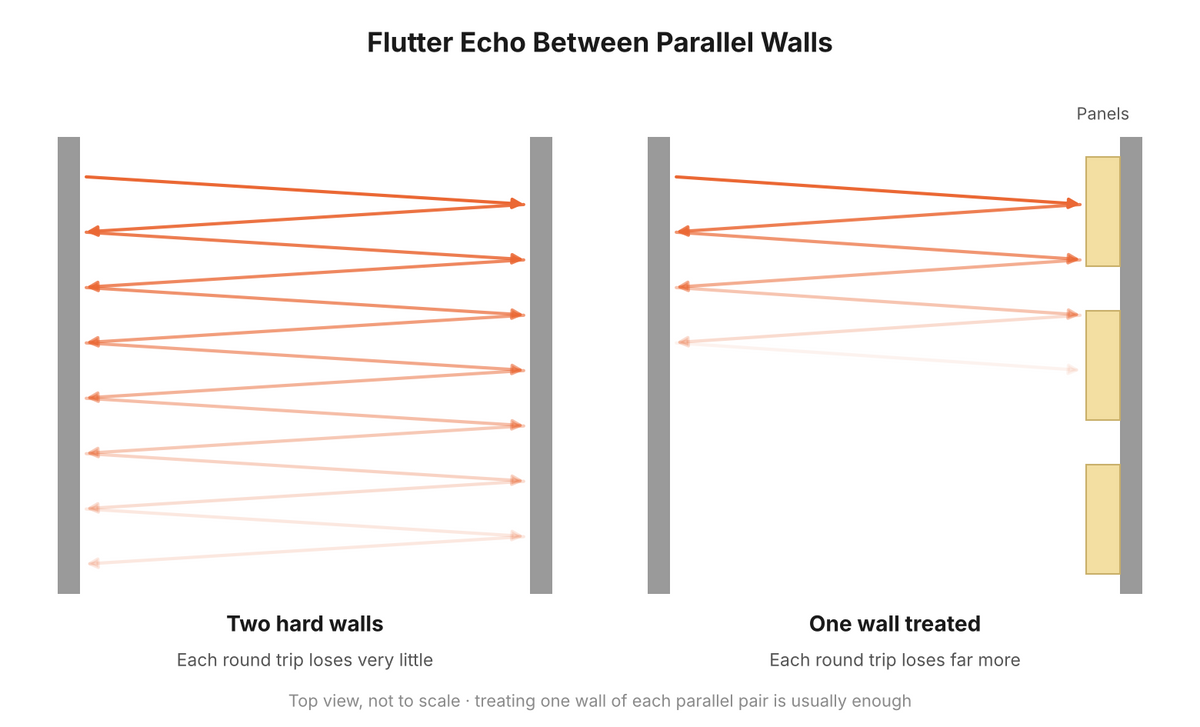
Flutter echo is sound bouncing back and forth between two hard, parallel surfaces: two side walls, a floor and ceiling, or a wall and a window. Each round trip sends a repeat back past your ears.
The time between repeats is the round trip distance divided by the speed of sound, 2d/c, where d is the distance between the surfaces and c is 1,125 ft per second.
- In a room 12 ft wide, a round trip takes about 21 milliseconds, so the repeats come about 47 times a second and run together into a buzz.
- Between a floor and an 8 ft ceiling, the round trip is 16 ft and the repeats are about 14 milliseconds apart.
Slap back is a single, distinct reflection, usually off a hard surface farther away, like the back wall of a garage.
Why It Rings So Long
Drywall absorbs very little in the upper mids. Published typical values for 1/2" drywall on studs are about 0.04 at 1 kHz and 0.07 at 2 kHz. The absorption coefficient is the fraction of sound energy a surface absorbs instead of reflecting, from 0 for none to 1 for all of it.
- At 2 kHz, each bounce off drywall keeps 93% of the energy (1 minus 0.07).
- A round trip is two bounces, so 0.93 x 0.93 = 0.865 of the energy is left.
- 10 x log(0.865) is a loss of only about 0.6 dB.
- To fade by 60 dB, the sound has to make 60 ÷ 0.63, or about 95 round trips.
Window glass is no better: the same published tables list ordinary window glass at 0.07 at 2 kHz and large panes of heavy plate glass at 0.02.
One Wall Is Usually Enough
Treat one surface of each parallel pair and the loss per round trip jumps, so the ring dies out many times faster. Calculated at 2 kHz, with drywall on the other side:
| Treated wall at 2 kHz | Loss per round trip | Round trips to fade 60 dB |
|---|---|---|
| None (both drywall) | 0.6 dB | About 95 |
| Absorbing 0.50 | 3.3 dB | About 18 |
| Absorbing 0.73 | 6.0 dB | About 10 |
| Absorbing 0.94 | 12.5 dB | About 5 |
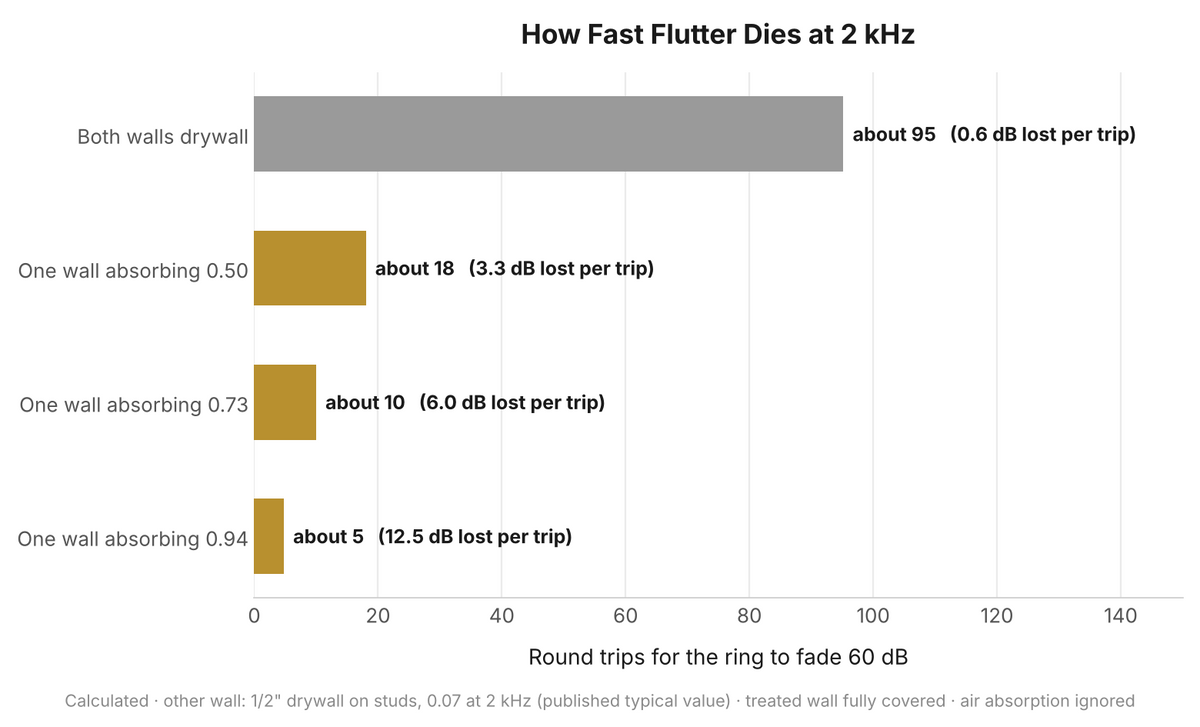
Each row is worked the same way. With a panel absorbing 0.50 on one wall:
- 0.50 x 0.93 = 0.465 of the energy is left after a round trip.
- That is a loss of 3.3 dB.
- 60 ÷ 3.3 is about 18 round trips.
The table assumes the treated wall is covered along the flutter path. It leaves out air absorption, the sound spreading out and the rest of the room, which only make the ring shorter.
Find Which Surfaces Are Flutter Pairs
Stand between each pair of parallel surfaces and clap: side wall to side wall, front wall to back wall, floor to ceiling. The pair that buzzes is the pair to treat. Move a few feet and clap again, because the buzz can come and go along a wall.
For a record of it, a free room measurement program and a measurement microphone will show flutter in the energy time curve, a plot of sound level against time after a test sweep.
Flutter shows up as a row of evenly spaced spikes. The spacing is 2d/c, so spikes about 21 milliseconds apart point to surfaces about 12 ft apart, and spikes about 14 milliseconds apart point to the floor and an 8 ft ceiling. Measure again after treatment and the row of spikes should drop away much faster.
What to Use to Fix Flutter Echo
-
2" Core Panels: Flutter is mostly a mid and high frequency problem.
- Manufacturer ASTM C423 data for 2" mineral wool and fiberglass board shows coefficients of about 1.0 from 500 Hz to 4 kHz, so a 2" core Mid / High panel hung flat on the wall on Z-clips or a cleat is the usual pick.
- For flutter alone you don't need the depth of a 4" core, unless the same wall also needs low mid control.
- Slats on Furring: Wood slat panels work too, mounted on 1" to 2" furring with insulation behind them. Published lab reports for felt-backed slats on 1" and 2" furring with the cavity insulated measured 0.98 at 500 Hz, 1.00 at 1 kHz and 0.92 to 0.96 at 2 kHz.
- Floor and Ceiling: Treat one of the two. A heavy rug on a pad is the cheapest fix: published values for heavy carpet on a felt or foam pad are 0.69 at 1 kHz and 0.71 at 2 kHz, against 0.37 and 0.60 for the same carpet laid straight on concrete. Overhead, a ceiling cloud does the same job.
What to Do First
- Step 1: Clap test each pair of surfaces and note where the buzz is.
- Step 2: Put a rug on a pad down if the floor is bare. It handles the floor and ceiling pair for the least money.
- Step 3: Hang panels on one wall of each side to side or front to back pair that still buzzes, at ear height. In a mix room, treat both side walls at the first reflection points instead, so the left and right speakers hear the same room.
- Step 4: Clap test or measure again, and add a panel wherever the buzz is still there.
Spread It Out at Ear Height
Flutter can run along any stretch of the two surfaces. One big block of panels only stops it where the block is. A few panels spread along the wall at ear height cover more of the paths you hear. Walk the room and clap as you go. Wherever the buzz comes back, that stretch of wall needs a panel.
Slap Back Off Glass
A common home example: a bedroom or garage studio with a window or sliding glass door on the wall behind the mix position. Treating the opposite wall stops the sound from bouncing back and forth between the two. The first reflection off the glass still reaches your chair.
If you still hear it, hang a heavy curtain you can pull across the glass while you work. Published values for heavy 18 oz per sq yd velour, hung in deep folds that gather it to half its flat width, are 0.72 at 1 kHz and 0.70 at 2 kHz. The other option is to turn the setup so the glass is on the wall behind the speakers instead of behind you.
If the room is also boomy or muddy, that's a different problem with a different fix. Start with our post on 4" core vs. 2" core panels.
Sources
- F. Alton Everest and Ken C. Pohlmann, Master Handbook of Acoustics, McGraw-Hill (typical absorption coefficients for gypsum board, glass, heavy carpet on concrete and on pad, and heavy velour drapery).
- Manufacturer published Technical Data Sheet: 6 PCF Stone Wool Multipurpose Board, ASTM C423 Sound Absorption, 2026.
- Manufacturer published Product Data Sheet: Rigid Fiberglass Board, ASTM C423 Type A Sound Absorption Coefficients, Pub. 10021736, 2026.
- Published ASTM C423 test reports for felt-backed wood slat panels on furring with an insulated cavity.
Need a Second Opinion?
Send us photos of the room and where you hear the ring through our free room review form. Our panels and bass traps are built to order in North Los Angeles in 50 fabric colors. Reach out to us for design assistance.