

Wood slat acoustic panels do work, mostly in the mids and highs, and how well depends on what is behind them. Published lab reports for felt-backed wood slat panels show NRC values of 0.70 to 0.95 when the panel is tested with a cavity behind it, and about 0.55 when it is laid flat.
NRC, the noise reduction coefficient, is the average of the absorption coefficients at 250, 500, 1000 and 2000 Hz. Glued flat to drywall, a slat panel absorbs much less than its cavity-mounted numbers. This post covers how slats absorb, what the lab reports show for each mounting, and how to mount them so they work.
How a Slat Panel Is Built
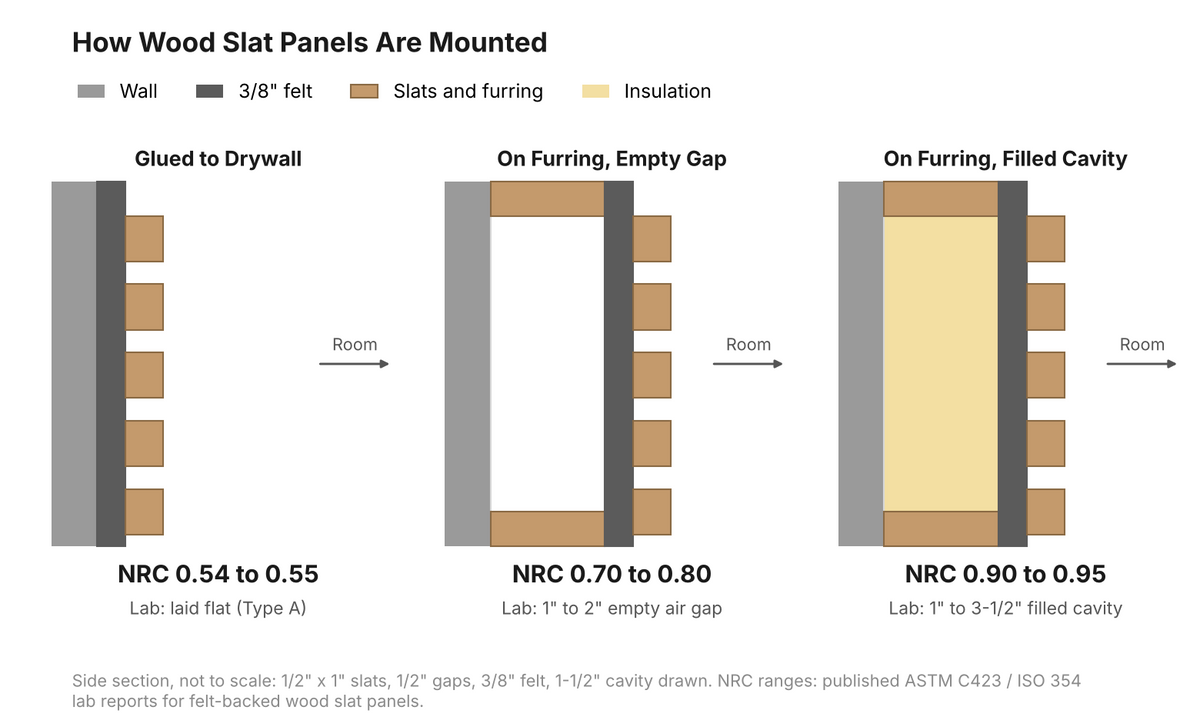
A typical slat panel is solid wood, MDF or wood veneered slats about 1/2" thick and about 1" wide, glued to a 3/8" (9 mm) felt backing, with gaps of about 1/2" to 11/16" between them. The slats cover roughly 60 to 70 percent of the face. The felt, and any insulation behind it, does the absorbing. Sound reaches it through the gaps.
How Slats Absorb
Slats with gaps over a cavity form a slotted resonant absorber, a form of Helmholtz resonator. The air in each gap acts as a mass, the air in the cavity behind acts as a spring, and the felt or insulation turns the motion into heat.
A National Research Council of Canada digest describes this kind of system, a slotted or perforated screen over a backspace containing porous material, as "a broadly resonant system that can be tuned to whatever frequency range is desired."
- Open Area: For slots, the open area is the gap width divided by the slat pitch. A 1/2" gap between 1" slats is 1/2" out of every 1-1/2", or 33%.
- Cavity Depth: A deeper cavity is a softer spring and tunes the panel lower. Glued to drywall, there is no air cavity at all, only the 3/8" felt behind the slats, so the panel works mainly in the upper mids and highs.
- Fill: Insulation in the cavity damps the resonance and spreads the absorption over a wider band.
Where the Lab Numbers Come From
Absorption is tested to ASTM C423 in a reverberation room. The mounting is set by a separate standard, ASTM E795, and it changes the result a lot:
- Type A: The panel is laid directly on the test surface. It is the closest of the lab mounts to a panel glued flat to a wall.
- Furred or Framed Mounts: The panel sits on wood furring or a frame, with an air gap behind it, often filled with insulation. Reports label these Type C or Type D, and the number after the letter is roughly the cavity depth in millimeters, so D-20 is about a 3/4" space and C-25 a 1" space.
Three published reports for felt-backed slat panels show the difference. Band values above 1.00 are shown as 1.00. The NRC column is the figure each lab reported, calculated from its uncapped values, so it can sit slightly above the average of the capped numbers.
| Lab Mount (measured) | 125 Hz | 250 Hz | 500 Hz | 1 kHz | 2 kHz | NRC |
|---|---|---|---|---|---|---|
| Report 1, laid flat (Type A) | 0.04 | 0.15 | 0.36 | 0.71 | 0.93 | 0.54 |
| Report 1, 1x3 furring over a second felt layer | 0.15 | 0.35 | 0.87 | 1.00 | 1.00 | 0.82 |
| Report 1, wood frame, 3.5" mineral wool | 0.59 | 0.74 | 1.00 | 0.93 | 0.91 | 0.90 |
| Report 2, laid flat (Type A) | 0.08 | 0.08 | 0.29 | 0.70 | 1.00 | 0.55 |
| Report 2, 1" air gap, empty | 0.04 | 0.18 | 0.50 | 1.00 | 1.00 | 0.70 |
| Report 2, 2" air gap, empty | 0.17 | 0.39 | 0.87 | 1.00 | 0.81 | 0.80 |
| Report 2, 2" cavity, insulated | 0.44 | 0.95 | 0.98 | 1.00 | 0.96 | 0.95 |
| Report 3, 1" furring, cavity filled | 0.29 | 0.55 | 0.98 | 1.00 | 0.92 | 0.90 |
- Laid Flat: Both flat tests land at NRC 0.54 to 0.55, with almost nothing at 125 Hz and 250 Hz. The absorption sits at 1 kHz and up, as expected from 3/8" of felt with no air space behind it.
- Air Gap: An empty 1" to 2" air gap, or furring over a second felt layer, raises NRC to 0.70 to 0.82, mostly at 500 Hz and 1 kHz. Our post on the air gap behind acoustic panels covers how depth shifts absorption lower.
- Filled Cavity: Insulation behind the slats is what moves the low end, 0.29 to 0.59 at 125 Hz depending on depth.
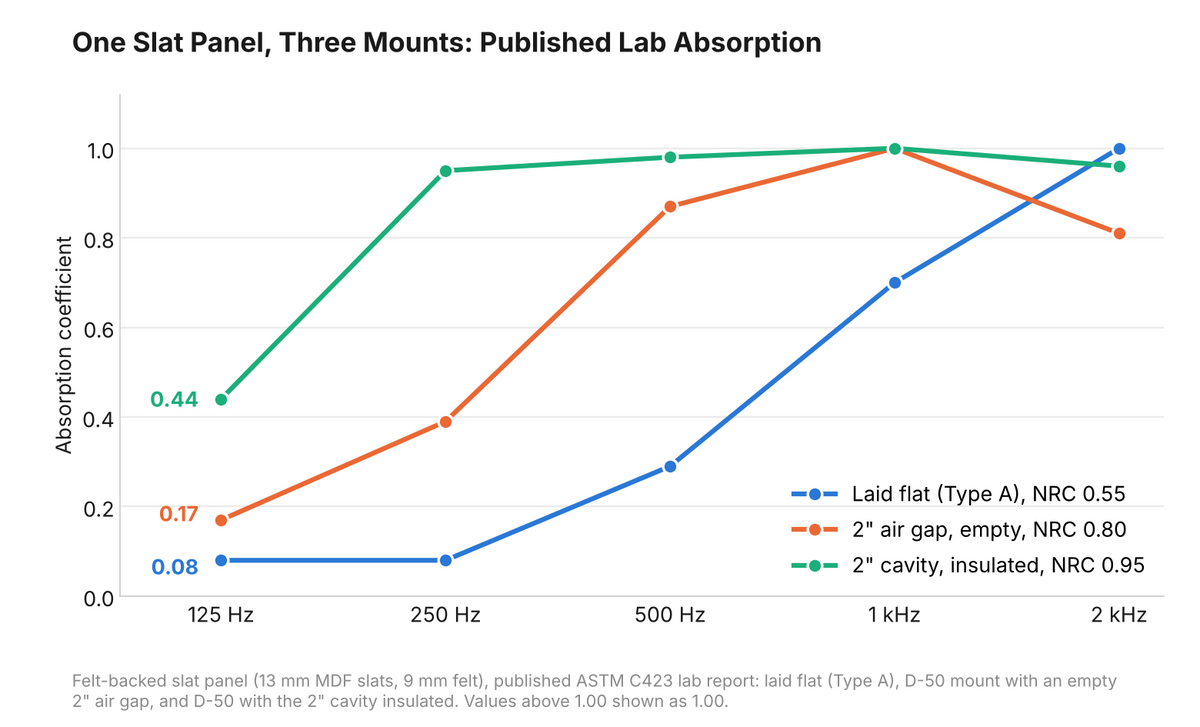
The chart is Report 2 from the table, one panel tested three ways. Laid flat it measured NRC 0.55, on an empty 2" air gap 0.80, and with the 2" cavity insulated 0.95. Most of the difference is at 1 kHz and below: at 250 Hz the same panel went from 0.08 to 0.39 to 0.95.
Before you compare two panels, check which mounting each test used.
How to Mount Wood Slat Panels
- Furring: Mount the panels on furring strips screwed into the studs rather than straight to the wall. 2x2 lumber gives a 1-1/2" cavity. A 2x4 frame gives 3-1/2" and more low end.
- Fill the Cavity: Put fiberglass or mineral wool between the furring before the slats go on. In the lab reports above, filled cavities measured NRC 0.90 to 0.95, against 0.70 to 0.80 for an empty 1" to 2" air gap.
- Faced Fiberglass: If the batt has a paper facing, put the paper against the wall, not against the felt.
Do Wood Slat Panels Work for Bass?
Slats are a mid frequency, high frequency and flutter echo fix. With the cavity filled, the lab reports above measured 0.29 to 0.59 at 125 Hz. The best of those, 0.59, had 3.5" of mineral wool behind the slats.
That is a wall build about 4-1/2" deep, and it is still not a bass trap. If your room is boomy, look at 4" core panels for the low mids and bass traps below that.
Where slats do fit: a room that rings or sounds harsh, parallel walls with flutter echo, and spaces where the look matters as much as the absorption.
Sources
- ASTM C423, Standard Test Method for Sound Absorption and Sound Absorption Coefficients by the Reverberation Room Method.
- ASTM E795, Standard Practices for Mounting Test Specimens During Sound Absorption Tests.
- Published ASTM C423 and ISO 354 test reports for felt-backed wood slat panels in flat, furred and framed mounts.
- Trevor J. Cox and Peter D'Antonio, Acoustic Absorbers and Diffusers: Theory, Design and Application, CRC Press.
- T.D. Northwood, CBD-92, Room Acoustics: Design for Listening, National Research Council of Canada, 1967.
- Arup, Resonant (Helmholtz) Absorber, engineering software technical reference (open area of slotted panels).
- T. Fidecki, Room Acoustics and Sound Reinforcement Systems, Warsaw University of Technology (Helmholtz resonator mass and air spring).
Need a Second Opinion?
Send us photos and rough dimensions of your room through our free room review form. Our panels and bass traps are built to order in North Los Angeles in 50 fabric colors. Reach out to us for design assistance.