

On a wall, the air gap behind an acoustic panel adds little low frequency absorption. Wall panels hang on Z-clips or cleats, interlocking metal or wood strips with one half on the wall and one on the panel, which leave about 1/2" to 1" of air behind them, and a gap that small barely changes what the panel does at 125 Hz.
If you want a wall panel to reach lower, a thicker core does far more than spacing it out.
The one common install with a deep air gap is a ceiling cloud hung below the ceiling. That is the case the published air gap data describes.
How Panels Hang
- Wall Panels: Z-clips or a cleat hold the panel about 1/2" to 1" off the drywall. The gap is there so the panel hangs flat and lifts off easily, not to add bass absorption.
- Ceiling Clouds: Hung on cables or eye hooks, usually several inches to about a foot below the ceiling.
Why a Small Gap Does Little for Bass
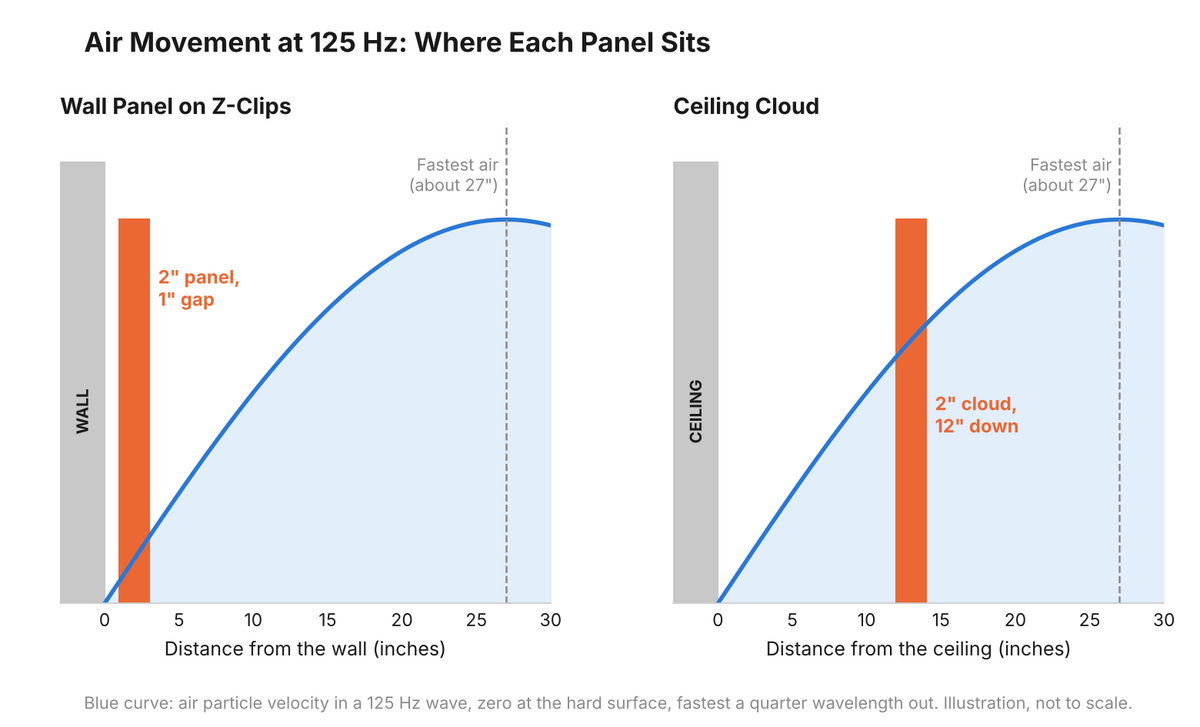
Fiberglass and mineral wool turn sound into heat through friction as air moves back and forth inside the fibers, so they absorb the most where the air moves fastest. The speed of that back and forth motion is called particle velocity. At a hard wall the air cannot move, so particle velocity is zero there. It rises with distance and reaches its first peak a quarter wavelength from the wall.
Sound travels about 1,125 feet per second at room temperature.
- At 125 Hz one wavelength is 9 ft, so the quarter wavelength is 27".
- At 250 Hz the quarter wavelength is about 13-1/2".
For sound striking the wall straight on, particle velocity at a distance x from the wall is proportional to sin(2πx/λ), where λ is the wavelength.
- At 125 Hz, the middle of a 2" panel mounted tight to the wall sits 1" out, where the air moves at about 6% of its peak speed.
- Put the same panel on a 1" Z-clip gap and its middle sits 2" out, at about 12%.
The math for that second case:
- 108" is the 9 ft wavelength.
- 2π × 2 ÷ 108 is an angle of 6.7 degrees.
- sin(6.7°) is about 0.12.
A National Research Council of Canada building digest states that a thin porous material against a hard backing "will be mainly reflective at low frequencies." A civil engineering materials text gives the two ways to extend porous absorption lower: porous absorbers also work at low and middle frequencies "if sufficiently thick or if backed by an air space." On a wall, thickness is the practical one.
What the Lab Mountings Mean
An absorption coefficient is the fraction of sound energy a surface absorbs instead of reflecting. In the US it is measured under ASTM C423, in a reverberation room. A companion standard, ASTM E795, sets how the sample is mounted in that room, because the absorption of a material "depends not only on the physical properties of the material but also on the way in which the material is mounted."
- Type A: The material is placed against a solid backing. This is the closest lab mount to a panel on Z-clips or cleats.
- Type E: The material sits over a sealed air space. The number is the distance in millimeters from the front face of the sample to the surface behind it, so in E-400 the face sits 400 mm (about 16") out, and the air space is that distance minus the sample's thickness. The design guide used below labels its 16" mounting E-405. This is the closest lab mount to a cloud hung well below the ceiling.
A coefficient of 0 means all of the sound reflects, and 1.00 means all of it is absorbed.
Air Gap Behind Acoustic Panels: The Published Numbers
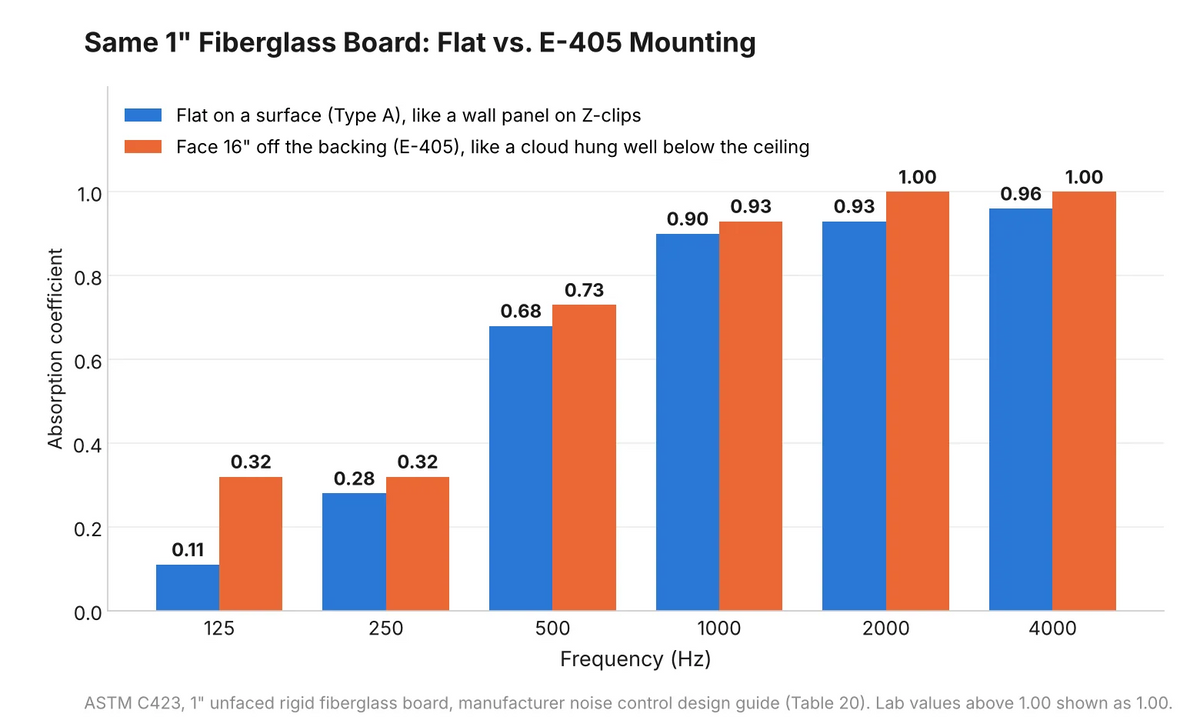
One manufacturer's noise control design guide lists the same unfaced rigid fiberglass board tested flat (Type A) and with its face 16" off the backing (E-405). The table shows its 1" and 2" boards, with the 2" flat value taken from the 6 PCF data used across this site. Wall panels never hang 16" off the wall. A cloud hung about a foot below the ceiling is the closest real install to this test.
| Board | 125 Hz Flat | 125 Hz, Face 16" Out |
|---|---|---|
| 1" | 0.11 | 0.32 |
| 2" | 0.18 | 0.40 |
Data Note: Lab values above 1.00 are shown as 1.00, since no surface absorbs more than all of the sound that reaches it.
- 1" Board: The E-405 mounting added 0.21 at 125 Hz. From 250 Hz to 4000 Hz it added only 0.03 to 0.07.
- 2" Board: The E-405 mounting reads 0.22 higher at 125 Hz, 0.40 against 0.18 flat. At 250 Hz the E-405 number, 0.73, is about the same as the 0.75 flat.
- 4" Core: The published data sheets used across this site put a 4" core mounted flat at 0.60 at 125 Hz. That is more than the 2" board gets even in the E-405 mounting, with its face 16" out. A wall panel on Z-clips gets nowhere near that much air, so core thickness is what moves its 125 Hz number.
Why an Absorption Sheet Can Overstate a Wall Panel
For a 1" or 2" panel, E-400 numbers read higher at 125 Hz than Type A numbers. If the panel will hang on Z-clips, an E-400 number describes a mounting 16" off the surface that it will never have.
- Find the Mounting: Look for "Type A" or "E-400" next to the table. If it is not listed, ask.
- Match It to Your Install: A wall panel on Z-clips or cleats should be judged on Type A data. E-400 data is a closer guide for a cloud hung well below the ceiling.
- Compare Like With Like: An E-400 number for one panel against a Type A number for another is not a fair comparison, especially at 125 Hz and 250 Hz.
- Read Values Above 1.00 as Test Artifacts: No panel absorbs more than all of the sound.
Where a Big Air Gap Pays Off: Ceiling Clouds
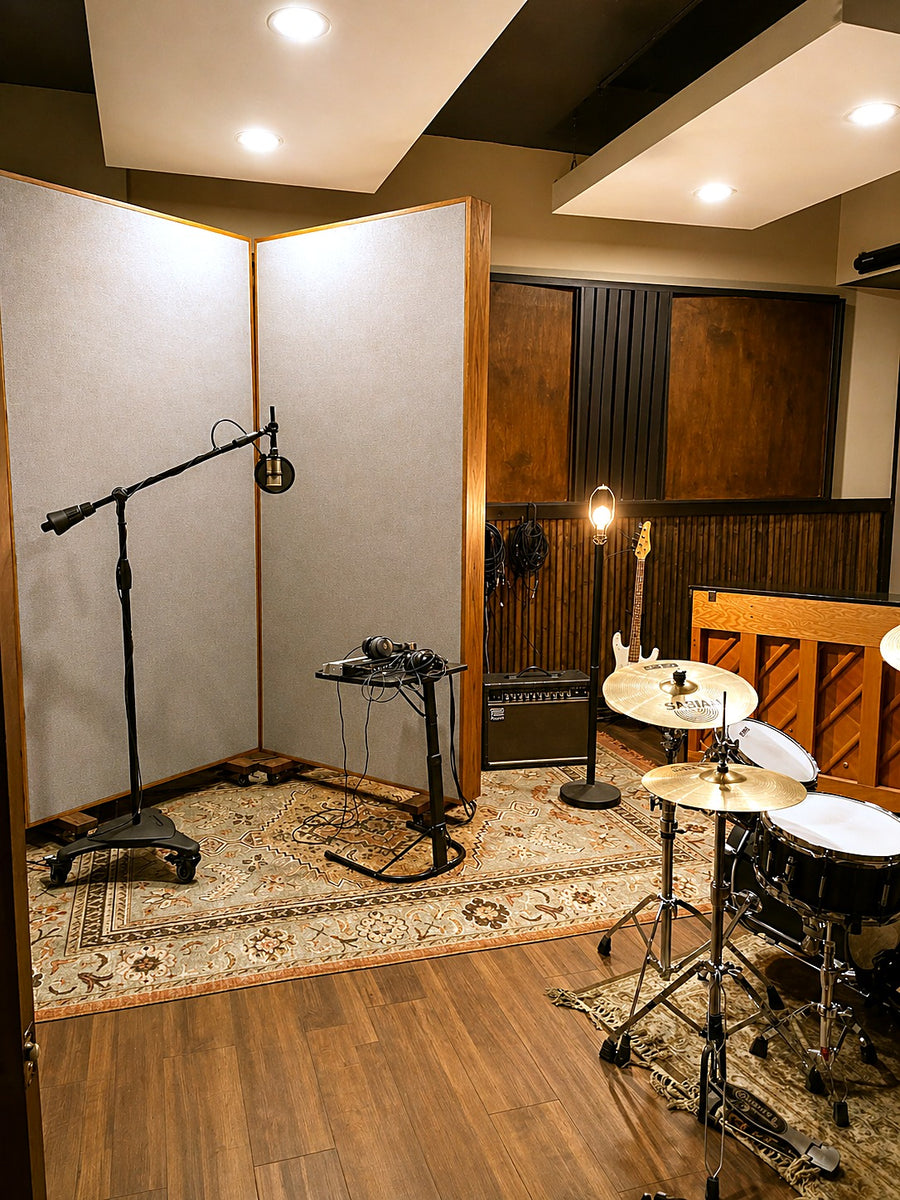
A cloud hung below the ceiling gets air above it without giving up any floor space. The core sits farther from the hard surface, where the air moves more at low frequencies.
Using the same sine relationship, the middle of a 2" cloud hung 12" below the ceiling sits 13" from it, where the air moves at about 69% of its peak speed at 125 Hz. A 2" wall panel on Z-clips works at about 12%.
The lower the cloud hangs, the closer it gets to the 16" lab test. Hung only a few inches down, it gets less of the gain.
In a room with an 8 ft ceiling, headroom usually decides how low a cloud can go. Our post on ceiling cloud placement covers where to hang it, and our ceiling clouds show the sizes.
What to Do on Your Walls
- Measure First: A measurement mic and free room measurement software show which frequencies ring longest.
- Use the Corners: For low end control, put deep bass traps in the corners.
- Pick Core Depth for Low End: A 4" core reaches lower than a 2" core. See broadband vs mid / high acoustic panels and why thin panels don't fix bass.
- Hang Panels the Normal Way: Z-clips or cleats are fine. Building standoffs to chase bass costs wall space and gains little.
Sources
- Manufacturer published Noise Control Design Guide, Table 20: Sound Absorption Coefficients for rigid fiberglass insulation board, mountings A and E-405.
- Manufacturer published Product Data Sheet: Rigid Fiberglass Board, ASTM C423 Type A Sound Absorption Coefficients, Pub. 10021736, 2026.
- Manufacturer published Technical Data Sheet: 6 PCF Stone Wool Multipurpose Board, ASTM C423 Sound Absorption, 2026.
- ASTM International, E795, Standard Practices for Mounting Test Specimens During Sound Absorption Tests, current edition E795-23.
- Marshall Long, Architectural Acoustics, 2nd Edition, chapter "Sound and Solid Surfaces," Academic Press, 2014.
- G. Baldinelli et al., "Building Envelope," Handbook of Energy Efficiency in Buildings, Butterworth-Heinemann, 2019.
- J. António, chapter in Fibrous and Composite Materials for Civil Engineering Applications, Woodhead Publishing, 2011.
- T.D. Northwood, CBD-92, Room Acoustics: Design for Listening, National Research Council of Canada, 1967.
- NASA Glenn Research Center, Speed of Sound Interactive, NASA.
Need a Second Opinion?
Send us your room dimensions, photos and what you're hearing through our free room review form. Our panels and bass traps are built to order in North Los Angeles in 50 fabric colors. Reach out to us for design assistance.