

Cover the walls of a room with thin absorbent panels and the mids and highs die away fast, while the bass barely changes. Do acoustic panels absorb bass? Published lab data for porous absorbers shows that thin ones barely do, and the reason is depth.
This post walks through that data, a research room built to switch between hard and absorbent walls, and what it means for treating a bedroom or garage studio.
Why Depth Is the Difference
Porous absorbers such as fiberglass and mineral wool work by friction, as air moves back and forth through the fibers. The speed of that motion is called particle velocity. Right at a hard wall it is zero. It rises with distance and reaches its first peak a quarter wavelength from the wall.
With sound at about 1,125 feet per second, a 125 Hz wave is 9 ft long, so that peak is 27" out. A 1" or 2" panel on the wall sits where there is little air movement to work on.
A common rule of thumb in the acoustics literature is that a porous absorber needs to be at least a tenth of a wavelength thick to be effective. At 125 Hz that is about 11". At 1 kHz it is under 1-1/2", which is why even a thin panel handles the mids and highs. Our post on porous vs. tuned bass traps goes deeper into this.
How Much Bass Do Thin Acoustic Panels Absorb?
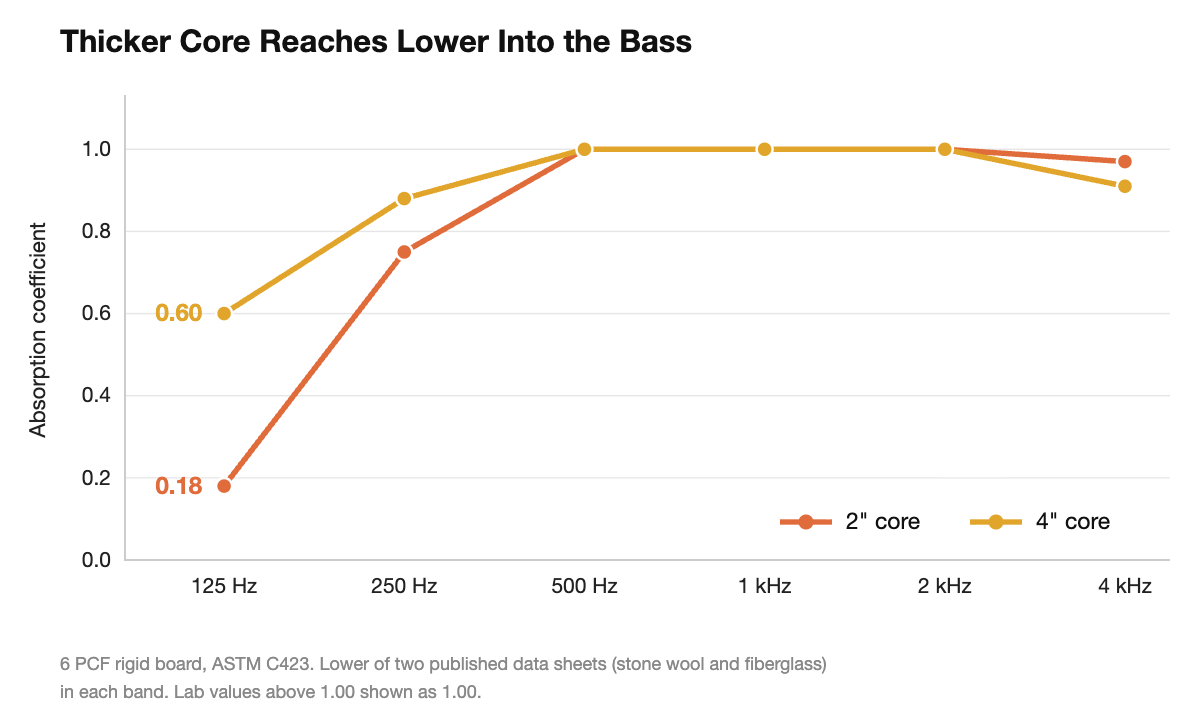
An absorption coefficient is the fraction of sound energy a surface absorbs instead of reflecting. A coefficient of 1.00 means all of it is absorbed. Two manufacturers' published data sheets for 6 PCF (6 pounds per cubic foot) rigid board, one stone wool and one fiberglass, list 2" and 4" thicknesses tested to ASTM C423. The table shows the lower of the two values in each band:
| Board | 125 Hz | 250 Hz | 500 Hz | 1 kHz |
|---|---|---|---|---|
| 2" | 0.18 | 0.75 | 1.00 | 1.00 |
| 4" | 0.60 | 0.88 | 1.00 | 1.00 |
Data Note: Lab values above 1.00 are shown as 1.00, since no surface absorbs more than all of the sound that reaches it.
- 2" Board: Absorbs everything that reaches it from 500 Hz to 1 kHz, and 0.18 at 125 Hz.
- 4" Board: Reaches 0.60 at 125 Hz, more than three times the 2" board.
What That Means in a Room
Total absorption in a room is counted in sabins. One sabin is one square foot of surface that absorbs all the sound that hits it, so a panel's sabins are its area times its coefficient. Ten 2 x 4 ft panels cover 80 square feet:
- 2" Board: 80 × 1.00 = about 80 sabins at 1 kHz, and 80 × 0.18 = about 14 sabins at 125 Hz.
- 4" Board: 80 × 1.00 = about 80 sabins at 1 kHz, and 80 × 0.60 = 48 sabins at 125 Hz.
Reverberation time, also written RT60, is how long a sound takes to fade by 60 dB after it stops. It falls as total absorption rises: by the Sabine equation, RT60 = 0.049 × room volume in cubic feet ÷ total sabins.
The 2" panels add more than five times as much absorption at 1 kHz as at 125 Hz, so the mids shorten a lot and the low end shortens little. The 4" panels add 48 sabins at 125 Hz against 80 at 1 kHz, so the low end comes down along with the mids.
A worked example: a 12 x 14 x 8 ft bedroom is 1,344 cubic feet.
- Say the furnished room starts with 100 sabins in both bands, which gives 0.049 × 1,344 ÷ 100, about 0.66 s. An empty room has far less, and our guide to how many acoustic panels you need works through that case.
- Ten 2" panels bring 1 kHz down to 0.049 × 1,344 ÷ 180, about 0.37 s.
- They bring 125 Hz only to 0.049 × 1,344 ÷ 114, about 0.58 s.
- Ten 4" panels bring 125 Hz down to 0.049 × 1,344 ÷ 148, about 0.44 s, much closer to the 1 kHz figure.
One Research Room
In a published research room about 20 x 20 x 8 ft, switching the ceiling and all four walls from hard laminate to perforated panels over mineral wool cut the reverberation time at 1 kHz from 0.73 s to 0.14 s. The authors report no 125 Hz or 250 Hz values, because their speakers did not put out enough low end for a reliable reading. In a bedroom or garage studio, the same idea means 4" core panels on the walls, deep traps in the corners, and a cloud overhead.
Why a Treated Room Can Still Sound Boomy
A room covered in 2" panels gets 1.00 absorption at 1 kHz on that area and 0.18 at 125 Hz. Clap and the room sounds dead. Play music and the low end hangs on after everything above it has stopped. That is why a room full of thin panels can sound boomy and dull at the same time.
Adding more thin panels makes the mids deader without fixing the bass. Absorption that reaches the bass does:
- Deeper porous panels on the walls.
- Bass traps in the corners.
- A cloud hung with air above it.
What to Do in Your Room
- Before You Buy: Measure. A measurement mic and free room measurement software show the decay at each frequency, so you can see whether the bass or the mids ring longer.
- Mids, Highs and Flutter: Thin panels do this job well. A 2" core panel is enough for flutter and reflections.
- Low Mids and Bass: Use depth. 4" core broadband panels reach lower than thin ones.
- Below 100 Hz: Look at bass traps built for low frequencies.
Sources
- D. Di Carlo et al., dEchorate: a calibrated room impulse response dataset for echo-aware signal processing, EURASIP Journal on Audio, Speech, and Music Processing, 2021 (room description and published reverberation times).
- Manufacturer published Technical Data Sheet: 6 PCF Stone Wool Multipurpose Board, ASTM C423 Sound Absorption, 2026.
- Manufacturer published Product Data Sheet: Rigid Fiberglass Board, ASTM C423 Type A Sound Absorption Coefficients, Pub. 10021736, 2026.
- G. Baldinelli et al., "Building Envelope," Handbook of Energy Efficiency in Buildings, Butterworth-Heinemann, 2019 (particle velocity at a boundary, tenth wavelength rule of thumb).
Need a Second Opinion?
Send us your room dimensions, a measurement if you have one, and what you're hearing through our free room review form. Our panels and bass traps are built to order in North Los Angeles in 50 fabric colors. Reach out to us for design assistance.