

"How many acoustic panels do I need?" is the question we get most. The count depends on the room's size, what is already in it and what the room is for, and you can estimate it with one formula. Start with where the first panels go, then use the math to see how far they get you.
Short Answer: A typical small mix room, about 12 x 14 ft, needs six 2 x 4 ft wall panels, one ceiling cloud and two corner bass traps to start. That covers about 12% of the room's surfaces and takes an empty room from about 1.9 seconds of decay to about half a second at 1 kHz. Larger rooms, live rooms and theaters need a plan of their own, and the math below shows how to size yours.
Start With Placement
A few panels on the surfaces that send sound straight to your ears do more than many panels on surfaces that don't. Find these spots before counting anything.
1. First Reflection Points
The spots on the side walls where sound from each speaker bounces straight to your ears. A wall reflects sound the way a mirror reflects light, so you can find them with a mirror.
- Sit in the mix position and have someone slide a mirror along the wall at ear height.
- Wherever you can see a speaker, that's a reflection point.
- Mark it with tape, and do both speakers on both side walls.
One panel on each side wall, centered on the marks, is usually the first thing to do.
2. The Ceiling Above You
The same reflection happens overhead. With speakers and ears at the same height, the ceiling reflection point sits halfway between each speaker and your head. A ceiling cloud above the mix position handles it. See where to hang a ceiling cloud.
3. The Corners
In a rectangular room, every room mode has a pressure peak in the corners. A room mode is a frequency where sound bouncing between the walls reinforces itself and rings.
That is why bass builds up in corners and why absorbers placed there reach more of the modes than the same absorber on a flat wall. Bass traps about 6" to 12" deep, or diaphragm absorbers, go in the front corners first, then the rear corners if you can.
4. The Rear Wall
Sound hits the back wall and comes back to the mix position a moment later. With your head 5 ft from the rear wall, that bounce travels an extra 10 ft and arrives about 9 milliseconds after the direct sound. Panels with a 4" core there, or diffusion in larger rooms, clean that up.
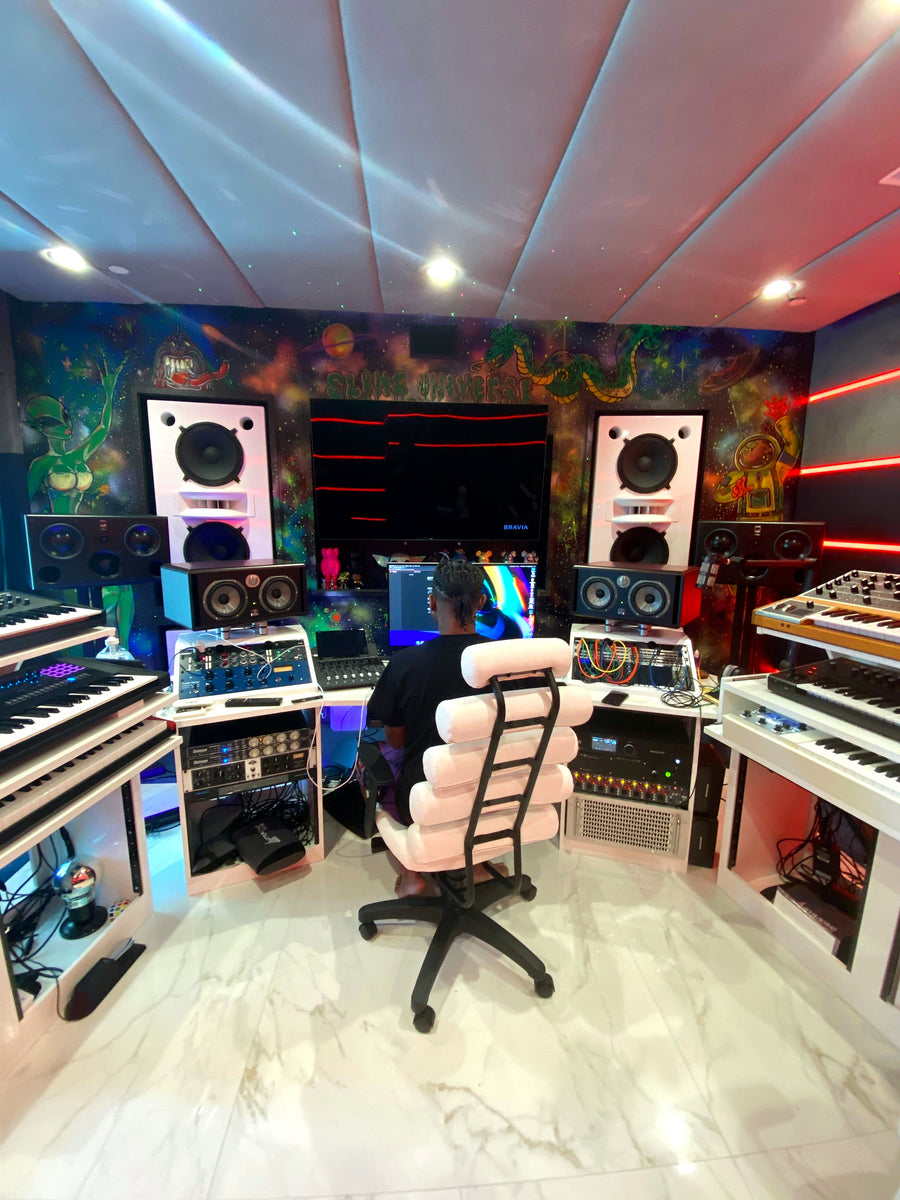
Estimating How Many Acoustic Panels You Need
Once those spots are covered, the question is how much total absorption the room needs. The standard estimate is the Sabine formula for reverberation time, the time it takes sound to fade by 60 dB after the source stops:
RT60 = 0.049 x V / A
In words: the decay time in seconds is 0.049 times the room's volume, divided by the total absorption.
- V is the room volume in cubic feet.
- A is the total absorption in sabins: each surface's area in square feet times its absorption coefficient, added up.
- The absorption coefficient is the fraction of sound a surface absorbs, from 0 for none to 1 for all of it.
A worked example at 1 kHz: an empty 12 x 14 ft spare bedroom with an 8 ft ceiling, drywall walls and ceiling, and a bare wood floor.
- Volume: 12 x 14 x 8 = 1,344 cubic feet.
- Walls and Ceiling: 584 sq ft of drywall at 0.04 = about 23 sabins.
- Floor: 168 sq ft of wood at 0.07 = about 12 sabins.
- Result: About 35 sabins, so RT60 = 0.049 x 1,344 / 35 = about 1.9 seconds.
Each 2 x 4 ft panel adds about 8 sabins at 1 kHz, its 8 sq ft face times a coefficient of about 1.0. Published ASTM C423 data for 2" and 4" mineral wool board is about 1.0 at 1 kHz.
| 2 x 4 ft Panels Added | Total Absorption | RT60 at 1 kHz | Share of Room Surface Covered |
|---|---|---|---|
| 0 | 35 sabins | About 1.9 s | 0% |
| 4 | 67 sabins | About 1.0 s | 4% |
| 8 | 99 sabins | About 0.66 s | 9% |
| 12 | 131 sabins | About 0.50 s | 13% |
| 16 | 163 sabins | About 0.40 s | 17% |
| 20 | 195 sabins | About 0.34 s | 21% |
Coverage is panel face area divided by the room's 752 sq ft of walls, ceiling and floor.
A furnished room starts lower than the empty one, because a couch, a bed, shelves full of books and a rug all add sabins. A 6 x 9 ft heavy rug adds about 16 sabins at 1 kHz over the wood floor it covers, from the published coefficient of 0.37 for heavy carpet on concrete.
For a target, the European Broadcasting Union's listening room standard, EBU Tech 3276, calls for a reverberation time between 0.2 and 0.4 seconds in the mids for control rooms of 30 square meters, about 320 sq ft, and up.
Its formula gives a shorter time for a smaller room, so a spare bedroom used for mixing belongs at the short end of that range. A live room or a home theater can sit longer.
The formula only works where the sound in the room is well mixed, which in a small room means the mids and highs. In the bass, a small room behaves as a set of room modes, and the bass response changes from seat to seat. That is why corner traps are counted separately from the wall panels. See why bass changes from seat to seat.
A Starting Point for a Small Mix Room
- Side Walls: Two panels at the first reflection points.
- Ceiling: One cloud above the mix position.
- Front Corners: Two deep absorbers or bass traps.
- Rear Wall: Two to four panels with a 4" core.
Run through the formula, that layout takes the empty example room from about 1.9 seconds to about 0.54 seconds at 1 kHz. It counts:
- Six 2 x 4 ft wall panels (48 sabins).
- A 4 x 6 ft cloud (24 sabins).
- Two traps with 2 x 4 ft faces (16 sabins).
- 35 + 48 + 24 + 16 = 123 sabins.
- 0.049 x 1,344 ÷ 123 = 0.54.
Add a heavy rug and it is about 0.47 seconds. That is a solid first stage, and it can grow from there toward the target. Larger rooms, live rooms and theaters need a plan of their own.
Measure Before and After
The formula is an estimate. A free room measurement program and a measurement microphone will give you the measured decay time in each band, usually as T20 or T30. Under the ISO 3382 measurement standard, T20 is fitted to the decay from 5 dB to 25 dB down and T30 from 5 dB to 35 dB down, each scaled to a 60 dB decay.
Measure the room before you buy, hang the first stage, and measure again. The difference tells you how many more panels the room needs and in which band.
Thickness Matters as Much as Count
Thin panels add sabins in the highs but very few in the bass. In published ASTM C423 data, using the lower of two data sheets, 2" board is 0.18 at 125 Hz and 4" board is 0.60 at 125 Hz, so a 4" panel adds more than three times the absorption of a 2" panel at that frequency.
For most studio rooms, start with our Broadband panels with a 4" core. Use the Mid / High panels with a 2" core where depth is tight. Both ship with an aluminum Z-bar cleat wall mount kit. The difference is explained in broadband vs. mid / high panels.
Sources
- Leo L. Beranek and Tim Mellow, Acoustics: Sound Fields and Transducers, Academic Press, 2012 (Sabine reverberation time, T = 0.049 V / S α in English units), as excerpted at ScienceDirect Topics: Sabine Equation.
- European Broadcasting Union, Tech 3276, Listening Conditions for the Assessment of Sound Programme Material (reverberation time 0.2 to 0.4 s, minimum floor area).
- F. Alton Everest and Ken C. Pohlmann, Master Handbook of Acoustics, McGraw-Hill (typical absorption coefficients for gypsum board, wood floor and heavy carpet).
- Manufacturer published Technical Data Sheet: 6 PCF Stone Wool Multipurpose Board, ASTM C423 Sound Absorption, 2026.
- Manufacturer published Product Data Sheet: Rigid Fiberglass Board, ASTM C423 Type A Sound Absorption Coefficients, Pub. 10021736.
- International Organization for Standardization, ISO 3382, Measurement of Room Acoustic Parameters (evaluation ranges for T20 and T30).
Get a Plan for Your Room
Send us the dimensions, photos and speaker positions. Our guide to measuring your room shows what to send. Then use our free room review form, and we'll come back with the panel types, count and placement for your room. Reach out to us for design assistance.