

Move your chair 20" and some bass notes get louder while others drop out. A kick drum can thin out at one spot and come back a short step away.
When bass sounds different in different spots of a room, the cause is the room's standing waves: bass notes that bounce between opposite surfaces and add up or cancel at fixed spots. Published measurements show how much the bass changes over short distances, and moving the chair and speakers is the first thing to try.
Two Spots, 20 Inches Apart
Take a 12 x 14 ft bedroom with an 8 ft ceiling. Along its 14 ft length, the first three standing waves fall at 40, 80 and 121 Hz (the math is further down).
The chart shows how strong each one is at every point from the front wall to the back wall, computed from the room's length. Two seats are marked: the center of the room, and 20" closer to the front wall.
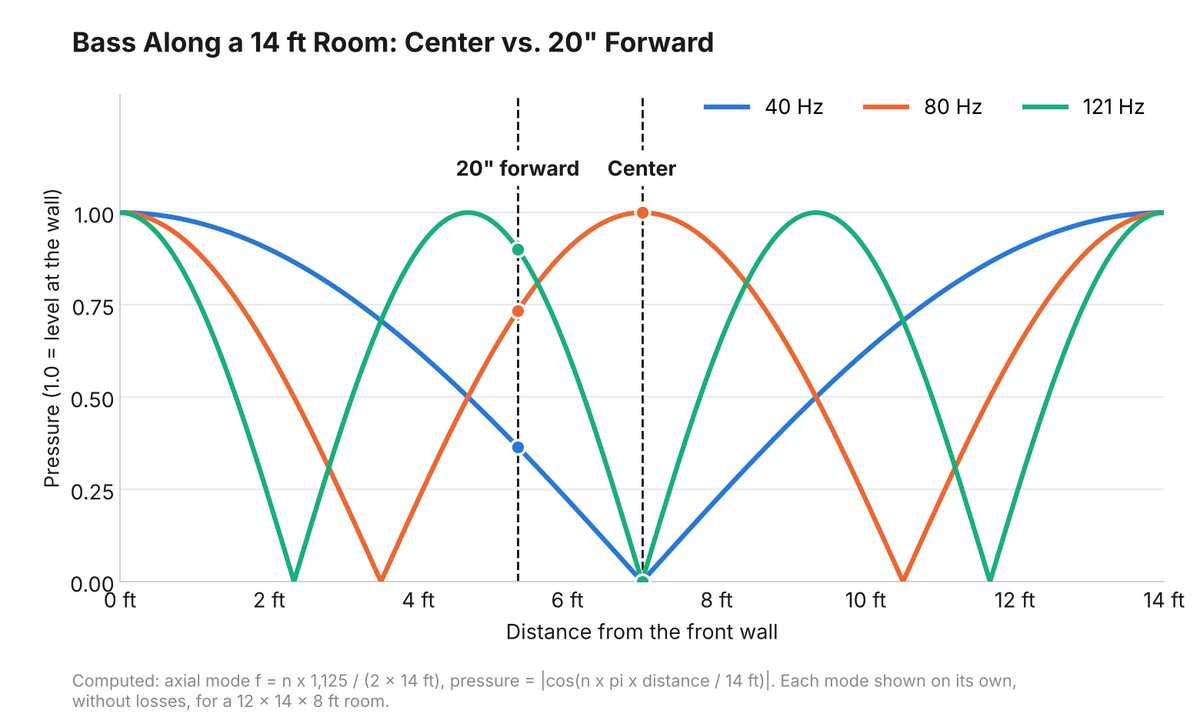
At the center, the 40 Hz and 121 Hz waves cancel and the 80 Hz wave is at full strength. Twenty inches forward, 40 Hz comes back to 9 dB below its level at the wall, 80 Hz drops 3 dB and 121 Hz comes back to within 1 dB.
The chart shows each wave on its own. In a real room the waves add together with the direct sound from the speaker, so a cancellation measures as a deep dip rather than silence.
The distance explains it. In a standing wave, the level goes from a peak to a cancellation over a quarter of a wavelength. At 121 Hz the wavelength is about 112", so peak to cancellation is about 28". At 200 Hz it is about 17". A 20" move covers most of that distance in the upper bass.
A Map of the Room
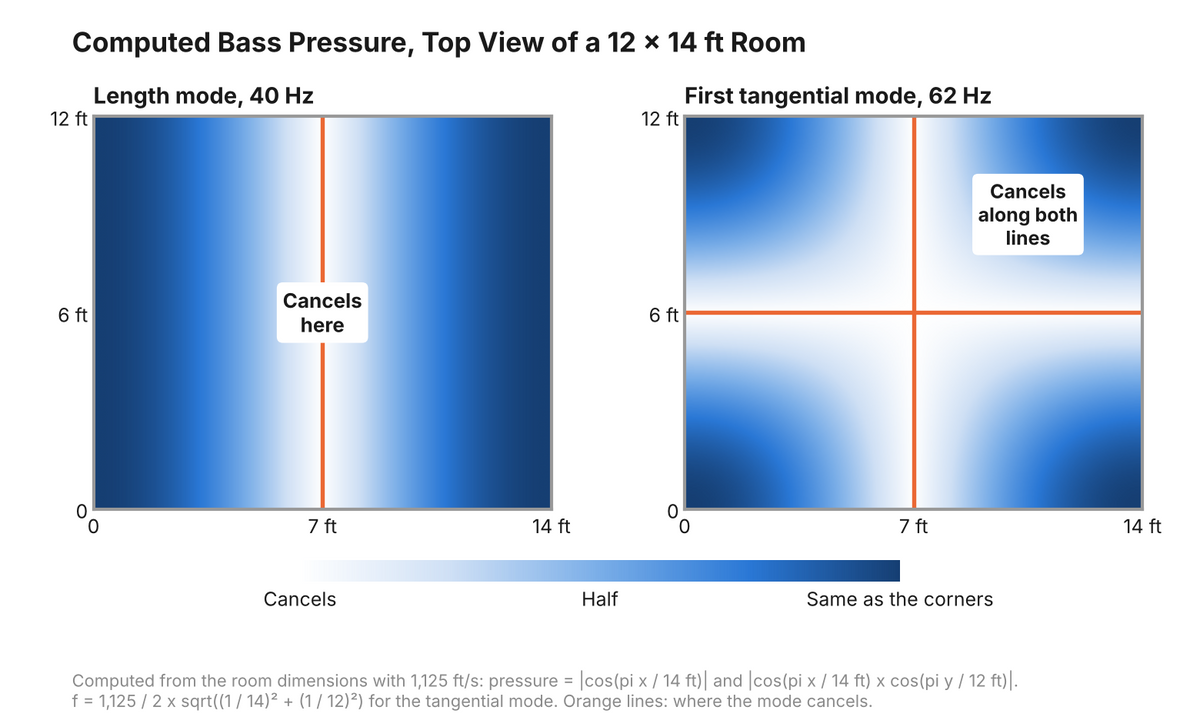
The chart shows two of the same bedroom's modes from above. The 40 Hz length mode is loudest along the front and back walls and cancels along a line across the middle of the room.
The first tangential mode reflects off all four walls and falls at about 62 Hz: 1,125 ÷ 2 x the square root of (1 ÷ 14² + 1 ÷ 12²). It is loudest in the four corners and cancels along two lines that cross at the center of the room. A chair on one of those lines loses that note, and a short move off the line brings it back.
How Deep the Dips Get
Todd Welti and Allan Devantier measured low frequency response at many seats in real listening rooms for a 2006 paper in the Journal of the Audio Engineering Society. In the rooms they tested, the dip at a null was typically around 25 dB deep.
They also found that the response changed significantly from one listening position to another, and that a system with that problem cannot be equalized effectively. A 25 dB dip is a note that has nearly gone away at that seat.
Why Bass Sounds Different in Different Spots
At low frequencies, sound reflects back and forth between the walls, floor and ceiling and sets up standing waves, called room modes. A room mode is a frequency where the reflections line up and reinforce each other. Each mode has places where it is loud and places where it cancels, and their positions are set by the room's dimensions.
The simplest modes run between one pair of parallel surfaces. They are called axial modes, and they fall at:
Axial mode (Hz) = n x 1,125 ÷ (2 x the distance between the surfaces in feet)
Here 1,125 ft/s is the speed of sound at room temperature and n is 1, 2, 3 and so on.
- Each mode is loudest at the two surfaces it runs between, and every mode is loud in the corners.
- The first mode cancels at the middle of the room.
- The second mode is loud at the middle and cancels a quarter of the way in from each wall.
Your seat lands somewhere in that pattern, and so does each speaker. Modes between two pairs of surfaces (tangential) and all three pairs (oblique) add more peaks and dips on top.
What It Means in a Bedroom or Garage Studio
A 12 x 14 ft bedroom with an 8 ft ceiling has these axial modes:
| Direction | 1st Mode | 2nd Mode | 3rd Mode |
|---|---|---|---|
| Length, 14 ft | 40 Hz | 80 Hz | 121 Hz |
| Width, 12 ft | 47 Hz | 94 Hz | 141 Hz |
| Height, 8 ft | 70 Hz | 141 Hz | 211 Hz |
The lowest modes sit in the range of a kick drum and the low notes of a bass guitar. Two modes land together at about 141 Hz, because 12 ft divided by 3 and 8 ft divided by 2 give the same 4 ft half wavelength. When modes stack like that, the peak or dip at that frequency is stronger.
Modes are also spread farther apart in a small room, so there are fewer of them to fill the gaps between peaks and dips.
Above a certain frequency, so many modes overlap that the room behaves more evenly. That point is called the Schroeder frequency, roughly 2,000 x the square root of (decay time in seconds ÷ room volume in cubic meters).
For this bedroom, about 38 cubic meters, that works out to:
- About 180 Hz with a 0.3 second decay.
- About 230 Hz with 0.5 seconds.
Below that, the seat-to-seat swings described above are what you hear.
Most home studios have one seat that matters: the mix chair. You can move that chair and the speakers until the bass at that one spot is as even as you can get it.
What to Do in Your Room
-
Measure Where Your Head Is: Put a measurement mic at ear height at the listening position and run a sweep, with the sub on if you use one.
- Take a few more measurements a few inches away in each direction and average them.
- A single point can show a dip that you won't hear a few inches over.
- Our guide to measuring your room covers the steps.
-
Avoid the Exact Middle: Halfway along the room's length is where the first length mode cancels, and a quarter of the way in is where the second one cancels.
- A third of the way in from the front or back wall sits clear of both. The third length mode is at full strength there, so treat it as a starting point and move in small steps while measuring.
- Our post on speaker and desk placement covers the rest.
- Move the Speakers Too: Each speaker sits in the same pattern as your seat, so moving the speakers and desk a few inches at a time changes the bass at the chair. It costs nothing, so try it before buying anything.
-
Bass Traps in the Corners: Every room mode is loudest in the corners, so bass traps 6" to 12" deep placed where walls meet reach all of them.
- Floyd Toole describes absorption as draining energy from the modes, which results in "reduced pressure maxima and elevated minima."
- The peaks come down, the dips come up and the low end stops ringing as long. The pattern of loud and quiet spots is still there.
- Use EQ Last, for Peaks Only: EQ can cut a peak at one seat. It can't fill a deep dip, because the boost feeds both of the waves that are canceling each other. Read room EQ vs acoustic treatment.
- More Than One Seat: On a couch, or with a producer's desk behind the mix position, the bass will differ between seats. Welti and Devantier showed that two or more subwoofers in the right positions reduce that variation. In a mix room, pick the seat that matters most and set the room up for that one.
Sources
- Todd Welti and Allan Devantier, Low-Frequency Optimization Using Multiple Subwoofers, Journal of the Audio Engineering Society, Vol. 54, No. 5, 2006.
- Floyd E. Toole, Loudspeakers and Rooms for Sound Reproduction: A Scientific Review, Journal of the Audio Engineering Society, Vol. 54, No. 6, 2006.
- Basic Room Acoustic Treatments, Acoustics, Physics LibreTexts.
- University of Southampton, Room Modes, Sound Waves.
- Magne Skålevik, Schroeder Frequency Revisited, Forum Acusticum, Aalborg, 2011.
- Mode frequencies, mode pressure along the room (|cos(n x pi x distance ÷ length)|, and the product of two such terms for the tangential mode), wavelengths and the Schroeder frequency are calculated from the formulas above, using a speed of sound of 1,125 ft/s (343 m/s).
Need a Second Opinion?
Send us your room dimensions, a measurement if you have one, and where you sit through our free room review form. Our panels and bass traps are built to order in North Los Angeles in 50 fabric colors. Reach out to us for design assistance.