

Before you buy any treatment, get your studio monitor placement right. Placement costs nothing, and moving a speaker a few inches can shift its deepest bass dip by almost 100 Hz. This guide covers where to put your studio monitors and desk, and the math behind each guideline.
How Far Should Studio Monitors Be From the Wall?
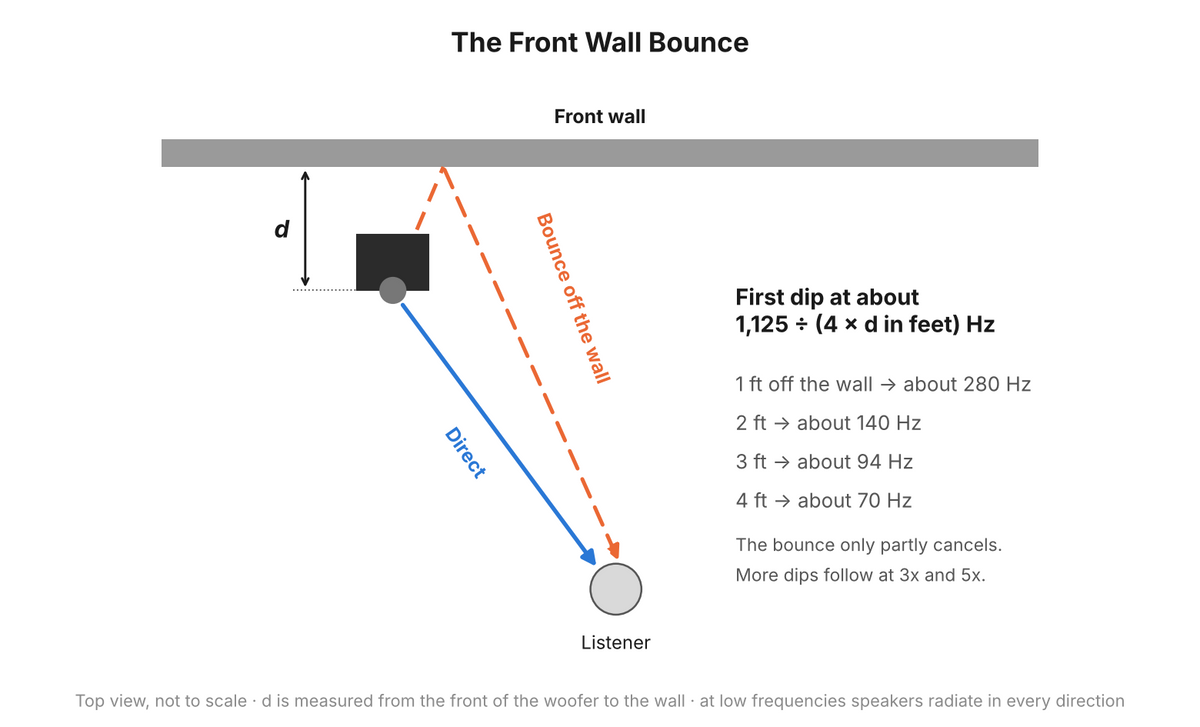
At low frequencies, speakers send sound in every direction, including backward. That sound reflects off the wall behind the speaker and comes back. At the frequency where the trip to the wall and back adds half a wavelength, the reflection arrives out of step with the direct sound and partly cancels it.
This is called speaker boundary interference. The first and usually deepest dip lands at:
1,125 ÷ (4 x distance from the woofer to the wall in feet) = first dip in Hz
The 4 comes from the trip. The sound goes to the wall and back, twice the distance, and the dip lands where that round trip is half a wavelength, so the full wavelength is four times the distance. Measure from the front of the woofer to the wall, because the depth of the cabinet is part of the trip.
For example, a woofer 2 ft from the wall gives 1,125 ÷ (4 x 2) = 1,125 ÷ 8, about 140 Hz.
- 1 ft Off the Wall: About 280 Hz.
- 2 ft Off the Wall: About 140 Hz.
- 3 ft Off the Wall: About 94 Hz.
- 4 ft Off the Wall: About 70 Hz.
More dips follow at three and five times those frequencies. They are usually shallower, because the speaker aims more of its sound forward as frequency rises and less of it reaches the wall.
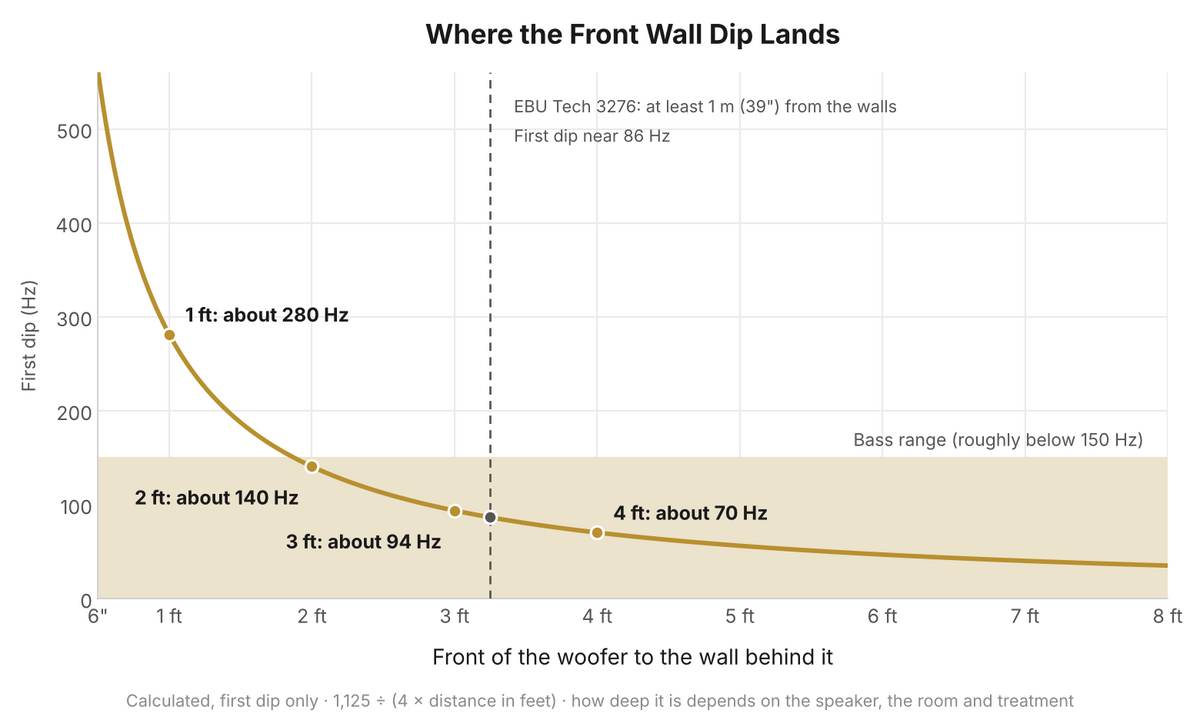
The farther out the speaker goes, the lower the dip lands. That leaves two workable setups:
-
Close to the Wall: With the woofer within about a foot of the wall, the first dip moves up to about 280 Hz or higher. The speaker sends less sound backward at those frequencies, so the reflection is weaker.
- A 4" core panel on the wall behind the speakers reduces what's left, and it reaches lower than a 2" core.
- In most bedroom and garage studios, this is the practical setup.
- Check the speaker's manual for a minimum clearance if it has a rear port.
-
Well Out into the Room: At 8 ft the first dip lands near 35 Hz. The reflection also has much farther to travel, so it arrives weaker and the dips it causes are shallower.
- EBU Tech 3276, the European broadcasters' listening room standard, puts the speakers' acoustic centers at least 1 m (about 39") from the surrounding walls, which puts the first front wall dip near 86 Hz.
- In a 12 ft long bedroom, a speaker 8 ft out is past the middle of the room, so most home studios don't have that space.
From about 2 ft out to about 4 ft, the first dip lands between about 140 and 70 Hz, in the middle of the bass. These figures are for the front wall alone. The other surfaces and the room's own modes change what you hear, so use them to plan and then measure.
Small Moves Change the Bass
Because the dip follows the distance, a few inches move it a long way. At 12" from the wall it lands near 280 Hz. At 18" it lands near 190 Hz. The side walls, the floor and the ceiling each add their own dips at their own distances. When two of those distances match, their dips land at the same frequency and the combined dip gets deeper.
- Avoid Equal Distances: Don't set the woofer the same distance from the front wall, the side wall and the floor.
- Keep It Symmetrical: Mirror the left and right speakers so both see the same room.
- Move in Small Steps: Try changes of a few inches and measure each one.
Don't Sit in the Middle of the Room
A room mode is a standing wave between two parallel surfaces. The lowest one along the length of the room falls at 1,125 ÷ (2 x room length in feet) and cancels at the center of the room.
In a 12 ft long room that is 1,125 ÷ 24, about 47 Hz. Sit at the center and that note can drop sharply.
The second length mode, at twice that frequency, cancels a quarter of the way in from each end wall, so a seat about a third of the way in from the front or back wall avoids both. In a 12 ft room, that is about 4 ft in.
Side to side is different: stay centered between the side walls so both speakers see the same reflections and the stereo image holds.
- EBU Tech 3276 sets a 60° angle between the two speakers as seen from the listening position. With the speakers the same distance from your head, that is an equilateral triangle: the speakers are as far from each other as each one is from you.
- Toe each speaker in so it points at your head.
- The standard also puts the speakers' acoustic centers at least 1.2 m (47") off the floor and aimed at seated ear height, about 1.2 m.
- Its reference rooms use a speaker spacing of 2 to 4 m (about 6.5 to 13 ft). Bedroom setups are usually tighter.
Keep the 60° angle and the symmetry at whatever size fits. Our post on why bass changes from seat to seat covers room modes in more detail.
The Desk Bounce
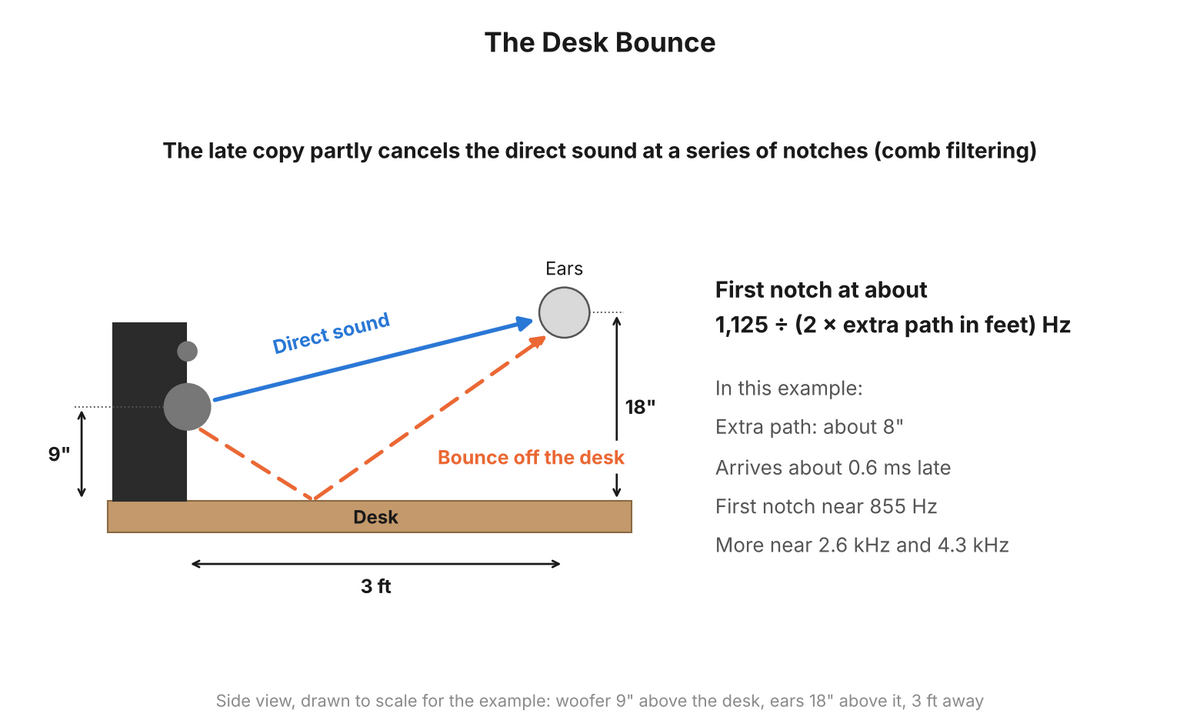
Sound from the speakers also reflects off the desktop and reaches your ears a fraction of a millisecond after the direct sound. Adding a late copy of the same sound cuts a series of notches into the response, starting in the midrange. This is called comb filtering. The first notch lands where the extra path is half a wavelength:
1,125 ÷ (2 x extra path in feet) = first notch in Hz
More notches follow at three, five and seven times that frequency. For example, the woofer sits 9" above the desk, your ears are 18" above it and 3 ft (36") away.
- The direct path is the square root of (36² + 9²), about 37.1".
- The bounce acts as if it came from a mirror image of the woofer 9" below the desk, so it climbs 27" to your ears: the square root of (36² + 27²) is 45".
- That is about 7.9" (0.66 ft) farther, and it arrives about 0.6 ms late.
- The first notch lands at 1,125 ÷ (2 x 0.66), near 855 Hz, with more near 2.6 kHz and 4.3 kHz.
Spreading over the longer path only lowers the bounce by about 2 dB in this example, so the desk reflection is nearly as loud as the direct sound unless the speaker's aim keeps sound off the desk.
For comparison, EBU Tech 3276 asks that reflections arriving within 15 ms of the direct sound be at least 10 dB below it from 1 kHz to 8 kHz.
The usual fixes are the same whatever the numbers:
- Raise and Aim the Speakers: Get them up off the desk surface and aim them at your ears, so less of their sound hits the desk on the way to you.
- Use Stands Behind the Desk: Put the speakers on stands behind the back edge of the desk, so less of the desk sits in the path.
- Keep the Desktop Clear: A large screen or a console in front of the speakers is another reflecting surface in the same path.
The same thing happens off the ceiling. Our post on ceiling cloud placement covers that one.
Measure an Area, Not One Point
Room modes leave peaks and dips spread across the room, and in the upper bass they sit close together. At 200 Hz, the distance from a peak to a dip in a standing wave is a quarter wavelength, about 17". A single measurement at one point can send you chasing a problem that moves when you lean forward.
Put a measurement mic at ear height, take several measurements around the head position and average them. Free room measurement programs can run the sweeps and average the results. Our guide to measuring your room walks through it.
Once the speakers and desk are set, our guide on how many acoustic panels you need picks up from there.
Sources
- EBU Tech 3276, Listening Conditions for the Assessment of Sound Programme Material, May 1998.
- Roy F. Allison, "The Influence of Room Boundaries on Loudspeaker Power Output," Journal of the Audio Engineering Society, 1974.
- F. Alton Everest and Ken C. Pohlmann, Master Handbook of Acoustics, McGraw-Hill.
- Dip, notch, delay and standing wave figures are calculated from the geometry, using a speed of sound of 1,125 ft/s (343 m/s).
Need a Second Opinion?
Send us your room dimensions, where the speakers and desk are now, and a measurement if you have one through our free room review form. Reach out to us for design assistance.