

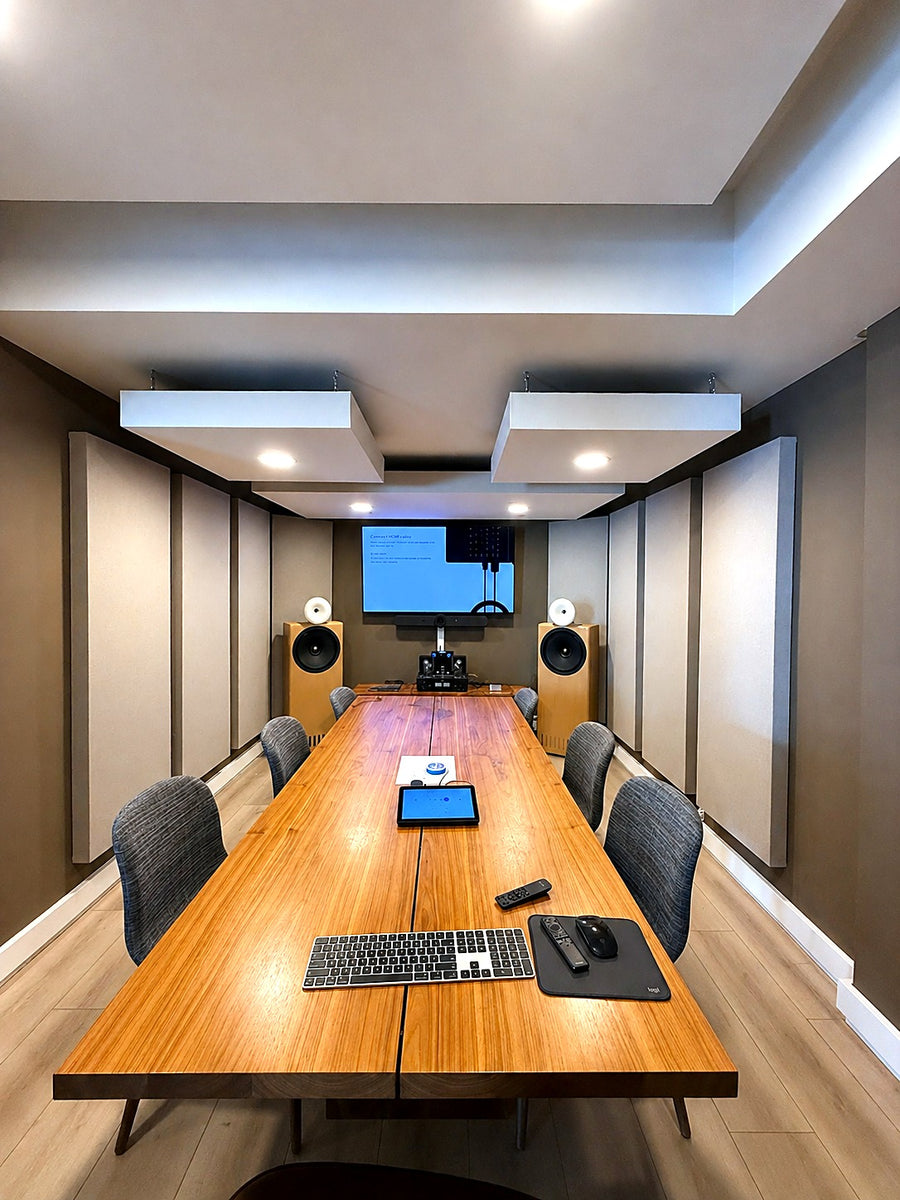
In most mix rooms the ceiling is the largest untreated surface, and it sits between the speakers and your ears. An acoustic ceiling cloud is an absorbing panel hung flat, or close to flat, a few inches to about a foot below the ceiling. It is often skipped, and at a mix position it is one of the most useful pieces of treatment.
Why Treat the Ceiling
Sound from each speaker reaches you directly, and then again a few milliseconds later off the ceiling. That early reflection combines with the direct sound and colors the frequency response at your ears, and it blurs the stereo image.
The numbers for a common setup: speakers and listener on a 5 ft equilateral triangle (each speaker 5 ft from the other and 5 ft from your head), tweeters and ears both about 4 ft off the floor, and an 8 ft drywall ceiling.
- Treat the ceiling as a mirror: the bounce goes 4 ft up and 4 ft back down while it crosses 5 ft of floor, so it travels the square root of (5² + 8²), about 9.4 ft, against 5 ft for the direct sound.
- It arrives about 3.9 milliseconds late: (9.4 minus 5) ÷ 1,125 = 0.0039 seconds.
- From distance alone it is only about 5.5 dB quieter: 20 x log(9.4 ÷ 5) = 5.5.
- Drywall's absorption coefficient, the fraction of sound energy it absorbs from 0 for none to 1 for all, is about 0.04 at 1 kHz, so the ceiling takes almost nothing off it.
The European Broadcasting Union's listening room standard, EBU Tech 3276, asks that reflections arriving in the first 15 milliseconds be at least 10 dB below the direct sound from 1 kHz to 8 kHz.
- Counting distance alone, a bare ceiling over a mix position misses that by about 4.5 dB.
- To close the gap, the cloud can send back no more than about 35% of the sound that hits it, because 10 x log(0.35) is about minus 4.5 dB.
- That means an absorption coefficient of at least about 0.65 across that range.
Published ASTM C423 data for 2" mineral wool board is about 1.0 from 1 kHz to 4 kHz, the top band the data sheets list, so either core depth clears it.
Where to Hang an Acoustic Ceiling Cloud
The spot that matters most is the first reflection point: the place on the ceiling where sound from each speaker bounces down to your head. A ceiling works like a mirror for sound, so you can find the point with a real mirror.
- Sit in the mix position and have someone slide a mirror across the ceiling.
- Wherever you can see a speaker in the mirror is a reflection point.
- Mark both with tape.
When the tweeters and your ears are at the same height, each reflection point sits halfway along the line from that speaker to your head. On the 5 ft triangle above, the two points are about 2.5 ft apart side to side and about 2.2 ft in front of your head. If the tweeters sit lower than your ears, the points move back toward your head.
The cloud should cover both points with room to spare, which usually means from about the front of the speakers back to just behind your head. In a home theater or listening room, the same idea applies to the main seats. In a live room or lounge, clouds are more about bringing down the overall reverberation, so spreading them out matters more than exact placement.
What Size Ceiling Cloud to Use
For a single mix position, a cloud wide enough to cover both reflection points with margin on each side, and long enough to cover the reflection points front to back, is a good starting point.
On the 5 ft triangle, the speakers sit about 4.3 ft in front of your head, so a cloud running from above the speakers to about 1 ft behind your head is a little over 5 ft long. A 4 x 6 ft cloud covers it, 4 ft across the 2.5 ft spread of the reflection points and 6 ft front to back.
Our clouds come in five sizes from 3 x 6 ft up to 4 x 10 ft. Larger rooms often use two or more.
How Far Below the Ceiling to Hang It
Most clouds hang on cables or eye hooks, several inches to about a foot below the ceiling. That air gap above the cloud helps it absorb lower frequencies than it would flat against the ceiling. Our post on the air gap behind acoustic panels shows the published numbers.
How much gap you can leave depends on ceiling height. You need to keep enough headroom below it, and in an 8 ft room that decides for you. Hang the cloud level and keep it over the reflection points you marked.
4" Core or 2" Core
Our Broadband clouds are 5.5" deep with a 4" core. Our Mid / High clouds are 3.5" deep with a 2" core, for rooms with less height to give up.
The difference is in the low mids. In published ASTM C423 data, using the lower of two data sheets, 4" board is 0.60 at 125 Hz and 0.88 at 250 Hz, while 2" board is 0.18 at 125 Hz and 0.75 at 250 Hz. Those are lab values for the board alone. The air gap above a cloud adds to the low end on top of that, most of all for a 2" core.
Adding Light
A cloud takes up the ceiling space where the lights usually go, so we build lighting into them. Any of our clouds can be ordered with two recessed 6" lights, an LED uplight strip that washes the ceiling above, or both, in standard white or Philips Hue. Final wiring to power is done on site by a licensed electrician.
Framed or Fabric Wrapped
Standard clouds are fabric wrapped on the underside and all four sides. If you want the frame to be part of the look, we build red oak and painted pine framed clouds with the fabric in a track, so it can be changed later.
Sources
- European Broadcasting Union, Tech 3276, Listening Conditions for the Assessment of Sound Programme Material (early reflections at least 10 dB below the direct sound within 15 ms, 1 kHz to 8 kHz).
- F. Alton Everest and Ken C. Pohlmann, Master Handbook of Acoustics, McGraw-Hill (typical absorption coefficient for gypsum board).
- Manufacturer published Technical Data Sheet: 6 PCF Stone Wool Multipurpose Board, ASTM C423 Sound Absorption, 2026.
- Manufacturer published Product Data Sheet: Rigid Fiberglass Board, ASTM C423 Type A Sound Absorption Coefficients, Pub. 10021736.
See every option in our ceiling clouds collection, or send us the room through our free room review form. We install clouds across the Los Angeles area. Reach out to us for design assistance.