

Acoustic diffusers do work in small rooms, but only above the frequency their depth was designed for, and only when the listener sits far enough away for the scattered sound to even out. A shallow diffuser does nothing for bass, and on the walls closest to your listening position, absorption is usually the better use of the space.
The published design math explains why a 2" deep pattern panel and a 2 ft deep diffuser do different jobs, and why the wall behind you is a better spot for diffusion than the wall beside you.
What a Diffuser Does
A flat, hard panel sends sound back in one direction, like a mirror. A diffuser breaks that one strong reflection into many weaker reflections spread across the room. It does this without removing much energy, which is why diffusers keep a room sounding live while absorbers make it quieter.
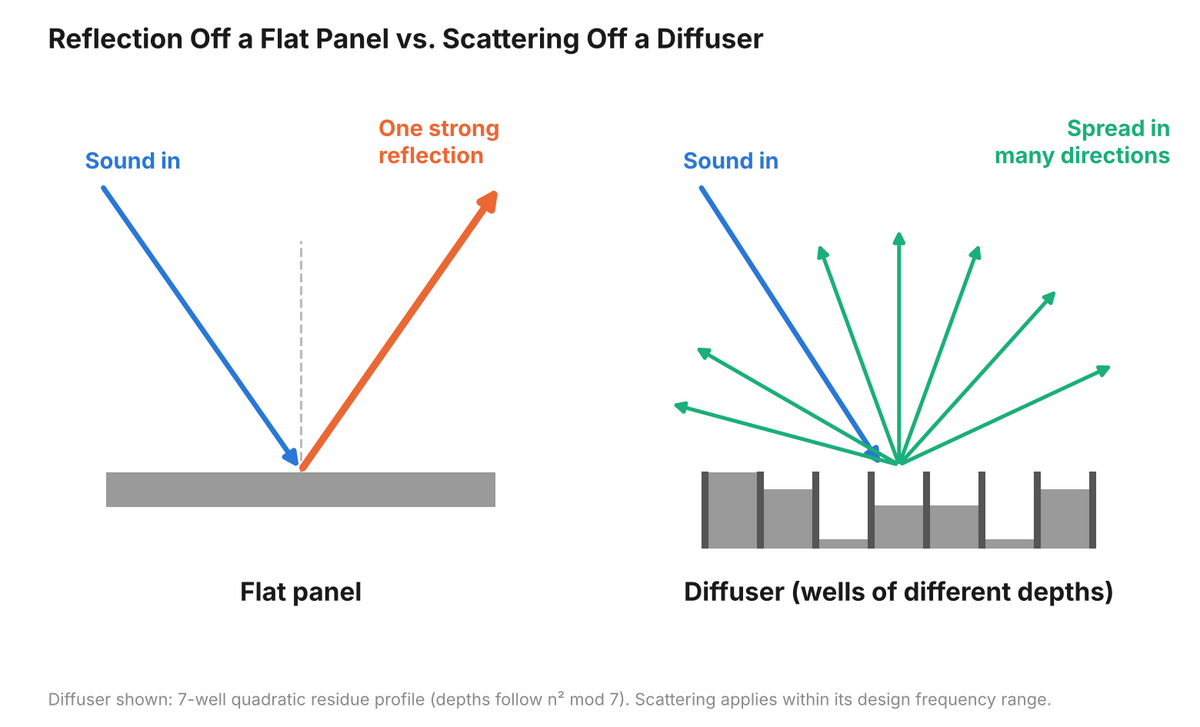
The most studied design is the quadratic residue diffuser: a row of wells separated by thin fins, with each well cut to a different depth. Sound entering the wells comes back out at different times, and that mix of delays is what spreads the reflection.
Diffuser Depth Sets the Lowest Frequency
The well depths come from a published formula: depth = s x λ0 / 2N, where s is the well's number in the quadratic residue sequence, λ0 is the wavelength at the design frequency and N is the number of wells.
Each number in the sequence is the well's position squared, minus whole multiples of N. For 7 wells:
- 0, 1, 4, 9, 16, 25 and 36 become 0, 1, 4, 2, 2, 4, 1.
- So the deepest well is 4/14 of the design wavelength.
The design frequency is the lowest frequency the pattern was built to scatter. Below the design frequency, the wells are too shallow compared to the wavelength to do the job they were designed for.
Two published examples show the scale.
- A 5-well diffuser designed for 500 Hz needs a total thickness of 27.4 cm, about 10.8".
- A 7-well diffuser designed for 500 Hz uses wells up to 0.2 m deep, about 7.9".
The chart and table below use the same formula with c = 1,125 ft per second (343 m/s). Worked through for a 2" deepest well:
- 2" is 4/14 of the design wavelength, so the wavelength is 2 x 14 ÷ 4 = 7".
- Sound travels 13,500" per second (1,125 ft x 12).
- 13,500 ÷ 7 is about 1,930 Hz.
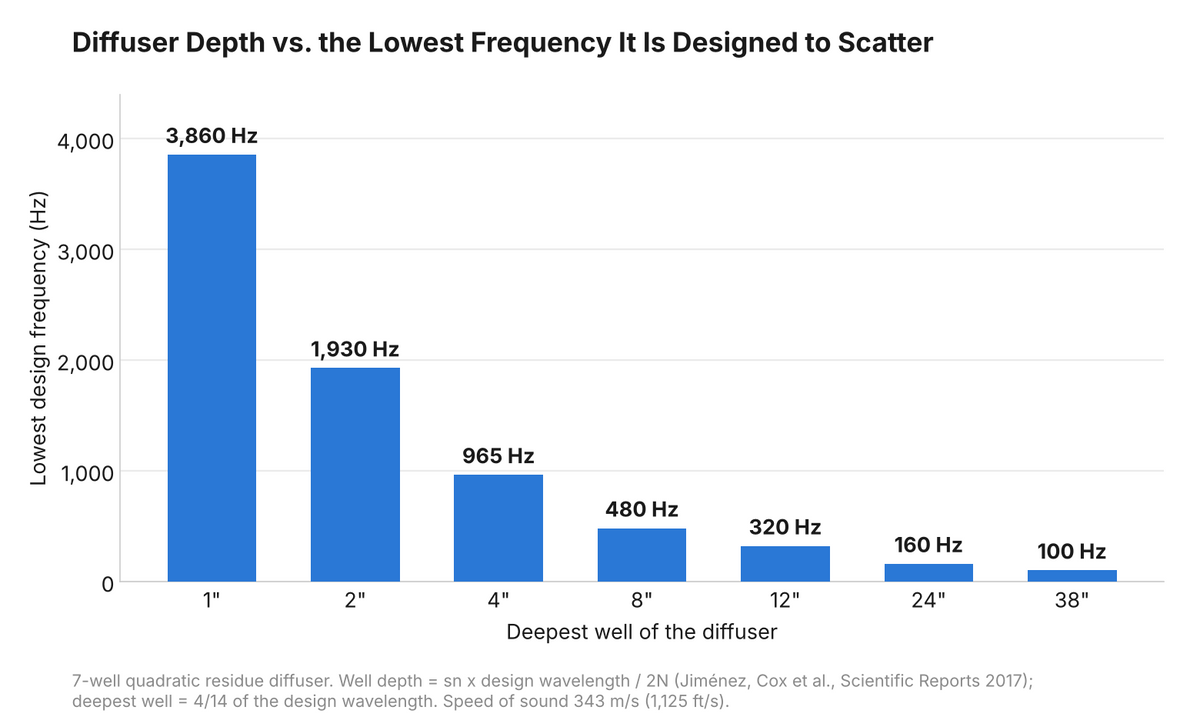
| Deepest Well | Lowest Design Frequency (7-Well Design) |
|---|---|
| 1" | About 3,860 Hz |
| 2" | About 1,930 Hz |
| 4" | About 965 Hz |
| 8" | About 480 Hz |
| 12" | About 320 Hz |
| 24" | About 160 Hz |
| 38" | About 100 Hz |
To scatter 100 Hz with this design, the deepest well has to be about 38" deep. That is more than 3 ft of wall depth, about a third of the width of a 10 x 12 ft bedroom. Even in a 20 x 25 ft room, that is a lot of floor to give up.
A decorative panel with 1" of relief starts working in the upper midrange and does nothing for bass.
In a home room, a diffuser you can hang on a wall is about 4" to 8" deep. By the table, that puts its lowest design frequency between about 480 and 965 Hz. It can help with the midrange and highs. Bass is a job for absorbers.
Compare that with a porous absorber of the same depth. Published ASTM C423 data for 4" board, using the lower of two data sheets, gives absorption coefficients of 0.60 at 125 Hz and 0.88 at 250 Hz, where 1.0 means all the sound striking it is absorbed.
A 4" deep 7-well diffuser is designed to scatter from about 965 Hz up. For the same depth of wall, the absorber reaches much lower. For bass in a small room, read why thin panels don't fix bass.
Well Width Sets the Top End
The width of each well sets the upper limit. The published design rule is a well width of half the shortest wavelength to be diffused. A published design that diffuses up to 5,000 Hz uses wells 0.034 m wide, about 1.3".
Every well diffuser has a working band, set by its deepest well at the bottom and its well width at the top. A product listing that gives neither number gives you no way to check what it does.
Do Diffusers Work in Small Rooms When You Sit Close?
The scattering patterns published for diffusers are far field patterns, measured or calculated at a distance from the panel. In one published study of a 1.32 m wide diffuser, the authors note their far field equation is not accurate at distances much shorter than the Rayleigh distance, the distance beyond which the scattered sound settles into the pattern the far field math predicts.
The even spread shown in a diffuser's data describes what a listener hears from a distance. Sit with your head a foot or two from a diffuser and you are not in that zone.
In a 10 x 12 ft room, the side walls next to your chair are often that close, and the rear wall may be only a few feet behind you. In a bigger room, around 15 x 20 ft and up, the rear wall is usually the one surface with real distance from your head.
Where Diffusion Fits in a Small Room
In a small room, absorption goes first at the first reflection points: the spots on the side walls and ceiling where sound from each speaker bounces straight to your ears. Those reflections arrive a few milliseconds after the direct sound and color what you hear.
Diffusion, if the room has space for it, goes farther from the listener, usually on the rear wall, where it keeps some life in the room without a strong single reflection coming back.
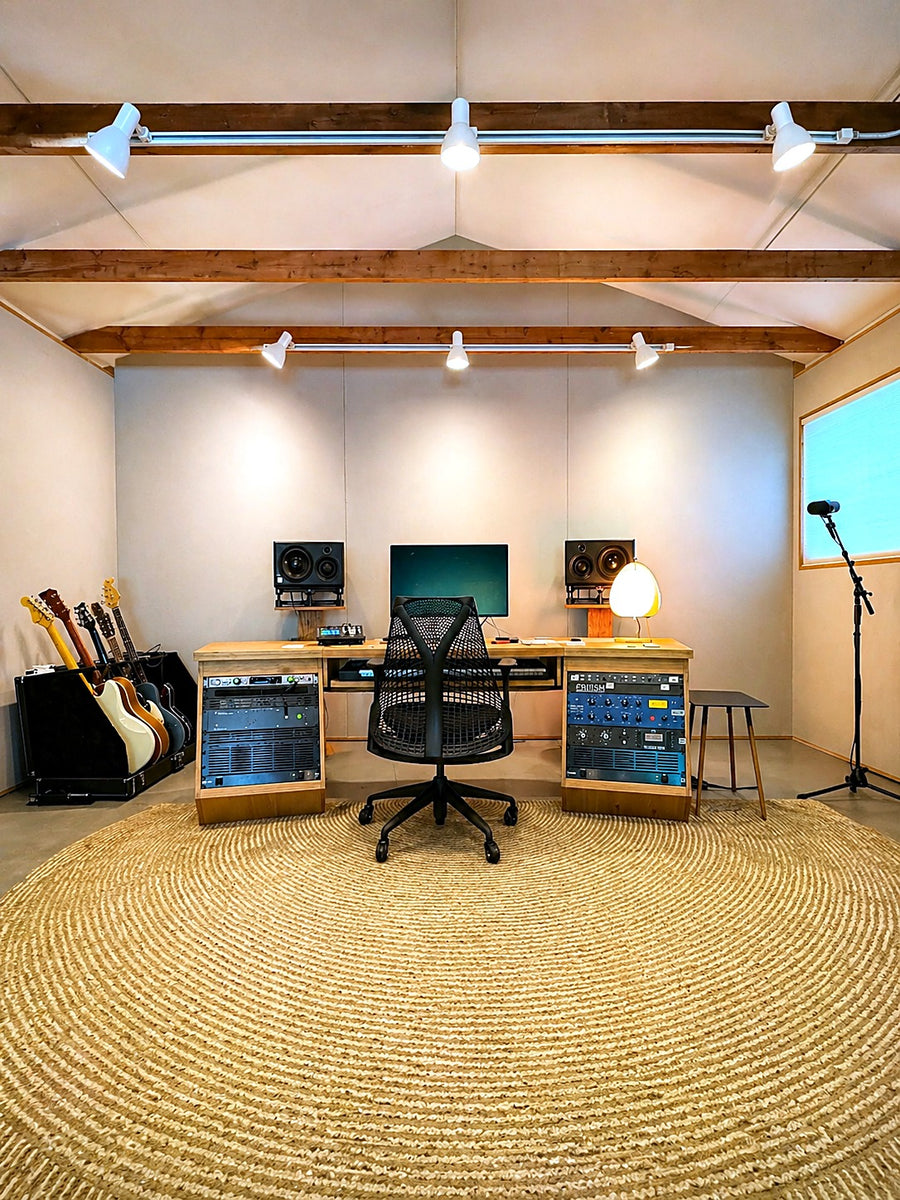
Control room designs that use diffusers follow the same logic. The live end dead end design is named for its absorbent front half around the speakers and its live rear half. In it and the later reflection free zone design, diffusers are used to disperse early reflections that would otherwise arrive with little delay and at a high level.
For more on early reflections, see speaker and desk placement and how to fix flutter echo and slap back.
How to Spot an Inflated Diffuser Claim
- Depth: Ask for the depth of the deepest well. If it is 2", the published formula puts its lowest design frequency near 1,930 Hz for a 7-well design.
- Bass Claims: A well diffuser sold as a bass fix needs feet of depth: about 38" for 100 Hz in a 7-well design.
- Frequency Range: A real diffuser has a stated design frequency and an upper limit set by well width.
- Placement: A diffuser sold for the wall right beside your chair puts you closer than the distance its published scattering data describes.
Practical Tips for a Small Room
- First Reflections: Use absorption on the side walls and ceiling between you and the speakers. See 4" core broadband acoustic panels and ceiling clouds.
- Bass: Most rooms lack bass absorption, so add deep absorbers for the low end, such as corner traps. See bass traps.
- Small Rooms: In a room around 10 x 12 ft, where the rear wall is only a few feet behind your chair, a thick absorber on the rear wall is usually the better use of the space. A given thickness of absorber works to a lower frequency than the same thickness of diffuser.
- Larger Rooms: In a room around 15 x 20 ft up to 20 x 25 ft, where your chair can sit several feet off the rear wall, a diffuser a few inches to about 8" deep on the rear wall can keep the room from sounding dead in the midrange and highs.
- Start With Measurements: Know your room size and your listening distance from the rear wall before buying anything. See how to measure your room.
Sources
- Trevor J. Cox and Peter D'Antonio, Acoustic Absorbers and Diffusers: Theory, Design and Application, 3rd edition, CRC Press, 2017.
- Noé Jiménez, Trevor J. Cox, Vicente Romero-García and Jean-Philippe Groby, Metadiffusers: Deep-Subwavelength Sound Diffusers, Scientific Reports 7, 5389, Nature Publishing Group, 2017.
- Ballestero et al., 3D Printed Quadratic Residue Metadiffuser: Design and Measurements of an Optimized Deep-Subwavelength Sound Diffuser, Proceedings of the 23rd International Congress on Acoustics, 2019.
- Pardo-Quiles, Rodríguez-Rodríguez and Rodríguez, Design of Optimal Sound Absorbers Using Acoustic Diffusers for Multipurpose Auditoriums, Acoustics 6(1), MDPI, 2024.
- Trevor J. Cox and Peter D'Antonio, A Brief History of Room Acoustic Diffusers, Acoustics Today, Acoustical Society of America, July 2006.
- Manufacturer published Technical Data Sheet: 6 PCF Stone Wool Multipurpose Board, ASTM C423 Sound Absorption, 2026.
- Manufacturer published Product Data Sheet: Rigid Fiberglass Board, ASTM C423 Type A Sound Absorption Coefficients, Pub. 10021736.
Need a Second Opinion?
Send us your room dimensions, photos and what you're hearing through our free room review form. Our panels and bass traps are built to order in North Los Angeles in 50 fabric colors. Reach out to us for design assistance.