

Porous fill absorbs little at 125 Hz and below unless it is deep. On published data sheets for 6 PCF rigid board, a 2" core absorbs 0.18 of the sound that hits it at 125 Hz and essentially all of it at 1 kHz. This guide to porous vs. tuned bass traps covers why the two behave differently and how deep porous fill needs to be.
Porous Absorbers Need Moving Air
Insulation absorbs sound mostly by friction. Air is pushed back and forth through the fibers and loses energy as heat. That only works where the air is moving. The speed of that motion is called particle velocity, and at a hard wall it is zero, so a thin panel mounted flat to the wall sits where bass does the least work inside it.
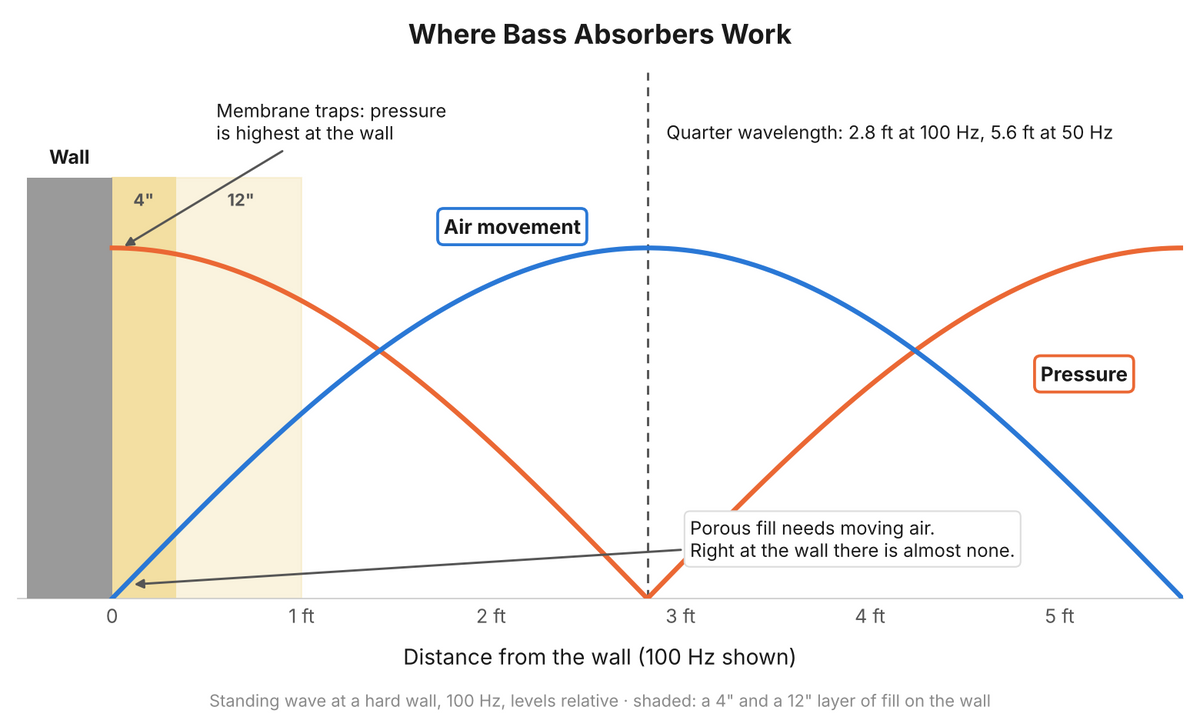
Away from the wall, particle velocity builds and peaks a quarter wavelength out. With sound at about 1,125 feet per second, that is about 2.8 ft at 100 Hz and 5.6 ft at 50 Hz. No home room can give up that much depth to a trap.
A common rule of thumb in the acoustics literature is that a porous absorber needs to be at least a tenth of a wavelength thick to be effective, which is about 14" at 100 Hz and 27" at 50 Hz.
Real bass traps in a bedroom or garage studio are roughly 6" to 12" deep, set in the corners or across them. That is less than the rule of thumb for the lowest notes, which is why fill choice, corners and coverage matter, and why tuned traps exist.
How Deep Should a Bass Trap Be?
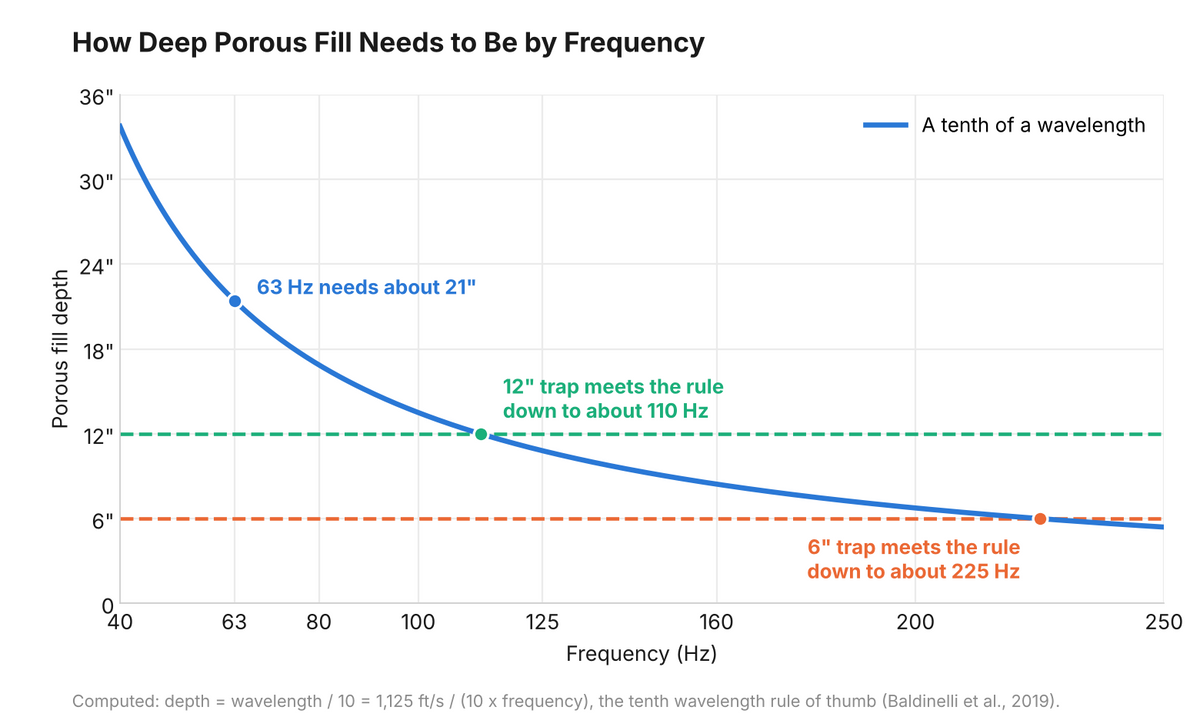
The chart applies the tenth wavelength rule to trap depth. A 6" deep trap meets it down to about 225 Hz and a 12" trap down to about 110 Hz. For 63 Hz the rule asks for about 21".
Below the frequency where a trap meets the rule, it still absorbs, but less, like the 2" board in the opening example. A trap deeper than about a foot rarely fits a home room.
Flow resistivity is how hard it is to push air through a material, per unit of thickness. Fill that resists airflow too much reflects part of the sound at its face instead of letting it in. Measurements on wool absorbers found the best absorption when thickness times flow resistivity is about 1,000 rayls (Pa·s/m, the unit of airflow resistance).
- For a 12" (0.3 m) deep trap, that works out to 1,000 ÷ 0.3, a flow resistivity of about 3,300 Pa·s/m².
- A 6" (0.15 m) trap works out to about 6,600 Pa·s/m², twice as resistive.
The deeper the trap, the lighter the fill should be.
Tuned Membrane Traps Work Off Pressure
A membrane trap works the other way around. It is a sealed box with a limp, heavy membrane across the front. It responds to sound pressure instead of air movement, and pressure is highest right at the wall, so it can work there at depths where porous fill does little.
The membrane is a mass and the sealed air behind it is a spring. The resonant frequency is approximately f = 60 / √(m × d), with m the membrane's mass in kg per square meter and d the air space depth in meters.
A membrane of about 4.9 kg per square meter (1 lb per square foot) over 0.10 m (4") of air gives 60 ÷ √(4.9 × 0.10), about 85 Hz. A heavier membrane or a deeper box tunes it lower. Below and above that band, it absorbs much less. Our post on diaphragm absorbers vs. membrane bass traps works through the US unit version.
Our Membrane Bass Trap comes in four tunings, 45, 60, 70 and 85 Hz, with predicted absorption graphs on each page.
Area Matters Too
A room mode is a frequency at which sound reflecting between surfaces reinforces itself. It presses on large areas of wall at once, and an absorber only works on the part of that area it covers. A full wall of treatment does more than two corner pieces of the same depth.
Corners are a good place to start, because every mode has a pressure maximum in the corners where two walls meet the floor or ceiling. A 2 ft wide corner trap still covers only 2 ft of wall.
Which One to Use
- Broad Low End Control: Porous traps and Diaphragm Bass Traps. The 9" and 12" Diaphragm Bass Traps are predicted to work from about 80 Hz up on 2 ft wide traps and about 60 Hz up on 3 ft and wider.
- One or Two Frequencies Ringing Long: A Membrane Bass Trap tuned to them.
- Not Sure Which: Measure first. A measurement mic and free room measurement software show which frequencies ring longest at the listening position. Our guide to measuring your room walks through it.
Sources
- Trevor Cox, Choosing & Using Porous Absorbers, Sound On Sound, July 2015.
- Trevor J. Cox and Peter D'Antonio, Acoustic Absorbers and Diffusers: Theory, Design and Application, CRC Press.
- Manufacturer published Technical Data Sheet: 6 PCF Stone Wool Multipurpose Board, ASTM C423 Sound Absorption, 2026.
- Manufacturer published Product Data Sheet: Rigid Fiberglass Board, ASTM C423 Type A Sound Absorption Coefficients, Pub. 10021736, 2026.
- G. Baldinelli et al., "Building Envelope," Handbook of Energy Efficiency in Buildings, Butterworth-Heinemann, 2019 (tenth wavelength rule of thumb, particle velocity at a boundary).
- J. António, chapter in Fibrous and Composite Materials for Civil Engineering Applications, Woodhead Publishing, 2011 (optimum flow resistivity).
- Depths in the chart are calculated as a tenth of the wavelength, 1,125 ft/s ÷ (10 x frequency), using a speed of sound of 1,125 ft/s (343 m/s).
- T. Fidecki, Room Acoustics and Sound Reinforcement Systems, Warsaw University of Technology (membrane absorber resonance, mode pressure in corners).
Need a Second Opinion?
Send us your room dimensions, a measurement if you have one, and what you're hearing through our free room review form. Our panels and bass traps are built to order in North Los Angeles in 50 fabric colors. Reach out to us for design assistance.