

A bare room with hard surfaces rings for a long time. In published measurements, an empty room with painted concrete-block walls took 3.3 seconds to die away at 1 kHz, and a 3,050 cu ft research room with hard walls and a hard ceiling over an absorbent floor took about 0.7 to 0.8 seconds. The reference rooms European broadcasters use to judge sound aim for 0.2 to 0.4 seconds.
This guide covers how decay time, or RT60, is measured, what the RT60 target is for your room size and how much absorption it takes to get there.
What Decay Time Means
Decay time, also called reverberation time or RT60, is how long a sound takes to fade by 60 dB after the source stops. The measurement standard for ordinary rooms, ISO 3382-2, defines it that way. Most rooms don't have 60 dB of clean decay above the background noise, so the decay is measured over part of its range and stretched to 60 dB:
- T20: The decay from 5 dB to 25 dB below the starting level, multiplied by 3.
- T30: The decay from 5 dB to 35 dB below the starting level, multiplied by 2.
Both are estimates of the same 60 dB decay time. T20 needs less clean decay, so it works in noisier rooms. Decay time is measured band by band, in octaves or 1/3 octaves, because a room can ring much longer at one frequency than another.
Measured Rooms
| Room | Volume | Measured decay at 1 kHz |
|---|---|---|
| University room, painted concrete-block walls, bare concrete floor | About 7,900 cu ft | 3.3 s |
| Same room with carpet on the floor | About 7,900 cu ft | 1.6 s |
| Research room, hard walls and ceiling, absorbent floor | About 3,050 cu ft | 0.73 s |
| Same research room, every surface absorbent | About 3,050 cu ft | 0.14 s |
Across the octaves from 500 Hz to 4 kHz, the hard research room measured 0.68 to 0.81 seconds. Carpet cut the concrete-block room's decay at 1 kHz roughly in half, which shows how much one large absorbent surface does in the mids and highs.
For scale, a 12 x 14 ft bedroom with an 8 ft ceiling is about 1,350 cu ft. A 20 x 20 ft garage with a 9 ft ceiling is about 3,600 cu ft, close to the research room. A smaller room with the same hard surfaces rings for less time, but its target is lower too, so the gap is still there.
The RT60 Target by Room Size
EBU Tech 3276, from the European Broadcasting Union, sets a decay target for reference listening rooms that grows with the room's volume: 0.25 x (volume ÷ 100 cubic meters) to the 1/3 power, in seconds. It is averaged over the 1/3 octave bands from 200 Hz to 4 kHz, and the target must lie between 0.2 and 0.4 seconds:
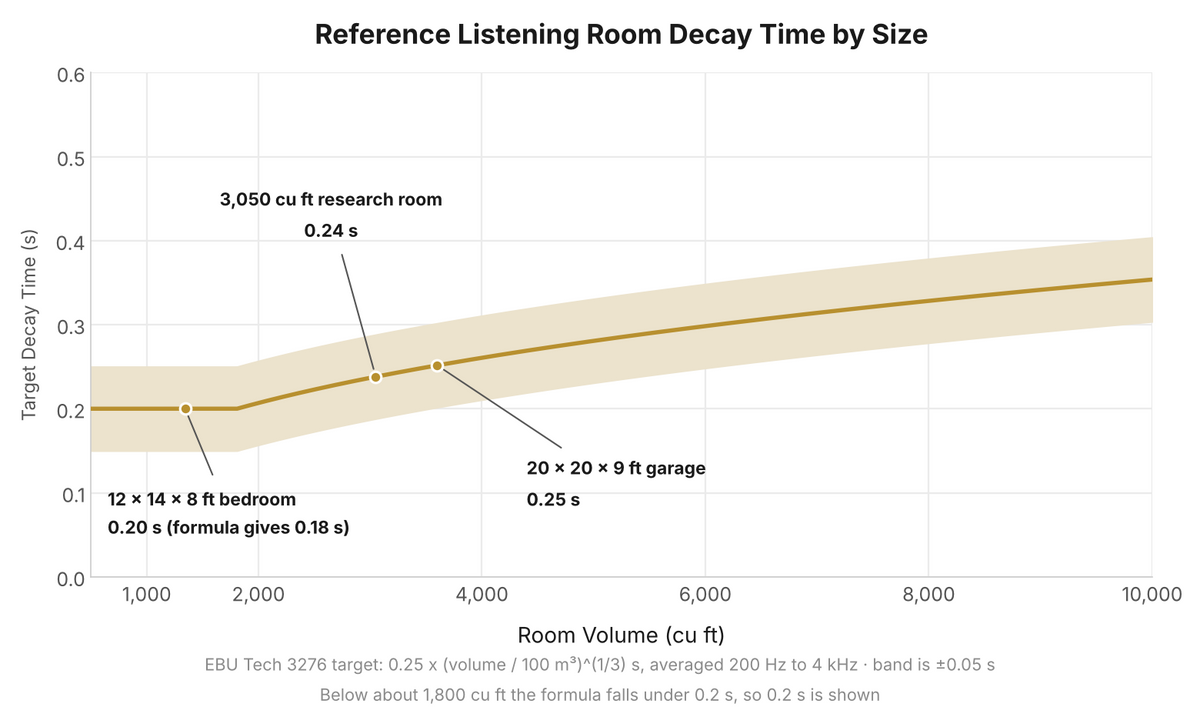
- 12 x 14 x 8 ft Bedroom: 1,344 cu ft is about 38 cubic meters. 38 ÷ 100 = 0.38, its cube root is about 0.72, and 0.25 x 0.72 = 0.18 s. That is below the 0.2 s floor, so 0.2 s is the working target.
- 20 x 20 x 9 ft Garage: About 0.25 s.
- The 3,050 cu ft Research Room Above: About 0.24 s, so with hard walls and ceiling it rang about three times longer than the target at 1 kHz.
The standard also limits how far each band can stray from the target. Each 1/3 octave band should stay within a tolerance mask from 63 Hz to 8 kHz, which is tightest from 200 Hz to 4 kHz, where ITU-R BS.1116 allows 0.05 seconds either way.
Neighboring 1/3 octave bands from 200 Hz to 8 kHz should differ by less than 0.05 seconds. The smallest room the EBU document covers is a high quality control room with at least 30 square meters of floor, about 320 sq ft, so most home studios are smaller than its rooms.
How Much Absorption It Takes
Sabine's formula estimates decay time from the room's volume and the total absorption in it:
Decay time (s) = 0.049 x volume in cu ft ÷ absorption in sabins
A sabin is one square foot of surface that absorbs all the sound that hits it. In metric units the formula is 0.161 x volume in cubic meters ÷ absorption in square meters.
Turned around, the absorption needed is 0.049 x volume ÷ target decay time. For the 12 x 14 x 8 ft bedroom:
- At 0.2 seconds, that is 0.049 x 1,344 ÷ 0.2, about 330 sabins.
- At 0.3 seconds it is about 220.
- The room has about 750 sq ft of wall, floor and ceiling.
- So the 0.2 second target means the room's surfaces have to absorb, on average, a bit over 40% of the sound hitting them in every band from 200 Hz up.
That is a lot of coverage, which is why a few panels on the side walls don't get a small room to the target on their own.
Use the result as a starting count and check it with a measurement. In the concrete-block room above, the measured decay at 1 kHz ran about 0.7 seconds longer than Sabine's formula predicted, both bare and carpeted.
One Room, Three Ways
The research room in the table, 6 x 6 x 2.4 m (about 20 x 20 x 8 ft), is lined with double-sided panels: a hard laminate face on one side and perforated panels over rock wool on the other. The floor stays absorbent. The authors published decay times for ten combinations of hard and absorbent surfaces. The chart shows three of them against the reference target for a room that size:
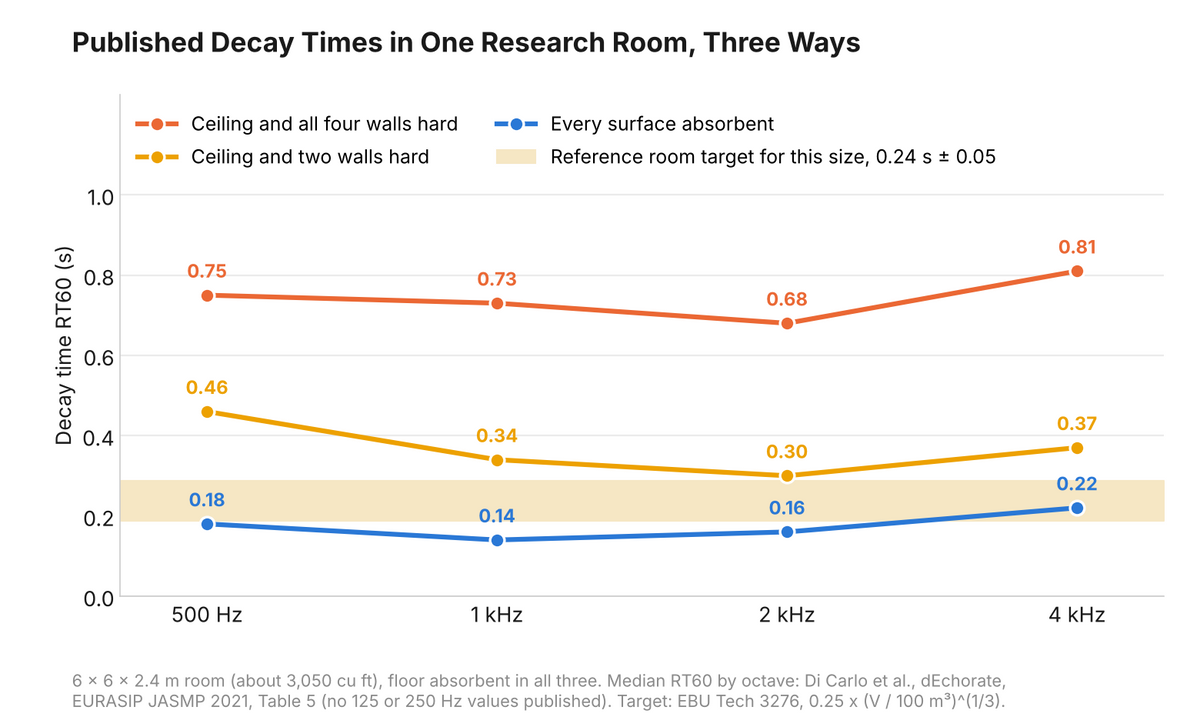
- Ceiling and All Four Walls Hard: 0.68 to 0.81 s, about three times the target.
- Ceiling and Two Walls Hard: 0.30 to 0.46 s. Turning two walls absorbent cut the decay at 1 kHz from 0.73 s to 0.34 s.
- Every Surface Absorbent: 0.14 to 0.22 s, at or under the target band.
The authors did not publish values at 125 Hz and 250 Hz, because their recordings did not carry enough energy there for a reliable estimate. Home wall panels are usually 2" or 4" thick, hung flat on Z-clips with a 1/2" to 1" gap. They still bring the mids and highs down as you add them. The bass is where thinner panels fall short, which the next section covers.
Bring the Bass Down With the Rest
A room that meets the average target can still fail the tolerance mask band by band. Thin panels bring the mids and highs down quickly but leave the bass ringing, so the room sounds dead and boomy at the same time.
A porous absorber works on moving air, and in front of a hard wall the air moves fastest a quarter wavelength out, which is about 27" at 125 Hz. That is why bass control means deep bass traps in the corners.
Our post on why thin panels don't fix bass shows this in published lab data. Plan the bass treatment first, then add panels for the mids and highs until the decay is even.
How to Check Your Room
- Measure It: A measurement mic with its calibration file and a free room measurement program will show T20 or T30 in each octave from a sine sweep. Our guide to measuring your room walks through it.
- Compare It to Your Size: Work out the room's volume, find your target on the room size chart above and see which bands are furthest off.
- Start With What's in the Room: A rug on a hard floor, a couch and a bed absorb some of the mids and highs at no cost. A rug is well under 1" thick, so it does almost nothing in the bass.
- Treat the Longest Bands First: In a room that already has some panels, that is usually the bass. In a bare room, it is every band.
Sources
- EBU Tech 3276, Listening Conditions for the Assessment of Sound Programme Material, May 1998.
- D. Di Carlo, P. Tandeitnik, C. Foy, A. Deleforge, N. Bertin, S. Gannot, dEchorate: a calibrated room impulse response dataset for echo-aware signal processing, EURASIP Journal on Audio, Speech, and Music Processing, 2021 (room description and published reverberation times, Table 5).
- ISO 3382-2:2008, Acoustics, Measurement of room acoustic parameters, Part 2: Reverberation time in ordinary rooms.
- Andreas Silzle and Michael Leistner, Room Acoustic Properties of the New Listening-Test Room of the Fraunhofer IIS, DAGA 2010 (ITU-R BS.1116 tolerance).
- Daniel A. Russell, Acoustics and Vibration Animations: reverberation time of a small room and Sabine equation, Graduate Program in Acoustics, Penn State.
- Volumes, targets, sabins and wavelengths are calculated from the formulas above, using a speed of sound of 1,125 ft/s (343 m/s). The imperial Sabine constant is 0.161 x 0.3048.
Need a Second Opinion?
Send us your room dimensions, a measurement if you have one, and what you're hearing through our free room review form. Our panels and bass traps are built to order in North Los Angeles in 50 fabric colors. Reach out to us for design assistance.