

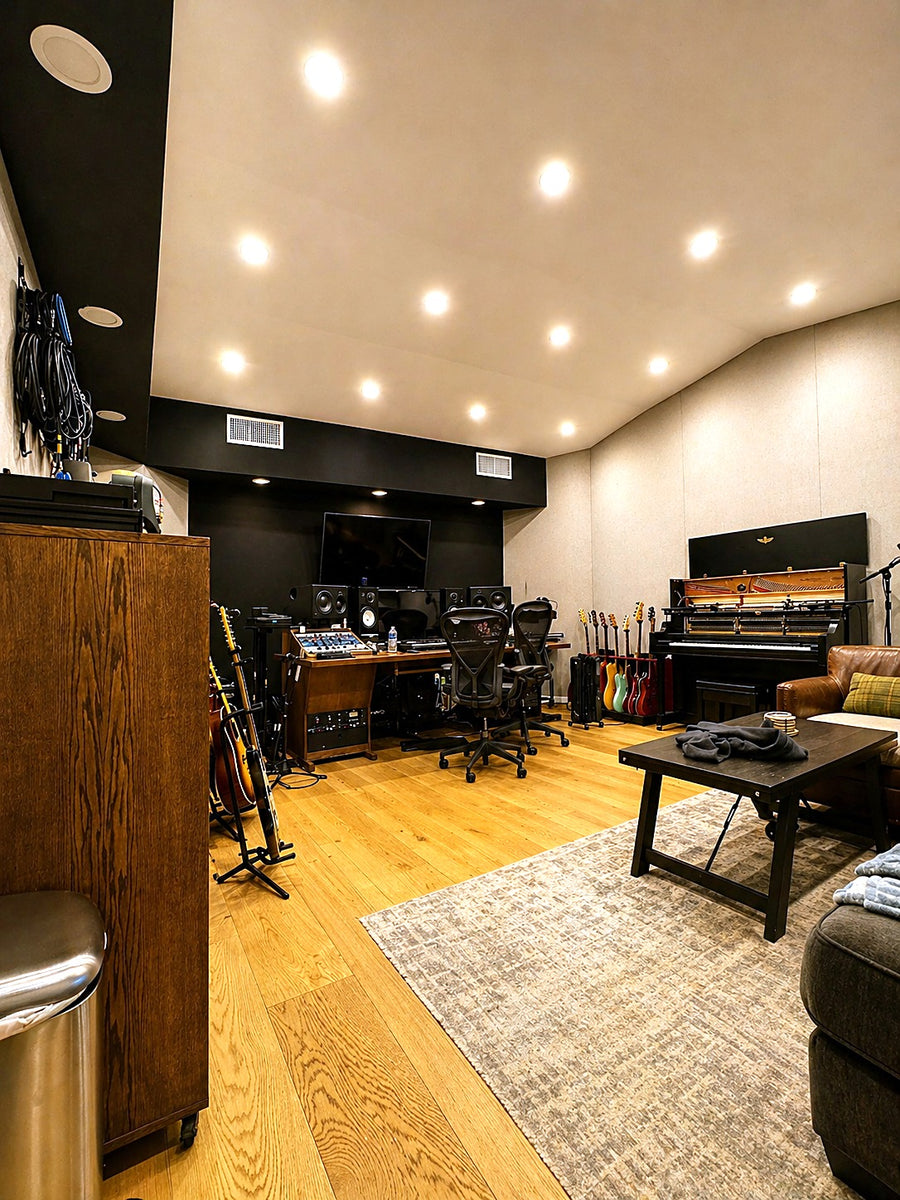
A fabric track wall has no panels hanging on it. The whole surface is fabric, stretched tight over absorption, running wall to wall and around corners. This is how the system goes together, how one of our jobs runs, and what we need from you to do it well.
What a Fabric Track System Is
A track, a thin profile with a jaw that grips the fabric edge, is fastened around the edges of the wall and along every seam line. The space inside the track is filled with acoustic absorption, usually rigid mineral wool or fiberglass board cut to fit, at the depth that surface needs. Acoustically transparent fabric is then stretched and tucked into the track. The result reads as a finished wall.
Because the fabric is tucked rather than glued or stapled, it can be taken out and replaced later. To change the color, the old fabric is pulled and new fabric is tucked into the same track over the same infill.
Why Choose Track Over Panels
- The Finish: Seamless, wall to wall, with no gaps or panel edges.
- Coverage: The absorption can be set surface by surface, deeper where the room needs bass control and thinner where it doesn't.
- Awkward Shapes: Track follows angled ceilings, soffits, corners and openings that panels can't.
- Theaters and Client Facing Rooms: Anywhere the room has to look finished as well as sound right. See home theater vs. recording studio acoustics.
How Deep the Infill Should Be
Depth sets how low the wall absorbs. In published ASTM C423 lab data, using the lower of two data sheets:
- 2" board measures 0.18 at 125 Hz and 0.75 at 250 Hz.
- 4" board measures 0.60 at 125 Hz and 0.88 at 250 Hz.
An absorption coefficient is the fraction of sound a surface absorbs, and 1.0 means it absorbs all the sound that hits it. Both thicknesses reach 1.0 from 500 Hz to 2,000 Hz.
So 2" of infill handles flutter and the upper mids, and 4" or more reaches into the low mids. Bass trapping needs more depth again, which is why the corners of a treated room are often framed out deeper than the flat walls. Our post on why thin panels don't fix bass explains the depth.
The fabric itself has to let air through. If you can't breathe through it easily, sound won't go through it either, and the absorption behind it is wasted.
How Long It Takes
On a retrofit, where the room already exists, most fabric track jobs take a few weeks. It depends on the scope: one wall behind a console is a very different job from a full room with a sloped ceiling, bass traps and lighting built in.
What the Job Site Needs
Fabric track is built on site, so a lot of the job happens in or near your room. What makes it go smoothly:
- Good Parking and Access: We bring in tools, lumber, insulation and rolls of fabric.
- A Place to Set Up: Often the room we're working in is also where we have to cut and prep, and that gets cramped. A garage, driveway or spare room nearby to lay out tools and materials helps.
- A Clear Room: Furniture and gear out of the way on work days.
- Power: Power on site for saws and tools.
Fabric Over a Wall vs. a Built Out, Treated Wall
Two different jobs both get called a fabric track wall, and they are priced differently.
- A Fabric Finish Over the Existing Wall: Track is stapled straight to the drywall, or to the framing where there is no drywall, such as a furred out acoustic wall. Whatever depth is behind the fabric does the absorbing. This sits at the low end of the cost range.
- A Built Out, Properly Treated System: Each surface is framed out to the depth the room needs and packed with rigid mineral wool. Bass trap cavities are built into the corners, and then the whole thing is tracked and wrapped. With corner bass traps and lighting built in, this sits at the high end.
The built out system costs more because the framing, the deeper infill and the corner traps are added treatment, with the depth set surface by surface for what the room needs. The fabric finish uses the depth the wall already gives you. That is the right call in some rooms, and it does less acoustically.
What a Fabric Track Wall Costs
Most full room fabric track jobs land between $20,000 and $50,000. They go higher when there's a lot of high end finish work: custom lighting, trim, diffusers. For how fabric track compares with panels on price, see how much acoustic treatment costs in Los Angeles.
Sources
- Manufacturer published Technical Data Sheet: 6 PCF Stone Wool Multipurpose Board, ASTM C423 Sound Absorption, 2026.
- Manufacturer published Product Data Sheet: Rigid Fiberglass Board, ASTM C423 Type A Sound Absorption Coefficients, Pub. 10021736.
Thinking About a Fabric Wall?
Send us photos and dimensions of the room through our free room review form, or call (818) 217-1653. We design and install fabric track systems across Los Angeles and Ventura County. Reach out to us for design assistance.