

How much acoustic treatment costs depends on the room. Below are the ranges we see on acoustic treatment jobs in Los Angeles, and what moves a project from one end to the other.
These figures are for treatment: panels, bass traps, clouds and fabric walls, supplied and installed. Sound isolation and construction are a separate budget. If you're not sure which you need, read soundproofing vs. acoustic treatment first.
What Acoustic Treatment Costs in Los Angeles
- A Single Room Done Right, Entry Level: Around $5,000 for panels and installation.
- A Medium Room, Around 250 to 300 Square Feet: $15,000 to $20,000 is a reasonable budget.
- Panel Jobs in General: Usually don't go past $20,000 to $25,000, depending on the size of the room.
- Fabric Track Walls: Most full rooms land between $20,000 and $50,000. Fabric over an existing wall sits at the low end, and walls framed out to depth with bass traps built in sit at the high end.
- A Home Theater, Panels and Bass Traps: About $4,000 to $18,500 installed in the Los Angeles area, depending on room size and how much control the room needs.
- A Home Theater, Fabric Track on the Side and Rear Walls: About $9,000 to $34,000 installed, depending on room size.
- A Large Home Theater with a Built-out Front Wall and Velour Curtains: Around $40,000.
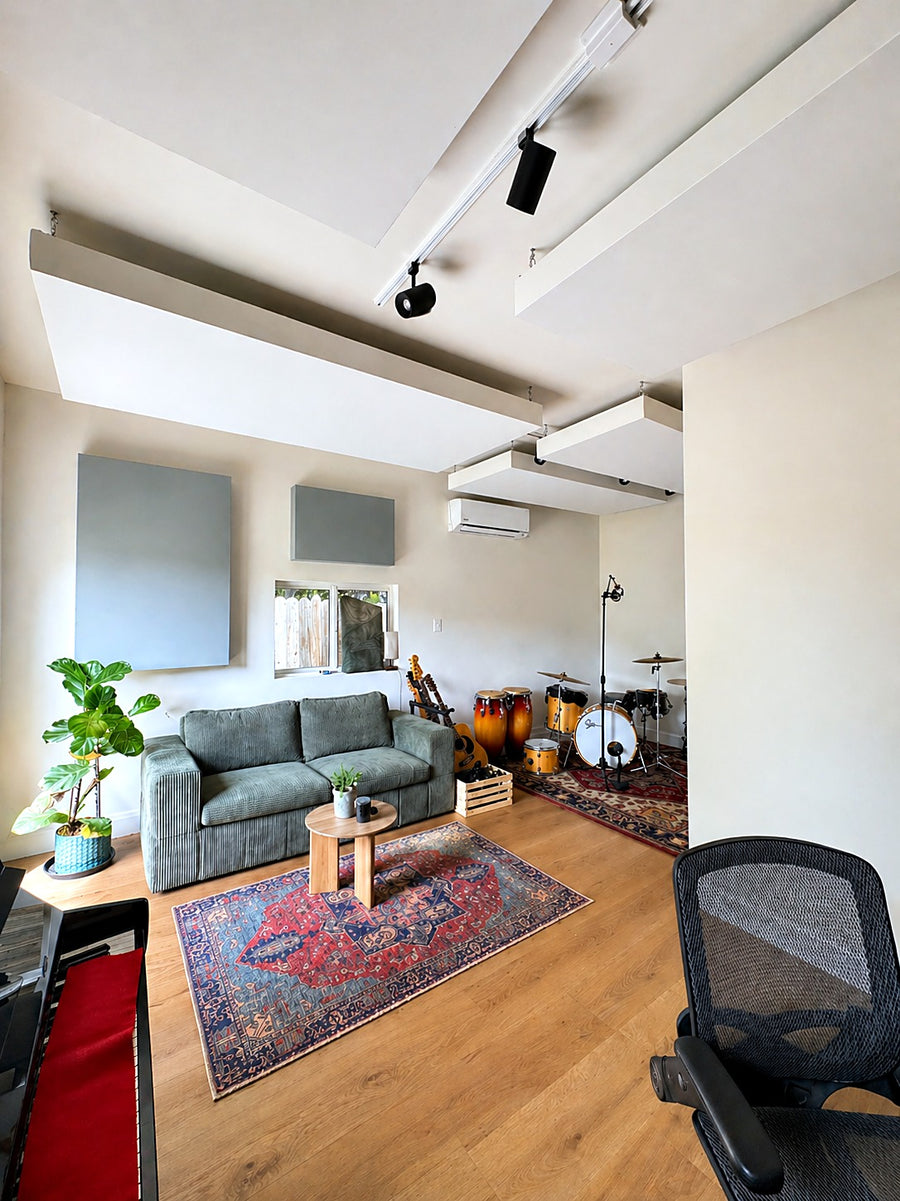
What Pushes the Number Up
Room Size and Ceiling Height: More surface means more treatment. A tall ceiling puts clouds on longer hanging hardware and takes more labor to hang them.
How Much Low End Control the Room Needs: Small rooms almost always need serious bass trapping. In a domestic-size room, Floyd Toole puts the transition frequency at around 200 to 300 Hz. Below it, room modes, the resonances set by the room's dimensions, dominate what you hear at the listening position.
Bass wavelengths are long:
- At 100 Hz the wavelength is 1,125 ÷ 100 = 11.25 ft.
- A porous absorber, such as mineral wool, works by friction as air moves through it, so it works best where the air moves fastest.
- Against a wall that point is a quarter wavelength out: 11.25 ft ÷ 4 = 2.81 ft, about 34" at 100 Hz.
- A 4" panel on the wall sits where the air barely moves at 100 Hz.
Pressure, on the other hand, is at its highest right at the wall. That is why bass control in a small room comes from deep corner traps and from pressure-driven absorbers that work at the wall, such as diaphragm absorbers and tuned membrane traps, which are deeper, heavier builds than a standard wall panel.
Fabric Track Instead of Panels: A fabric track wall is built on site and runs wall to wall, so it covers more area and takes more labor than hanging panels. The result is a seamless finished wall.
Finishes: The jobs that go past the ranges above are the ones with a lot of high end finish work: custom lighting, nice trim, diffusers, and wood that's meant to be seen. Wood framed panels and clouds with built-in lighting cost more than fabric wrapped panels.
Mounting Surface and Access: Concrete, high ceilings, tight stairs and difficult parking all add install time.
What Keeps It Down
Treat What Matters First: Start with:
- The first reflection points on the side walls.
- The ceiling above the mix position.
- The room corners.
The broadcast listening room standard, EBU Tech 3276, asks that reflections arriving within 15 ms of the direct sound be at least 10 dB below it from 1 kHz to 8 kHz. Absorptive panels at the first reflection points are the usual way to bring those reflections down.
To find the side wall points:
- Sit at the mix position and have someone slide a mirror flat along the wall.
- Wherever you can see either speaker in the mirror is a reflection point.
In a rectangular room, every room mode has a pressure peak in the corners where two walls meet the floor or ceiling, so floor-to-ceiling corner bass traps reach all of them. A room can be treated in stages, starting there.
Measure Before and After: A measurement microphone and a free room measurement program show the bass response at the listening position and the decay time (how long the room takes to go quiet after a sound stops).
Leave the mic and speakers in the same spots for every measurement so you can see what each stage changed before you buy the next one. Our guide to measuring your room covers the setup.
Install It Yourself: Our wall panels ship with a Z-bar mount kit and our clouds with a ceiling mounting kit. If you're comfortable finding studs and hanging a cloud safely, you only pay for the treatment.
Plan It Before You Buy: If you book an on-site consultation and go ahead with an order for panels and installation of $5,000 or more, the consultation fee is credited in full.
Sources
- Floyd E. Toole, Music, Rooms and Listeners: Science in the Creation and Delivery of Audio Art, Acoustics Today, Vol. 9, No. 2, Acoustical Society of America, 2013.
- EBU Tech 3276, Listening Conditions for the Assessment of Sound Programme Material, May 1998.
Get a Number for Your Room
Send us the room dimensions, ceiling height, a few photos and what's bothering you through our free room review form, or call (818) 217-1653. We work across Los Angeles and Ventura County from our shop in North Los Angeles. Reach out to us for design assistance.