

People often assume a home theater needs the same acoustic treatment as a recording studio. It usually needs less. The two rooms have different jobs, and the published targets for each one reflect that.
A Studio Is for Making Decisions
In a control room, the engineer is judging a mix that will be played everywhere else, so the room has to be accurate at one seat, the mix position. The broadcast listening room standard, EBU Tech 3276, shows how strict the targets are:
- Short, Even Decay: Reverberation time (RT60) is the time it takes sound to fall by 60 dB after the source stops. EBU sets the target as Tm = 0.25 × (V ÷ 100)^(1/3) seconds, where V is the room volume in cubic meters and Tm is the average of the 1/3 octave bands from 200 Hz to 4 kHz, and keeps it between 0.2 and 0.4 s.
In words: divide the volume by 100, take the cube root and multiply by 0.25. For a 15 x 22 ft room with a 9 ft ceiling, 2,970 cubic feet or about 84 cubic meters, that is:
- 84 ÷ 100 = 0.84.
- A cube root of 0.94.
- 0.25 × 0.94 = 0.24 s.
Even means neighboring bands from 200 Hz up differ by no more than 0.05 s. The standard calls for at least 30 square meters (about 323 sq ft) of floor area in a control room. Most home studios are smaller, but these numbers are still the reference.
- Controlled Early Reflections: Reflections arriving within 15 ms of the direct sound should be at least 10 dB below it from 1 kHz to 8 kHz. In practice that means absorbing the first reflection points on the side walls and ceiling, and keeping the desk and gear from bouncing sound back to the listener.
- Heavy Bass Control: In a domestic-size room, Floyd Toole puts the transition frequency at around 200 to 300 Hz. Below it, room modes, the resonances set by the room's dimensions, dominate what you hear. Bass problems at the mix position lead straight to bad mix decisions, so studios carry deep bass trapping in the corners, where every mode has a pressure peak.
- Symmetry: The left and right sides of the room need to behave the same around the listener.
- Quiet: EBU asks for background noise preferably no higher than NR 10 and never above NR 15. NR (Noise Rating) curves set the highest allowed level in each octave band, and a lower number is quieter.
- Isolation for Recording: If the room is also used for tracking, outside noise has to stay out of the microphones.
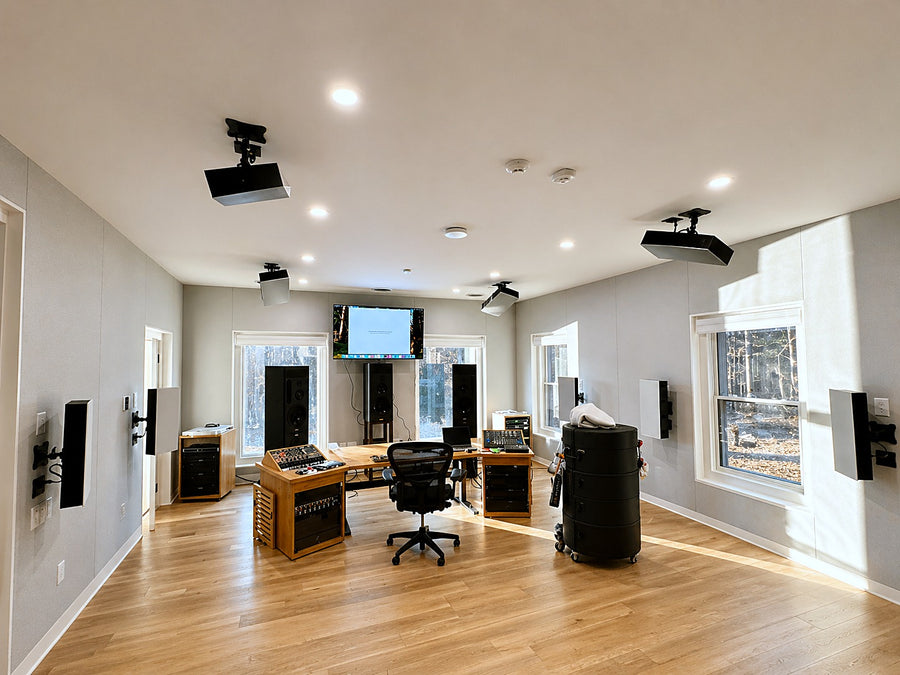
A Theater Is for Enjoying What's Already Mixed
A home theater plays back content that has already been mixed. The goal is sound that is clear and consistent from every seat. That changes the priorities:
- Several Seats: Treatment is about keeping dialogue clear and bass even across the seating, rather than perfecting one position.
- A Looser Decay Target: Toole gives a reverberation time target for home entertainment spaces of 0.5 s or less, based mainly on speech intelligibility, and calls it easy to hit. Toole also reports that the room's audible effect is greatest with a single speaker and diminishes as more channels play.
- Bass Is Shared with the Subwoofers: Welti and Devantier tested subwoofer layouts for seat-to-seat consistency. Four subwoofers at the midpoints of the four walls was the best practical layout, and two at the midpoints of opposite walls was nearly as good.
- Published Targets: The CEDIA/CTA-RP22 recommended practice for home theater audio sets background noise, seat-to-seat bass variation and early reflection targets in tiers, by performance level.
- Looks and Light Matter: Treatment in a theater also needs to look finished, and dark surfaces near the screen keep light from bouncing back onto the picture.
Subwoofer placement and calibration do much of the work of evening out bass across the seats, alongside bass trapping. See why bass changes from seat to seat.
Why a Home Theater Usually Needs Less Treatment Than a Studio
A control room aims for a decay of 0.2 to 0.4 s and strongly controlled reflections at one seat. A home theater can sit at 0.5 s or less, with bass evened out across a row of seats by subwoofer placement as well as trapping.
The front wall, first reflection points and bass still get attention in both, but a theater usually carries less total absorption, less deep bass trapping and more of its budget in finish.
In either room, measure before and after. A measurement microphone and a free room measurement program show the decay time and the bass response at each seat. Our guide to measuring your room covers the setup.
What Theaters Often Get Instead
Fabric Walls and Ceilings: A stretched fabric track system gives a theater a finished, seamless look, with absorption placed behind the fabric only where the design calls for it.
Curtains: Velour theater curtains finish the room and add some absorption of their own.
Lighting: Ceiling clouds with recessed lights or LED uplight treat the ceiling and light the room at the same time.
Where Isolation Comes In
Both rooms can need isolation, for different reasons. A studio keeps outside noise out of the recordings. A theater is usually about keeping movie night from waking up the rest of the house.
In both, low frequencies are the hard part. In a single layer wall, each octave lower in pitch loses about 6 dB of transmission loss, and subwoofers put out exactly those frequencies. See soundproofing vs. acoustic treatment for the difference between the two jobs, and what STC means for how walls and doors are rated.
Sources
- EBU Tech 3276, Listening Conditions for the Assessment of Sound Programme Material, May 1998.
- Floyd E. Toole, Music, Rooms and Listeners: Science in the Creation and Delivery of Audio Art, Acoustics Today, Vol. 9, No. 2, Acoustical Society of America, 2013.
- Todd Welti and Allan Devantier, Low-Frequency Optimization Using Multiple Subwoofers, Journal of the Audio Engineering Society, Vol. 54, No. 5, 2006.
- CEDIA and Consumer Technology Association, CEDIA/CTA-RP22 Immersive Audio Design Recommended Practice, Version 1.2, September 2023.
- A.C.C. Warnock, CBD-239: Factors Affecting Sound Transmission Loss, Canadian Building Digest, National Research Council Canada, 1985.
Planning a Theater?
Send us the room, the seating plan and the speaker layout through our free room review form, or call (818) 217-1653. We work on home theaters and studios across Los Angeles and Ventura County. Reach out to us for design assistance.