

STC, or Sound Transmission Class, is a single number that rates how well a wall, door or window blocks airborne sound, mostly in the speech range. A wall is only as good as its weakest part, so a high STC wall with a hollow core door in it performs close to the door, not the wall.
Most people asking about STC can't rebuild the wall between their studio and the rest of the house. In a normal house wall, the door and the gaps usually set the limit, and a homeowner can fix those.
What Does STC Mean?
A lab measures how much sound a wall stops, called transmission loss (TL), in the 16 one-third octave bands from 125 to 4000 Hz (three bands to each octave) under ASTM E90. ASTM E413 then fits a reference STC contour to that curve.
- The measured curve may fall below the contour by no more than 8 dB in any one band and no more than 32 dB summed over all bands.
- The highest contour that fits gives the STC.
Higher is better. Every 10 dB of TL means one tenth as much sound energy gets through.
Riverbank Acoustical Laboratories publishes this guide to what the numbers sound like:
| STC | What You Hear Through the Wall |
|---|---|
| 25 to 30 | Speech can be easily understood |
| 35 to 45 | Loud speech is audible but less intelligible |
| 50 to 55 | Speech privacy at normal voice levels, loud sounds still audible |
| 60 to 65 | Loud sounds are barely audible |
Published STC Ratings for Walls, Doors and Windows
These ratings are from lab tests by the National Research Council of Canada (NRC Canada) and the U.S. National Bureau of Standards (NBS). Walls are 2x4 size wood studs 16" on center with one layer of 5/8" Type X drywall on each side, and mineral fiber or glass fiber batts in the cavity. Resilient channels are 24" on center.
| Assembly | STC | Source |
|---|---|---|
| Single wood studs, 1 layer drywall each side, mineral fiber batts | 34 | NRC IR-761 |
| Same, with resilient channels on one side | 46 | NRC IR-693 |
| Staggered wood studs, 1 layer each side | 49 | NRC IR-693 |
| Double wood studs, 1 layer each side | 55 | NRC IR-693 |
| Hollow core wood door, sealed | 21 | NBS BSS 77 |
| Solid core wood door, normally closed, spring brass weatherstrip | 27 | NBS BSS 77 |
| Solid core wood door, sealed | 30 | NBS BSS 77 |
| Single strength glass, sealed | 28 to 29 | NBS BSS 77 |
| 1/4" laminated glass with damping layer | 34 | NBS BSS 77 |
The best door here is 25 points below the double stud wall. The NBS sealed doors had their edges fully sealed in the lab. The solid door lost 3 points when tested normally closed against a weatherstrip.
Why One Door Ruins a Wall: The Composite Math
Sound energy passes through each part of a wall in proportion to its area. The standard method, used in NBS Building Science Series 77, adds up each part's transmission coefficient, the fraction of sound energy that gets through it (τ = 10-TL/10), weighted by area, then converts back:
Composite TL: 10 x log10( total area / sum of area x τ ).
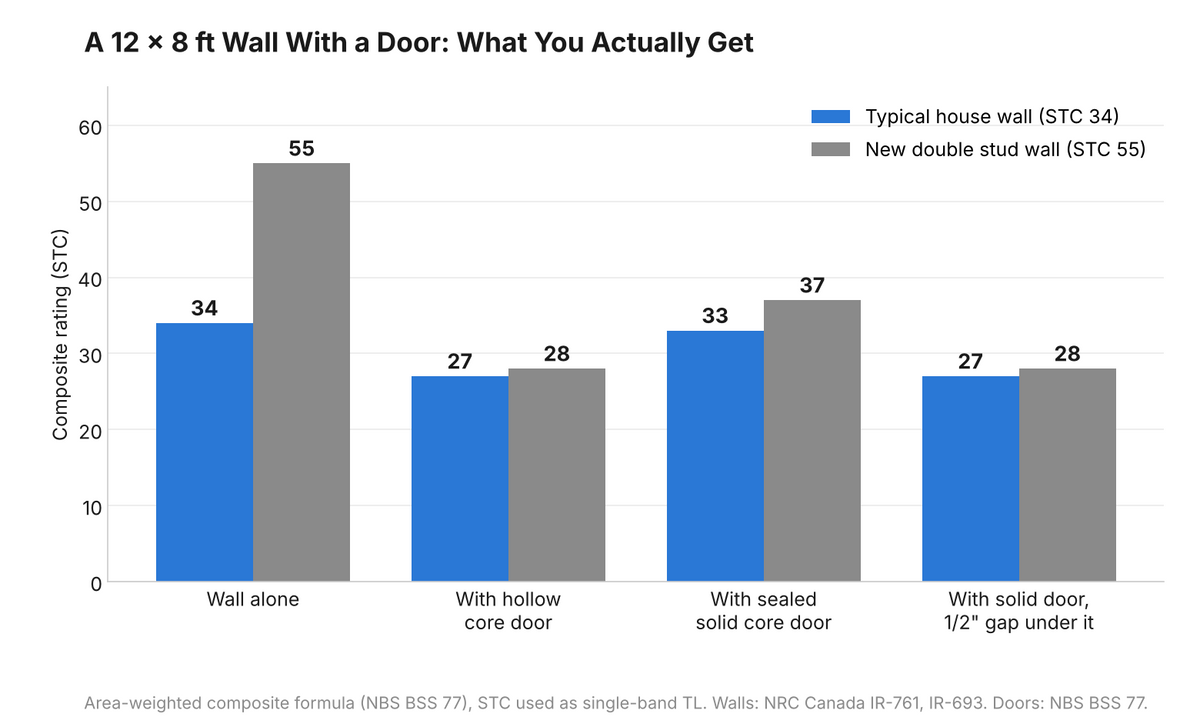
NBS applies the formula to the TL in each frequency band. Putting each part's STC into it instead, as below, gives an estimate of the composite rating. Take a 12 ft x 8 ft interior wall (96 sq ft) with drywall on both sides of single wood studs, about STC 34, and a 3 ft x 6 ft 8" door (20 sq ft):
- Wall Alone: STC 34.
- With a Hollow Core Door (21): The door's 20 sq ft passes about 5 times as much sound as the other 76 sq ft of wall combined. The composite drops to about 27.
- With a Sealed Solid Core Door (30): The composite is about 33, close to the wall itself.
- Same Solid Door, 1/2" Gap Under It: That gap is 18 sq in, about 0.13% of the wall. Open air has a TL near 0. The composite falls to about 27, back to the hollow door number.
Worked Example:
- For the hollow door, τ = 10-21/10 = 0.0079.
- For the wall, τ = 10-34/10 = 0.00040.
- Area times τ is 20 x 0.0079 = 0.159 for the door.
- 76 x 0.00040 = 0.030 for the wall, 0.189 in total.
- Then 96 / 0.189 = 508.
- 10 x log10(508) = 27.
Now the same math for a new room a contractor builds with double wood studs (55):
- With a Hollow Core Door (21): The door passes about 660 times more sound than the rest of the wall. The composite is about 28, one point better than the house wall with the same door.
- With a Sealed Solid Core Door (30): The composite is about 37.
- Same Solid Door, 1/2" Gap Under It: About 28 again.
With a 1/2" gap under the door, both walls end up at about STC 27 to 28, so the door and the gaps come first.
NRC Canada's A.C.C. Warnock, in Canadian Building Digest 186: a leak of one tenth of one percent of a partition's area limits its effective STC to about 30, whether the partition is rated STC 40 or STC 60. The formula gives the same answer for an STC 55 wall.
A crack 1 mm wide by 1 m long at the top of a wall is just as detrimental as an obvious hole, and it can go unseen where caulking was left out.
What You Can Do to the Wall You Have
Work in this order. The first steps cost the least and do the most.
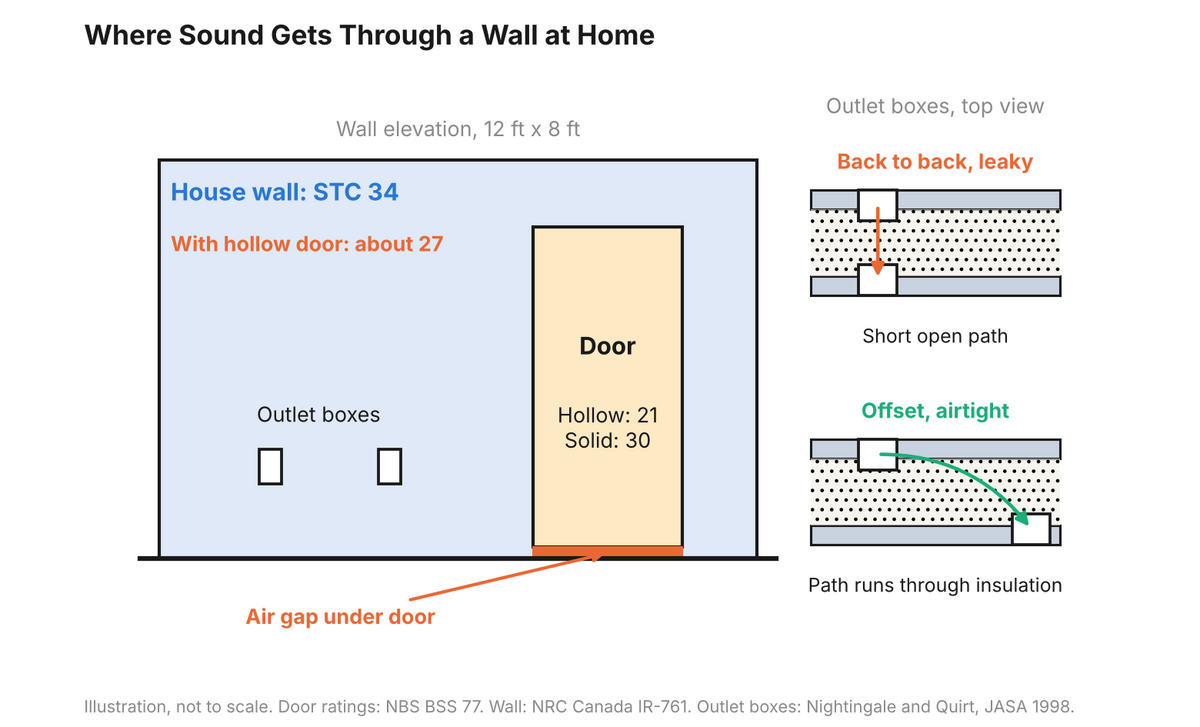
- Seal the Gaps: Caulk where the drywall meets the floor, the ceiling and the door frame, and around anything that passes through the wall. NBS notes that cracks can have a transmission loss near zero.
- Door Bottom: Close the gap under the door with a door sweep or an automatic door bottom.
- Door Perimeter: Add seals or weather stripping around the jambs and head. In NRC Canada data, a solid core door rated about STC 15 with clearance all around and about STC 27 when fully sealed with gaskets or weather stripping.
- Solid Core Door: If the door is hollow, swap it for a solid core door and seal it. In the house wall above, that takes the composite from about 27 to about 33.
- Outlet Boxes: Make every box airtight. Caulk the gap between the box and the drywall and put a putty pad on the back of the box. NRC Canada researchers Nightingale and Quirt found that airtight boxes sealed to the drywall have an almost negligible effect, and leaky boxes back to back do the most damage.
- Another Layer of Drywall: On a basic wood stud wall, a second layer of 5/8" drywall on one side raised the NRC Canada test wall from STC 34 to 36. With a sealed solid core door, that moves the composite only from about 33 to about 34.
- Check the Result: Use a measurement microphone and a free room measurement program. Play pink noise loud in the room, read the level in the room and on the other side of the door, and note the difference.
Look at the 125 Hz band as well as the overall number, since that is where bass gets through. Repeat after each step to see which fix moved the number.
STC Says Little About Bass
STC is calculated from 125 to 4000 Hz. Nothing below 125 Hz is in the number. ASTM E413 states that the rating correlates in a general way with speech, radio, television and similar sources of noise in offices and buildings. It lists sources it is not appropriate for, including musical instruments, many music systems and transportation noise, and says those need a detailed analysis in frequency bands.
The NRC Canada STC 34 wall shows why. It measured 46.7 dB of TL at 1000 Hz but only 13.0 dB at 125 Hz and 12.7 dB at 160 Hz. That low dip sits near the wall's mass-air-mass resonance, where the two drywall faces bounce against the air trapped in the cavity like two weights on a spring.
The resonance is f0 = 60 x √((m1 + m2) / (m1 x m2 x d)), where m1 and m2 are the weights of the two faces in kg per square meter and d is the cavity depth in meters. With 11.0 kg/m² boards and a 3-1/2" (0.089 m) cavity:
- That is 60 x √(22 / (11 x 11 x 0.089)).
- That equals 60 x √2.04.
- That is about 86 Hz, just below the STC range.
The measured dip sits above it at 125 and 160 Hz. Close to the resonance, NRC Canada notes, the TL is usually lower than the two layers would give by mass alone. A larger air space or heavier layers move the resonance lower.
The same wall also dipped to 37.4 dB at 2500 Hz. That is the coincidence dip, where the drywall's own bending waves line up with the sound striking it and let more through. By the mass law, a single layer also loses about 6 dB of TL for each halving of frequency, so bass gets through more easily than voices.
The Outdoor-Indoor Transmission Class (OITC, ASTM E1332) uses data from 80 to 4000 Hz and a spectrum averaged from aircraft takeoff, road traffic and diesel train noise, which has strong low frequency content, so it says more about low end than STC. For a kick drum or a subwoofer, the full TL curve tells you more than any single number.
Building a New Room With a Contractor
For a new studio or theater room, the staggered stud, double stud and resilient channel walls in the table above are the usual choices. Check these before you pay for a high STC wall.
- Doors: Ask for the tested STC of the door with its seals, and compare it to the wall.
- Outlet Boxes: They should be airtight and offset, not back to back. Nightingale and Quirt found boxes offset by 350 mm (about 14") or more, with insulation in the cavity, showed very little loss.
- Windows: A 4 ft x 3 ft window of 1/4" laminated glass (34) in an STC 55 wall brings the composite to about 43.
- Bass: For music or a subwoofer, ask for the low frequency TL data.
- Flanking: Sound also travels around the wall, through shared floor and ceiling framing, ducts and the structure. A lab STC covers the wall alone. A field test to ASTM E336, with a source in one room and levels measured in both, includes the flanking paths.
- Treatment: Panels and bass traps shape the sound inside a room. They do not raise a wall's STC. See soundproofing vs acoustic treatment.
Valley Acoustics designs studio and home theater rooms, then contractors build them. Inside the room, our bass traps, broadband acoustic panels and ceiling clouds handle the room sound.
Sources
- ASTM International, E413-22, Classification for Rating Sound Insulation, 2022.
- ASTM International, E1332-22, Standard Classification for Rating Outdoor-Indoor Sound Attenuation, 2022.
- Riverbank Acoustical Laboratories, Understanding Sound Transmission Class (STC) Ratings and Testing, 2024.
- Halliwell, R.E., Nightingale, T.R.T., Warnock, A.C.C., Birta, J.A., Gypsum Board Walls: Transmission Loss Data (IRC-IR-761), National Research Council Canada, 1998.
- Quirt, J.D., Warnock, A.C.C., Birta, J.A., Summary Report for Consortium on Gypsum Board Walls: Sound Transmission Results (IRC-IR-693), National Research Council Canada, 1995.
- Sabine, H.J., Lacher, M.B., Flynn, D.R., Quindry, T.L., Acoustical and Thermal Performance of Exterior Residential Walls, Doors and Windows (Building Science Series 77), National Bureau of Standards, 1975.
- ASTM International, E336-23, Standard Test Method for Measurement of Airborne Sound Attenuation between Rooms in Buildings, 2023.
- Warnock, A.C.C., CBD-186, Office Partitions: Acoustical Requirements for Design and Construction, National Research Council Canada, 1977.
- Northwood, T.D., CBD-51, Sound Insulation in Office Buildings, National Research Council Canada, 1964.
- Warnock, A.C.C., CBD-239, Factors Affecting Sound Transmission Loss, National Research Council Canada, 1985.
- Warnock, A.C.C., CBD-236, Introduction to Building Acoustics, National Research Council Canada, 1985.
- Nightingale, T.R.T., Quirt, J.D., Effect of Electrical Outlet Boxes on Sound Insulation of a Cavity Wall, Journal of the Acoustical Society of America 104(1), 1998.
Need a Second Opinion?
Send us your room dimensions, photos and what you're hearing through our free room review form. Our panels and bass traps are built to order in North Los Angeles in 50 fabric colors. Reach out to us for design assistance.