

Moving blankets, egg crates and mattress foam work for acoustics only in the mids and highs. In published tests they absorb close to nothing at 125 Hz, they do not block sound from leaving or entering a room, and they won't fix bass or room modes.
That still makes them useful for a few jobs, listed below with the published numbers for each.
How to Read Absorption Numbers
An absorption coefficient runs from 0 to 1. A value of 0.05 means a surface soaks up 5% of the sound that hits it and reflects the rest. A value of 0.80 means it soaks up 80%.
Lab tables list a coefficient for each octave band from 125 Hz to 4 kHz, where each band is double the frequency of the one below it, so you can see where a material works and where it doesn't.
At 125 Hz a sound wave is 1,125 / 125 = 9 ft long. At 4 kHz it is about 3-3/8". A thin layer on a wall can absorb the short waves and does little to the long ones.
Do Moving Blankets Work for Acoustics?
The closest published textbook data for a heavy blanket on a wall is heavy velour drapery, 18 oz per square yard. Hung flat against the wall, it absorbs 0.05 at 128 Hz and 0.12 at 256 Hz. From 512 Hz up it reaches 0.35 to 0.45.
Spacing helps. The same velour hung 4" off the wall absorbs 0.33 at 256 Hz and 0.45 at 512 Hz. At 128 Hz it only reaches 0.09. In a real room, that means hanging blankets from a curtain rod or a few hooks a few inches out from the wall instead of nailing them flat to the drywall. The gap helps from 256 Hz to 2 kHz.
Carpet: The same textbook table lists 0.4" carpet on concrete at 0.09 at 128 Hz and 0.37 at 4,096 Hz. That is close to a rug on a garage slab. It takes some of the high frequency reflection off the floor and very little lower down: 0.21 or less from 128 Hz through 512 Hz.
Do Egg Crates Work for Acoustics?
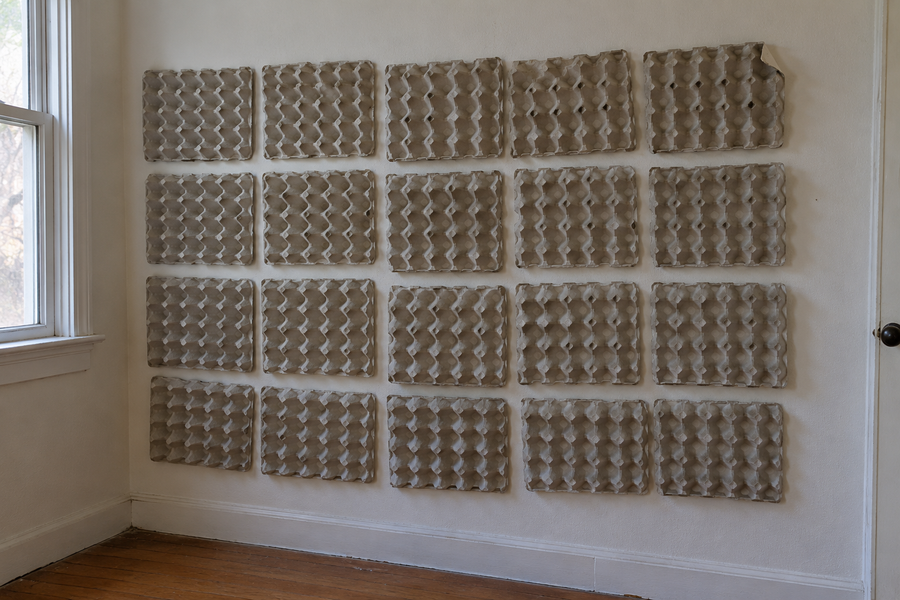
Egg cartons are the most repeated DIY tip. In a 2017 study that used ASTM C423 reverberation room testing, common egg cartons measured a noise reduction coefficient (NRC) of 0.32. NRC is the average of the absorption coefficients at 250, 500, 1000 and 2000 Hz. The authors wrote that this proves they are not good absorptive materials.
A second study, using the tone burst method, measured egg cartons at 0.04 at 125 Hz, rising to 0.69 at 2 kHz and 4 kHz. Its author concluded that below 2 kHz "it does not serve at all."
Does an Egg Crate Mattress Topper Work for Acoustics?
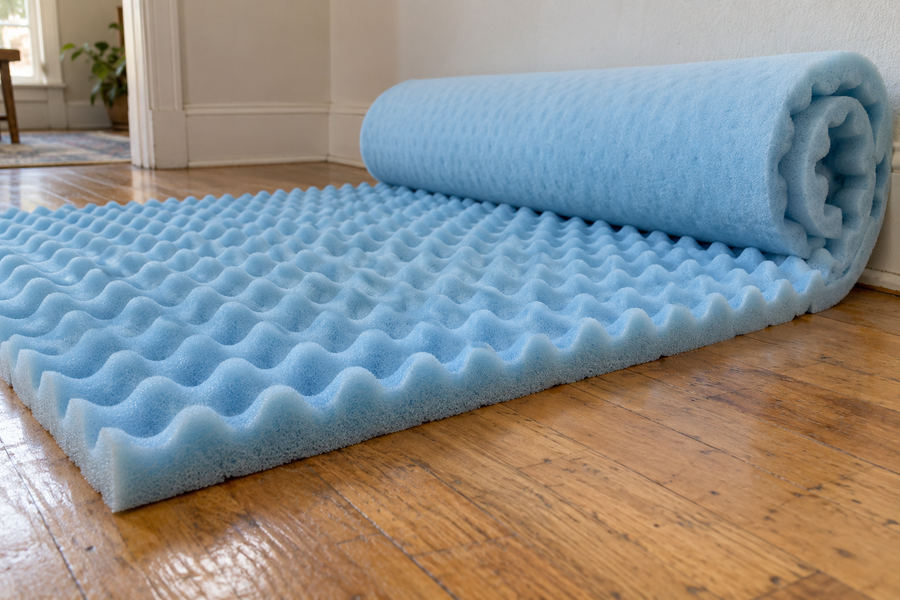
The closest published data for an egg crate topper or packing foam is thin open-cell polyurethane foam. A published impedance tube test of 25 mm (1") polyurethane foam, which measures sound striking the sample head on, found a peak of 0.92 at 3.15 kHz. Below 250 Hz the same researchers measured an absorption coefficient of zero. Air gaps of up to 25 mm (about 1") behind the foam did not change that.
So a topper pinned to the wall can soak up a lot of treble and none of the bass. Cover a bedroom in it and the room sounds dull while the bass stays where it was.
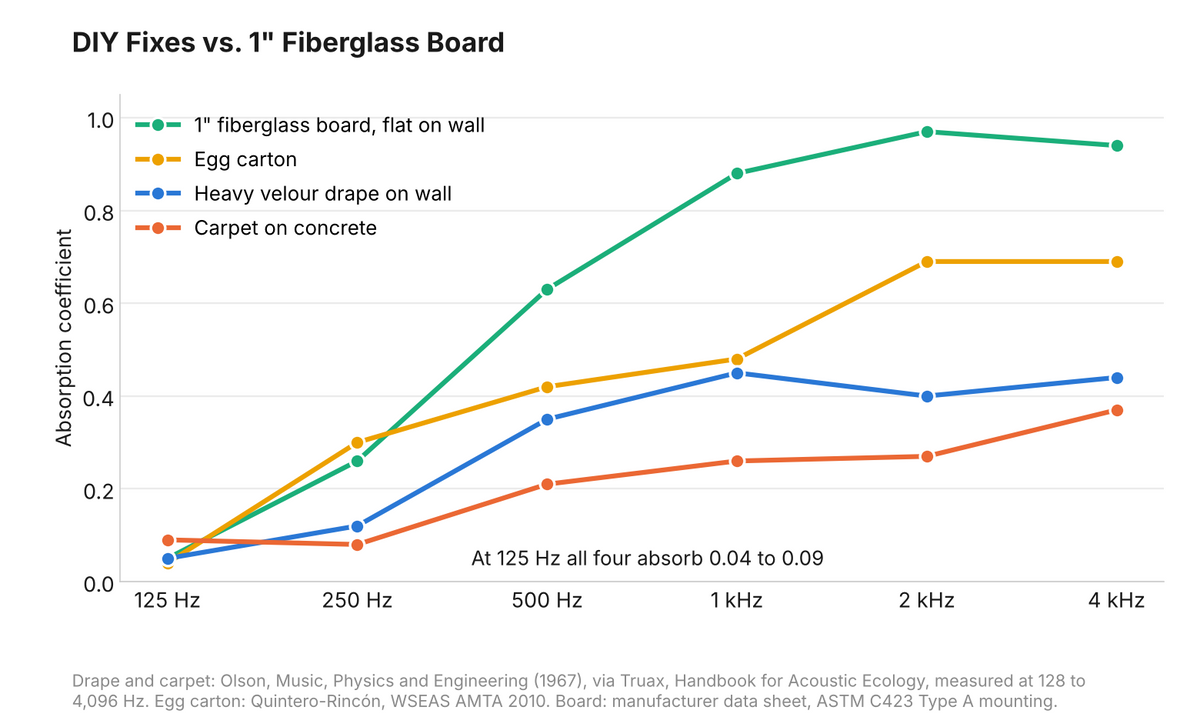
| Material | 125 Hz | 250 Hz | 500 Hz | 1 kHz | 2 kHz | 4 kHz |
|---|---|---|---|---|---|---|
| Heavy velour drape, on wall | 0.05 | 0.12 | 0.35 | 0.45 | 0.40 | 0.44 |
| Heavy velour drape, 4" off wall | 0.09 | 0.33 | 0.45 | 0.52 | 0.50 | 0.44 |
| Carpet on concrete | 0.09 | 0.08 | 0.21 | 0.26 | 0.27 | 0.37 |
| Egg carton | 0.04 | 0.30 | 0.42 | 0.48 | 0.69 | 0.69 |
| 1" fiberglass board, flat on wall | 0.05 | 0.26 | 0.63 | 0.88 | 0.97 | 0.94 |
The textbook values for drape and carpet were measured at 128 Hz to 4,096 Hz and are shown here in the nearest band. The fiberglass board row is the manufacturer's ASTM C423 data for 1" unfaced board laid flat against the test surface (Type A mounting), the way a thin panel sits on a wall.
At 125 Hz it absorbs 0.05, no more than the DIY fixes. From 1 kHz up it absorbs 0.88 to 0.97, well above any of them. Low frequency absorption takes depth.
Do Moving Blankets Block Sound?
Every number above measures absorption: how much of a reflection a material soaks up inside the room. None of it measures how much sound gets through a wall. Stopping sound takes mass and an airtight wall, floor, ceiling and door, and a blanket or a sheet of foam adds almost no mass.
Where DIY Fixes Help
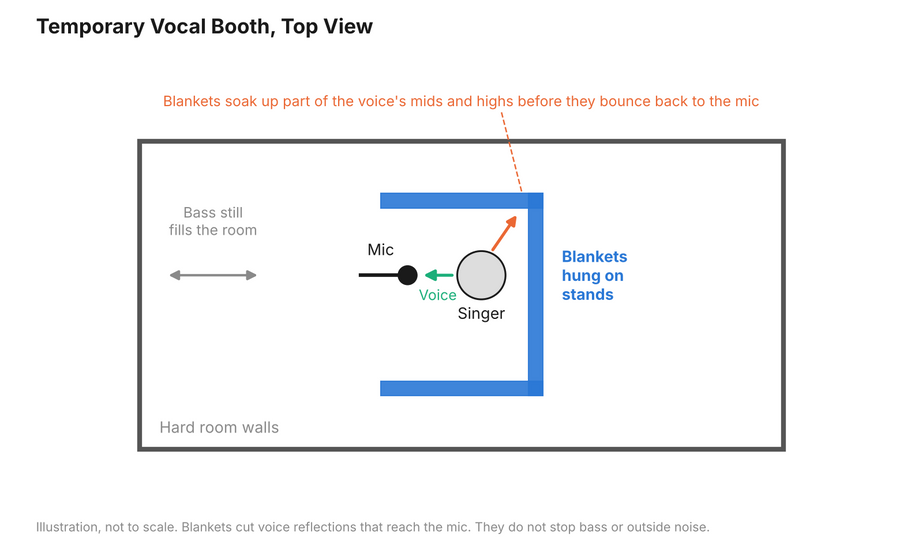
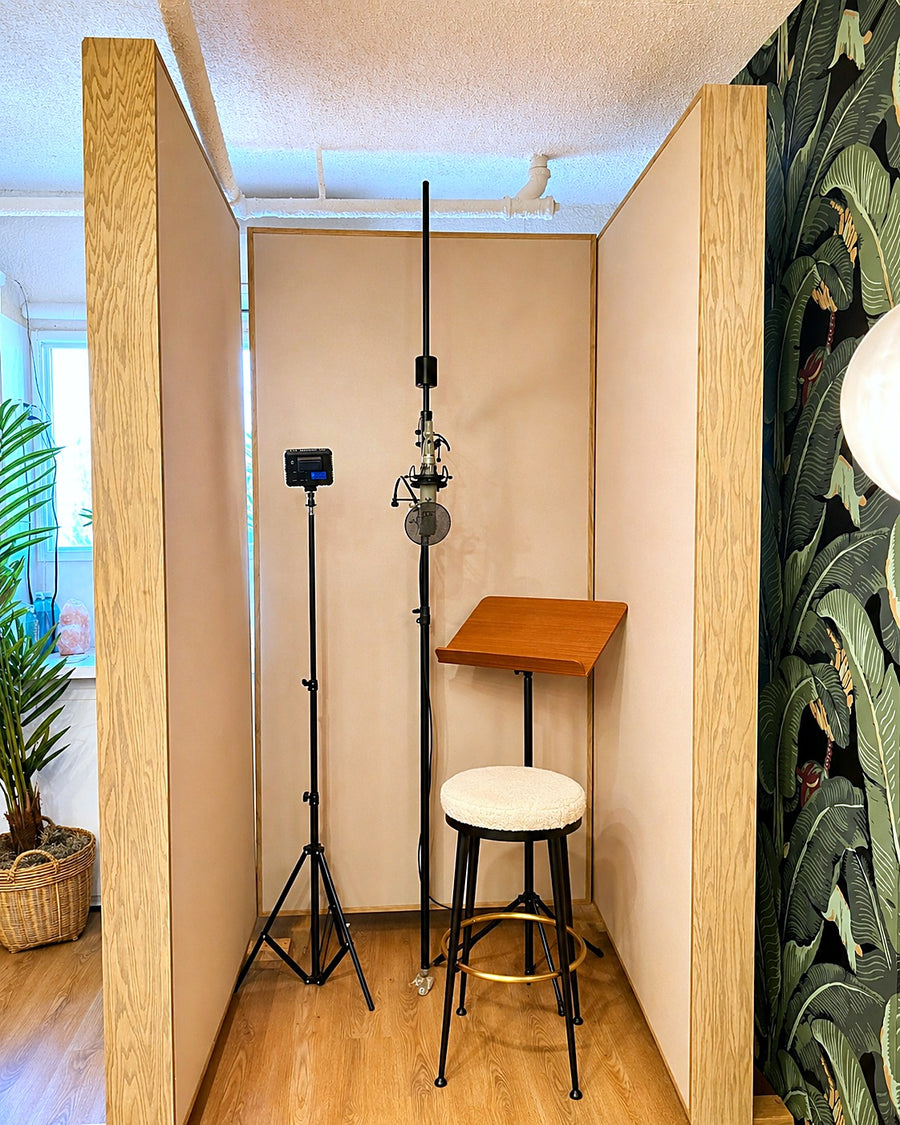
- Temporary Vocal Booth: Blankets on stands or a clothes rack behind and beside the singer catch the voice's mid and high reflections before they bounce back into the mic. Heavy velour drapery absorbs 0.35 to 0.45 from 512 Hz up when it is flat on a wall, and 0.44 to 0.52 when it hangs 4" out.
- Flutter Echo: Two parallel hard walls can trap a fast ringing reflection you hear when you clap. Covering one of the two surfaces with a heavy blanket cuts the high frequency bounce that causes it.
- Bare Floors: A thick rug on a hard floor takes some edge off the highs at no real cost.
What They Won't Fix
- Bass: Every DIY fix in the table absorbs 0.09 or less at 125 Hz. Bass buildup needs deep absorbers. Read why thin panels don't fix bass.
- Room Modes: The peaks and nulls that make bass change from seat to seat come from the room's dimensions. Thin layers on the wall don't change them.
Fire Safety With Foam
In its investigation of the 2003 Station nightclub fire, NIST found that pyrotechnics ignited polyurethane foam lining portions of the walls and ceiling of the band's platform. One hundred people died. In NIST's tests, a non-fire retarded foam sample that NIST purchased ignited in less than 15 seconds when exposed to a pyrotechnic device. A fire retarded foam exposed the same way did not ignite.
Don't line a room with foam unless it comes with a fire test report. Our post on what Class A fire rated means covers what to ask for.
What to Use Instead
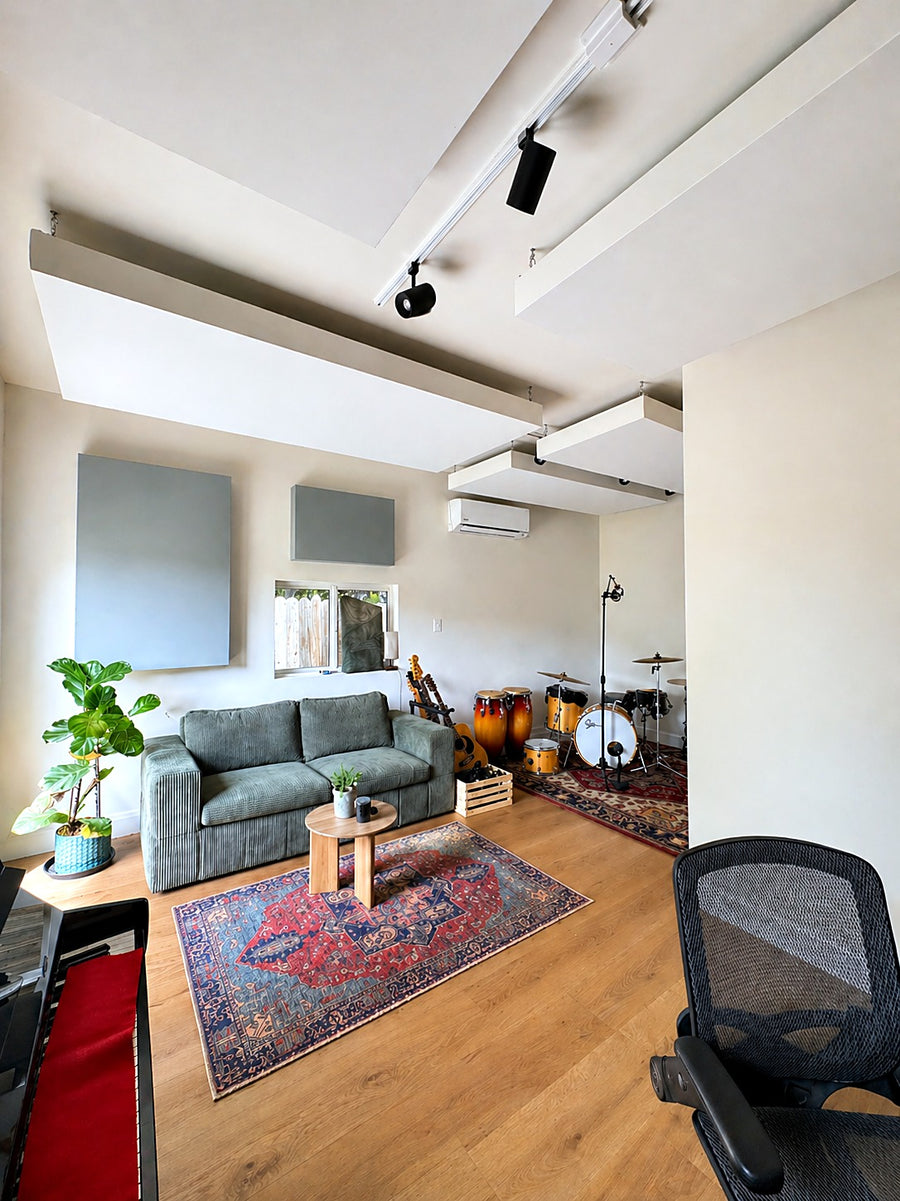
- First Reflections and Flutter: Broadband acoustic panels with a 4" core, hung flat on the side walls at the first reflection points. Sit in the mix seat while someone slides a mirror along the wall. Wherever you can see a speaker in the mirror, the panel goes there.
- Bass: Bass traps in the corners.
- Ceiling Bounce: Ceiling clouds over the mix position.
Sources
- Harry F. Olson, Music, Physics and Engineering, Dover, 1967, p. 271, table reproduced in Barry Truax (ed.), Handbook for Acoustic Ecology: Absorption Coefficient, Simon Fraser University.
- Prasasto Satwiko, Verza Dillano Gharata, Herybert Setyabudi, Fefen Suhedi, Enhancing egg cartons' sound absorption coefficient with recycled materials, Building Acoustics, SAGE, 2017.
- Antonio Quintero-Rincón, Measurement of the sound-absorption coefficient on egg cartons using the Tone Burst Method, Proceedings of the 11th WSEAS International Conference on Acoustics and Music: Theory and Applications (AMTA '10), 2010.
- Mohd Moesli bin Muhammad, Noor Aishah Sa'at, Hasril Naim, Mahdi Che Isa, Nik Hassanuddin Nik Yussof, Mohd Subhi Din Yati, The Effect of Air Gap Thickness on Sound Absorption Coefficient of Polyurethane Foam, Defence S&T Technical Bulletin, 2012.
- Manufacturer published product data sheet for rigid fiberglass insulation board (ASTM C423 Type A sound absorption coefficients), 2026.
- Grosshandler, Bryner, Madrzykowski and Kuntz, Report of the Technical Investigation of The Station Nightclub Fire (NIST NCSTAR 2), Volume 1, NIST, 2005.
Need a Second Opinion?
Send us your room dimensions, photos and what you're hearing through our free room review form. Our panels and bass traps are built to order in North Los Angeles in 50 fabric colors. Reach out to us for design assistance.