

A gobo in a recording studio is a free standing acoustic panel that you move around the room to control what each microphone hears. The same word is used in film and stage lighting for a screen that blocks light.
What Does a Studio Gobo Do?
When several players track at once, every mic picks up some of everything. The kick drum is in the vocal mic. The guitar amp is in the overheads. Some of that bleed is part of a live sound. Too much of it and you can't fix one part without dragging the others along.
A gobo goes between the sources and does two things. It blocks the direct path from one instrument to another instrument's mic, which puts the mic in the gobo's sound shadow. Its absorbing faces also soak up sound that would otherwise bounce off it and back into the mics nearby. Two players in the same room will still be in each other's mics. The gobo reduces how much.
What a Gobo Blocks and What Gets Around It
How well a gobo blocks a sound depends on the size of the gobo compared to the wavelength. Wavelength is the speed of sound, 1,125 ft per second, divided by frequency:
- At 1 kHz that is 1,125 / 1,000 = 1.125 ft, about 13.5".
- It is about 2.3 ft at 500 Hz.
- About 4.5 ft at 250 Hz.
- About 9 ft at 125 Hz.
A 6 ft tall gobo is more than five wavelengths tall at 1 kHz and casts a strong shadow. At 125 Hz it is shorter than one wavelength, and much of the sound bends over and around it.
So a gobo cuts bleed most in the mids and highs: cymbals, vocals, guitar amp bite. It cuts kick and bass guitar much less. Two things help with the low end:
- Distance: Sound from a source in open air drops about 6 dB each time the distance doubles. Moving an amp from 4 ft to 8 ft from a vocal mic cuts the amp's direct sound at that mic by about 6 dB before any gobo goes up.
- Close Miking: A mic close to its own source picks up much more of that source than of the room. Keep each mic close to its source and on the side of the gobo away from the loud instrument. Aim each mic's null, the back of a cardioid, at the loudest neighbor.
In a room the drop is smaller once sound reflected off the walls and ceiling takes over, so distance works best together with close miking.
Common Uses
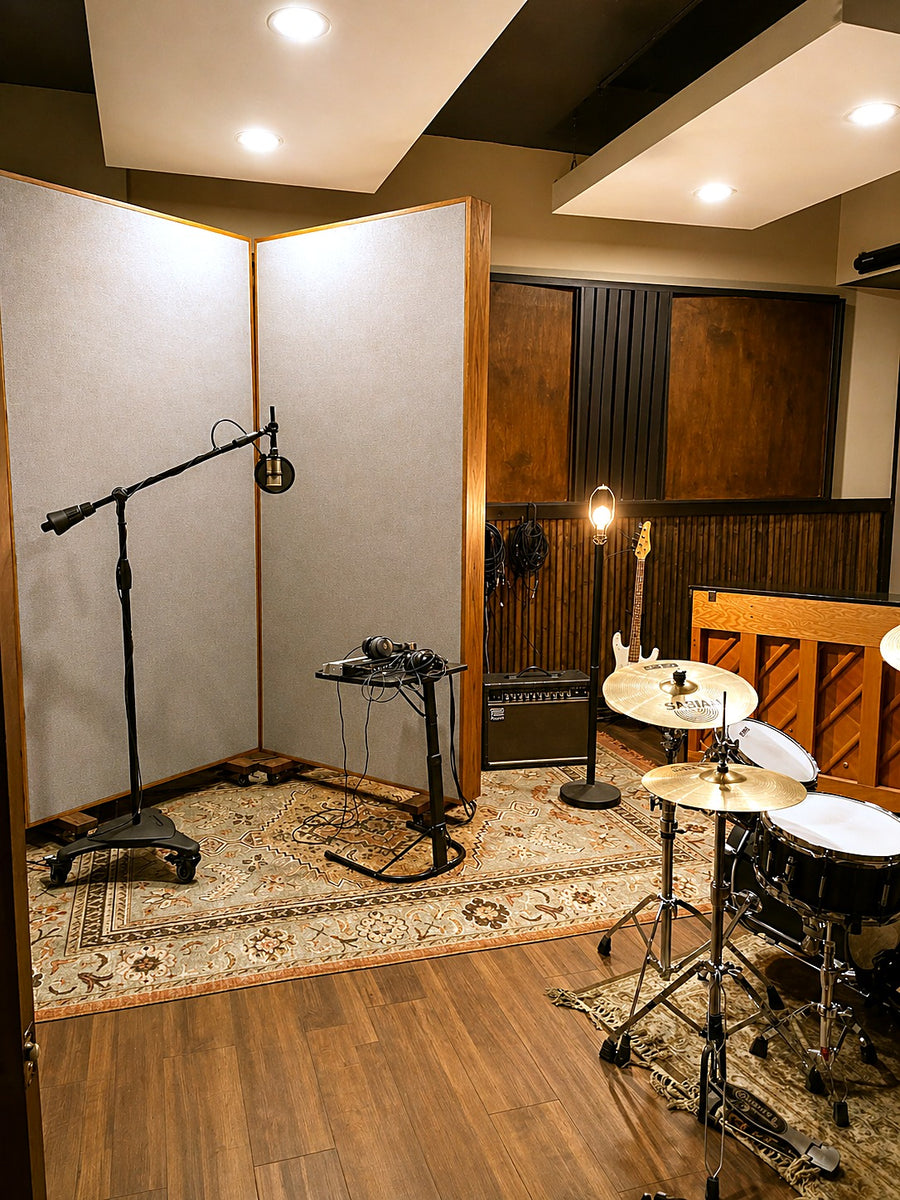
- Between the Drums and an Amp: Keeps the amp out of the overheads and the cymbals out of the amp mic.
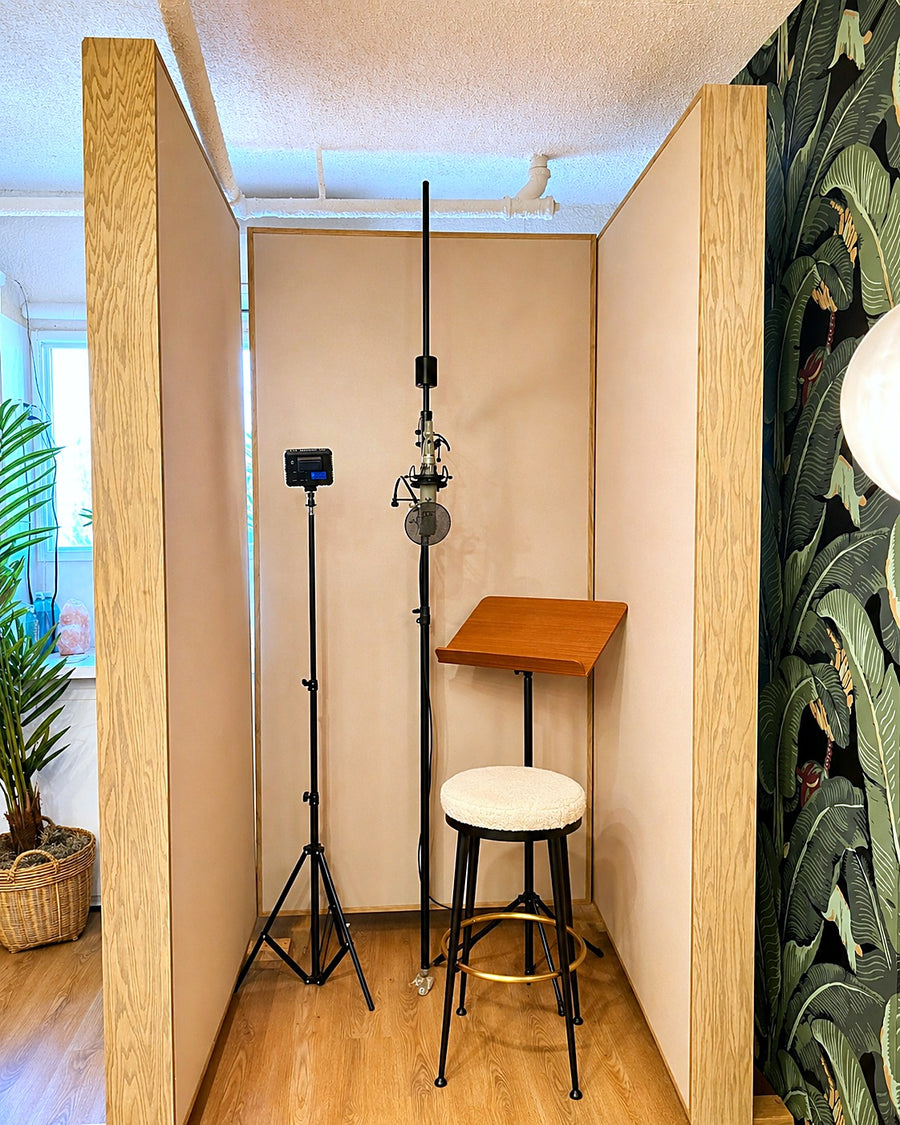
- Around a Vocalist: Three gobos make a quick vocal booth in a live room, and deaden the reflections the vocal mic hears.
- Around an Acoustic Instrument: Guitar, upright bass or strings recorded alongside louder instruments.
- Across a Doorway or an Opening: Where a wall panel can't go.
- In Rooms That Change: Rooms that do tracking one day and podcasts the next.
What to Look For
- Double Sided: A gobo sits in the middle of the room, so both faces are seen and both faces should absorb. A wall panel turned on its edge has a finished front and a back that was never meant to be looked at.
- Core Depth: A thin gobo handles cymbals and vocals and absorbs less as frequency drops, the same tradeoff covered in 4" core vs 2" core acoustic panels. Ours use a 4" mineral wool core, the same as our broadband panels.
In published ASTM C423 data, using the lower of two data sheets, 4" board measures 0.60 at 125 Hz, 0.88 at 250 Hz and about 1.0 from 500 Hz to 2 kHz, against 0.18 at 125 Hz and 0.75 at 250 Hz for 2" board. Those numbers describe the core material in the lab test, not a free standing gobo, and as above, bass still bends around the gobo whatever its core.
- Height: A gobo has to be taller than the sources it's separating and the mics it's shielding. Our gobos run from 2 x 6 ft up to 4 x 8 ft. The taller sizes are for standing vocalists and loud amps.
- A Window, If Players Need to See Each Other: Musicians play better when they can see each other. A clear acrylic window at eye level lets them keep contact across the gobo. Acrylic is hard and reflects sound, so keep the mic aimed away from the window side.
- Casters: If the gobos move every session, locking casters mean one person can roll them into place and lock them there.
How to Set Up Gobos for Tracking
- Step 1: Put the loudest sources, usually drums and bass amp, as far apart as the room allows.
- Step 2: Stand a gobo between each loud source and the mics you want to protect, close to the mic side.
- Step 3: Record a few seconds with only one player, solo each other mic and listen to how much of that player is in it.
- Step 4: Move or add gobos and repeat until the bleed is at a level you can mix with.
Our Gobos
We build wood frame free standing gobos in our shop in North Los Angeles. The frame is red oak veneer plywood in six stains, or painted pine in ten colors. The fabric sits in a track on both faces, so it can be changed later, and it comes in 50 fabric colors. Floor legs are included. Locking casters and an acrylic viewing window are options.
Sources
- Manufacturer published technical data sheet for 6 PCF stone wool board, ASTM C423 sound absorption, 2.0" and 4.0".
- Manufacturer published Product Data Sheet: Rigid Fiberglass Board, ASTM C423 Type A Sound Absorption Coefficients, Pub. 10021736.
- Wavelengths computed as λ = c / f with c = 1,125 ft per second. The 6 dB per doubling of distance is the inverse square law for a point source in open air, 20 x log of the distance ratio.
If you're outfitting a live room, send us the room and how you track in it through our free room review form. Reach out to us for design assistance.