

Soundproof curtains do not soundproof a room. Curtain fabrics in published tests weigh from under 1 ounce to about 2 ounces per square foot, and a curtain on a rod hangs with open gaps at the top, bottom and sides, so most of the noise passes straight through or around it.
Curtains sold as "soundproof" or "noise canceling" can reduce reverberation and cut some high frequency sound inside a room, but they come nowhere close to what a plain drywall wall does.
This post covers the published data on why weight blocks sound, what curtain fabric weighs, how much sound gets through gaps, and what a heavy drape does well.
Blocking Sound Takes Weight
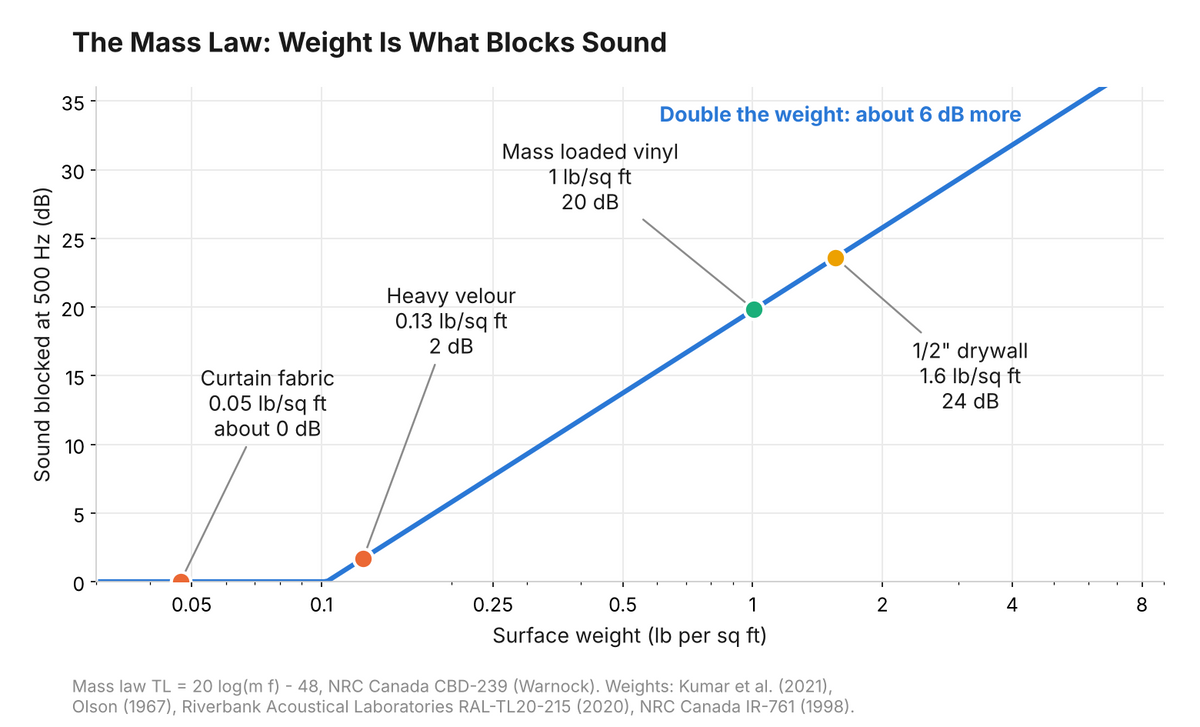
For a single layer like a sheet of drywall, vinyl or fabric, the amount of sound it blocks is set mostly by how much it weighs per square foot. Acousticians call this the mass law.
The National Research Council of Canada gives it as TL = 20 log(m f) - 48, where TL is transmission loss in decibels, m is the weight in kg per square meter and f is the frequency in Hz. Transmission loss is how much of the sound energy striking the layer is stopped before it gets through.
For one sheet of 1/2" drywall at 7.3 kg per square meter and 500 Hz:
- 7.3 x 500 = 3,650.
- 20 x log(3,650) = 71.2.
- 71.2 - 48 = about 23 dB.
Each time the weight doubles, the layer blocks about 6 dB more. The same 6 dB gain happens each time the frequency doubles, so every layer blocks bass worst. To block 18 dB more, a layer has to get 8 times heavier. Light materials start from almost nothing, so they need a lot of added weight before they block much at all.
What a Curtain Weighs Next to Drywall
The table lists published surface weights for common materials, with the mass law result at 500 Hz worked from the formula above.
| Material | Weight per sq ft | Mass law at 500 Hz |
|---|---|---|
| Woven curtain fabric | About 0.05 lb | Near 0 dB |
| Heavy velour drape (18 oz per sq yd) | 0.13 lb | About 2 dB |
| Mass loaded vinyl | 1 lb | About 20 dB |
| One sheet of 1/2" drywall | 1.5 to 1.7 lb | About 23 to 24 dB |
The formula gives a negative number for very light fabric, which means it blocks next to nothing. A single sheet of 1/2" drywall weighs about 12 to 13 times as much as a heavy velour drape, and 30 to 34 times as much as ordinary woven curtain fabric. A normal interior wall has a sheet on each side.
Measured results agree. Researchers at the National University of Singapore tested woven curtain fabrics and felts weighing about 0.21 to 0.32 kg per square meter. Small samples measured in a sealed impedance tube averaged about 1 to 6 dB of transmission loss from 150 to 1,600 Hz.
Heavier PVC based curtain materials, including a PVC coated polyester at about 1.1 kg per square meter, were then clamped and sealed into a test opening in a reverberation room. They gave an average insertion loss of 8 to 15 dB from 500 to 1,600 Hz. Insertion loss is the drop in level with the curtain in place compared with no curtain.
Do Soundproof Curtains Work Compared to a Wall?
- Curtain Fabric and Felt: About 1 to 6 dB on average, measured with sealed edges.
- Mass Loaded Vinyl, 1 lb per sq ft: STC 26 in an ASTM E90 lab test. STC (Sound Transmission Class) is the single number rating taken from the lab's transmission loss curve, and higher blocks more. It blocked 15 dB at 125 Hz, 21 dB at 500 Hz and 36 dB at 4,000 Hz.
- Basic Stud Wall: 2x4 wood studs 16" on center with one layer of 5/8" drywall on each side and mineral fiber batts rated STC 34 in National Research Council of Canada tests.
A sheet of vinyl that weighs as much as 8 heavy drapes still rates below a basic stud wall. The vinyl also blocks far less at 125 Hz than at 4,000 Hz, as the mass law predicts. Its measured 21 dB at 500 Hz is close to the 20 dB the formula gives for 1 lb per sq ft.
Low frequency sound like bass, traffic rumble and kick drums is the hardest to stop, and it is exactly where a light fabric does the least.
Gaps Around the Edges Leak Sound
Lab tests seal a sample on all four edges. A curtain on a rod is open at the top, the bottom and both sides, and sound goes through any opening it finds.
- Small Leaks: A leak equal to one tenth of one percent of a wall's area limits it to about STC 30, whether the wall itself is rated STC 40 or STC 60.
- Doors: A solid core door rates about STC 15 with clearance all around, about STC 20 with stops on three sides and no gaskets, and about STC 27 when fully sealed.
- Windows: An openable window with good weatherstripping usually rates 3 to 5 STC lower than the same window sealed shut. The loss is greatest at high frequencies.
A curtain's gaps are far larger than one tenth of one percent of the window. Sealing the small clearance around a door is worth about 12 STC points, so a curtain with open edges cannot come close to a sealed wall.
What Heavy Curtains Do Help With
Curtains absorb sound. They soak up some of the sound bouncing around inside the room, which cuts reverberation and harshness. Published absorption coefficients show where they work. A coefficient of 1.00 means all the sound striking the surface is absorbed.
| Drapery | 128 Hz | 256 Hz | 512 Hz | 1,024 Hz | 2,048 Hz |
|---|---|---|---|---|---|
| Cotton, 10 oz per sq yd, flat on wall | 0.04 | 0.05 | 0.11 | 0.18 | 0.30 |
| Velour, 18 oz per sq yd, flat on wall | 0.05 | 0.12 | 0.35 | 0.45 | 0.40 |
| Velour, 18 oz per sq yd, 4" from wall | 0.09 | 0.33 | 0.45 | 0.52 | 0.50 |
The heavier velour absorbs more than the light cotton. Hanging the velour 4" off the wall raises its absorption in every band up to 2,048 Hz, most at 256 Hz, where it goes from 0.12 to 0.33. Even hung off the wall, it absorbs only 0.09 at 128 Hz, so it does almost nothing for bass.
How to Spot an Inflated Curtain Claim
- Weight: Ask for the weight per square foot. Compare it to about 1.5 lb for a single sheet of 1/2" drywall.
- Test Standard: A real transmission loss rating comes from a lab test such as ASTM E90, reported as STC or by frequency. A percentage of "noise reduced" with no test standard tells you nothing.
- Frequency Range: Check what the product does at 125 Hz. Light fabric does little there.
- Absorption Versus Blocking: An absorption rating describes reverberation inside the room. It says nothing about noise coming through the wall.
What to Do Instead of Soundproof Curtains
- Outside Noise: Find and seal the leaks first. Caulk gaps around window and door trim, weatherstrip the windows, and add a sweep and seals to the door. A sealed solid core door beats a hollow one. Blocking sound takes weight and airtight edges. Read more in what STC means and why one door ruins a wall.
- Check the Result: Play pink noise loud inside the room and read the level outside the door or window with a measurement mic or a sound level meter. Repeat after each fix to see which one moved the number.
- Reverberation and Harshness: Heavy drapes hung a few inches off the wall will tame some mid and high frequency reflections, 0.45 to 0.52 from 512 Hz up in the table above.
- Broadband acoustic panels with a 4" mineral wool core do the same job further down. In published ASTM C423 data, using the lower of two data sheets, 4" board measures 0.60 at 125 Hz and 0.88 at 250 Hz, against 0.09 and 0.33 for the velour hung 4" out.
- Bass: Curtains do almost nothing for it. Low frequencies need depth, which is why bass traps exist. Read why thin panels don't fix bass.
Sources
- A.C.C. Warnock, CBD-239: Factors Affecting Sound Transmission Loss, National Research Council Canada, 1985.
- A.C.C. Warnock, CBD-186: Office Partitions: Acoustical Requirements for Design and Construction, National Research Council Canada, 1977.
- T.D. Northwood, CBD-51: Sound Insulation in Office Buildings, National Research Council Canada, 1964.
- J.D. Quirt, CBD-240: Sound Transmission Through Windows, National Research Council Canada, 1988.
- H.J. Sabine, M.B. Lacher, D.R. Flynn, T.L. Quindry, Acoustical and Thermal Performance of Exterior Residential Walls, Doors and Windows (Building Science Series 77), National Bureau of Standards, 1975.
- R.E. Halliwell, T.R.T. Nightingale, A.C.C. Warnock, J.A. Birta, Gypsum Board Walls: Transmission Loss Data (IRC-IR-761), National Research Council Canada, 1998.
- S. Kumar, J.W. Aow, W. Dexuan, H.P. Lee, Investigation of Lightweight Acoustic Curtains for Mid-to-High Frequency Noise Insulations, National University of Singapore, 2021.
- Riverbank Acoustical Laboratories, Report RAL-TL20-215: ASTM E90 Transmission Loss Test of a 1 lb per sq ft Mass Loaded Vinyl Sheet, 2020.
- Manufacturer published Technical Data Sheet: 6 PCF Stone Wool Multipurpose Board, ASTM C423 Sound Absorption, 2026.
- Manufacturer published Product Data Sheet: Rigid Fiberglass Board, ASTM C423 Type A Sound Absorption Coefficients, Pub. 10021736, 2026.
- H.F. Olson, Music, Physics and Engineering (Dover, 1967), absorption data as reproduced in B. Truax, Handbook for Acoustic Ecology: Absorption Coefficient, Simon Fraser University.
Need a Second Opinion?
Send us your room dimensions, photos and what you're hearing through our free room review form. Our panels and bass traps are built to order in North Los Angeles in 50 fabric colors. Reach out to us for design assistance.